Banking and KYC verification calls in another language
Global AML penalties ran to billions in 2024 and 2025, with a meaningful share tracing back to customer identification failures. Language sits inside that risk — but the fix is not to translate the identity check.
Prakash Vakhesa · September 29, 2026 · 4 min read
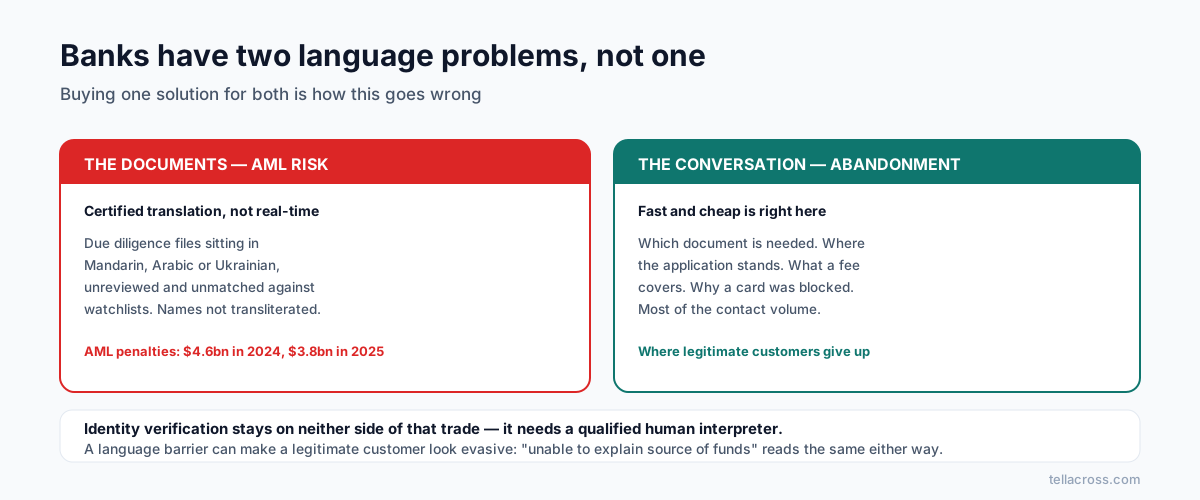
Disclosure: we make TellAcross, a call translation tool. This post draws a hard line through the middle of banking operations and puts our product firmly on one side of it. Anyone selling you live translation for identity verification is not thinking about your regulator.
Banks have two language problems that look similar and are completely different. Conflating them is how compliance functions end up with either unnecessary friction or unacceptable risk.
Problem one: the documents
Customer due diligence requires verifying identity and address, confirming business purpose, anticipating transaction patterns and verifying source of funds where necessary. For an international customer base, the evidence supporting all of that arrives in whatever language the customer's home country issues it in.
The failure mode is well documented: customer due diligence files sitting in Mandarin, Arabic or Ukrainian while compliance officers read only English — untranslated, unreviewed, and not properly matched against watchlists. A name that isn't transliterated consistently is a name that doesn't hit a sanctions screen.
This is not a small-stakes area. Global AML penalties reached $4.6 billion in 2024 and $3.8 billion in 2025, with a meaningful share of enforcement tracing back to customer identification failures.
This problem is solved with certified document translation and proper transliteration standards. It is not solved by anything real-time, and it isn't what this post is mainly about.
Problem two: the conversation
The other problem is the customer on the phone who can't complete a process because they can't follow it.
An account application stalls. A card is blocked and the fraud line can't establish what happened. A customer doesn't understand which document is being requested, so they send the wrong one four times. A business customer can't explain their source of funds clearly, so the file sits in review for six weeks.
Some of that is compliance friction working as designed. Much of it is a language gap producing delay that looks — to a reviewer later — indistinguishable from a customer being evasive.
That's the part worth taking seriously: a language barrier can make a legitimate customer look like a risk, because "unable to clearly explain source of funds" reads the same in a file whether the cause is evasion or vocabulary.
The line, and why it's where it is
Identity verification itself should not run through live translation. Not the knowledge-based authentication questions, not the identity confirmation on a fraud call, not the source-of-funds attestation, not anything you would later cite as evidence that you verified who you were speaking to.
The reason isn't translation quality. It's that identity verification requires you to know exactly who is speaking and exactly what they said — and any intermediary, human or software, weakens both. A regulator asking how you satisfied yourself as to identity does not want to hear about an interpretation layer.
The same reasoning rules out the customer's family member, which banks accept far more readily than they should. A relative on a KYC call is an unverified third party with unknown interests, being given access to the customer's financial information.
What's on the other side of the line is everything that isn't the regulated check: explaining what a product does, explaining why a document is needed and which one, telling a customer where their application stands, walking through a fee, general servicing.
That's most of the contact volume, it's where the frustration lives, and it's currently where a lot of legitimate customers give up.
What actually works
Capture language preference at onboarding and route accordingly. Most banks hold this data and don't use it.
Translate your process explanations, not just your legal documents. "We need a document showing your address dated within three months" fails far more often than it should, in every language.
Use qualified interpreters for regulated conversations — identity verification, enhanced due diligence interviews, complaints, anything with a regulatory record.
Never let a family member interpret a verification call. Have a policy that says so.
Track abandonment by language. If applicants from one language group drop out at three times the rate, that's either a compliance problem or a commercial one, and both are worth knowing about.
Where a translation tool fits
Servicing calls, product explanations, application-status updates, and helping a customer understand which document to send. TellAcross does that — browser link with nothing to install, 60+ languages both directions, per-minute pricing. Ten free minutes a month is enough to test it on a few servicing calls.
Not identity verification. Not enhanced due diligence interviews. Not anything that becomes a compliance record. If a conversation would be cited to a regulator as evidence of what you verified, it needs a qualified human interpreter and a documented process.
The honest summary
Banks tend to treat language as a single problem and buy one solution for it. It's two: a document-translation problem that sits at the heart of AML risk, and a conversation problem that sits at the heart of customer abandonment.
Solve the first with certified translation and consistent transliteration. Solve the second with something fast and cheap for the routine contact. And keep live translation out of the identity check entirely — because the one thing worse than a customer who can't complete verification is a verification you can't defend.