Language access laws in the US — what changed, what didn't, and what your state adds
A 2025 executive order revoked the federal language-access order and DOJ rescinded its guidance. Title VI is a statute and remains binding. Understanding that distinction is the whole of this topic.
Prakash Vakhesa · October 15, 2026 · 5 min read
Disclosure: we make TellAcross, a call translation tool — and to be clear up front, software does not satisfy the obligations described below. I'm not a lawyer and this is not legal advice. This is a map of what to ask your counsel about.
Language access law in the US is layered, and 2025 changed one layer while leaving another intact. A lot of confusion follows from not separating them.
What changed in 2025
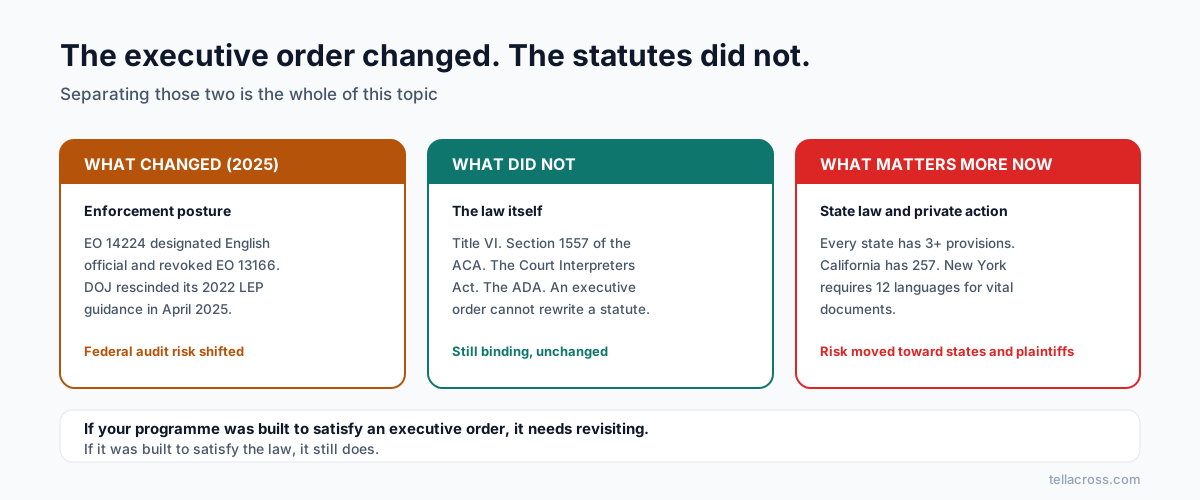
In March 2025, Executive Order 14224 designated English as the official language of the United States and revoked Executive Order 13166 — the 2000 order that had directed federal agencies and recipients of federal funding to improve access for people with limited English proficiency.
In April 2025, DOJ rescinded its 2022 LEP guidance and issued new implementation guidance. Notably, the Department also indicated it would no longer rely on Title VI disparate-impact regulations treating LEP-based discrimination as national-origin discrimination.
That is a real shift in federal enforcement posture.
What did not change
Here's the distinction that matters, and it's the thing most commentary got wrong in both directions.
An executive order cannot rewrite a statute. Title VI of the Civil Rights Act of 1964 is federal law, it prohibits national-origin discrimination by any recipient of federal financial assistance, and EO 14224 did not amend it. The order itself states that nothing in it requires or directs a change in the services any agency provides.
Several statutes independently require language access, and none were touched:
- Title VI — applies to any recipient of federal funding: hospitals, schools, many social service providers, transit agencies, and more.
- Section 1557 of the Affordable Care Act — independently prohibits national-origin discrimination in health programs receiving federal funds, covering hospitals, community health centres, Medicaid programmes and any provider accepting Medicare or Medicaid.
- The Court Interpreters Act — requires qualified interpreters in federal court proceedings where a party or witness has limited English proficiency.
- The ADA — a separate track covering sign language and communication access for disability, unaffected by any of this.
So the practical position is: the statutory duties stand, the enforcement environment around them has loosened federally, and private rights of action and state law are correspondingly more important than they were.
If you were complying because it was the law, it is still the law. If you were complying because you expected a federal audit, your risk calculation has changed — and shifted toward state regulators and plaintiffs.
What states add
This is where the real variation lives, and it grew while federal attention receded.
Every state now has at least three language-access provisions, and California has 257 — by a wide margin the most.
California operates the Dymally-Alatorre Bilingual Services Act, requiring state and local agencies to provide language services where substantial numbers of non-English speakers use them, alongside Government Code §11135, which prohibits language discrimination and triggers multilingual service obligations where a language group exceeds 5% of the population served.
Most other states sit somewhere between three provisions and California's 257, typically concentrated in healthcare, courts, education and social services.
Why I'm not giving you a 50-state table
Because I can't verify one to the standard a compliance decision requires, and a table that's wrong about your state is worse than no table.
The authoritative resource is the National Health Law Program's Summary of State Law Requirements Addressing Language Needs in Health Care, which is maintained by people who do this properly. For anything outside healthcare, ask counsel licensed in your state.
Treat what follows as the questions to bring them, not as answers.
The questions to ask
- Do we receive federal financial assistance, directly or indirectly? Medicaid and Medicare participation counts. This determines whether Title VI applies at all, and organisations are often surprised by the answer.
- Are we a health programme under Section 1557? Independent of Title VI, with its own requirements.
- What does our state require, specifically for our sector?
- Do we cross a numeric threshold — like California's 5% — for any language group in our service area?
- Which documents are "vital" in our context, and are they translated?
- What is our standard for "qualified" interpretation, and can we evidence it?
- What is our exposure through private action, given the change in federal enforcement posture?
What software does and does not do
Since this is a vendor's blog, the boundary should be explicit.
Statutory language-access obligations generally contemplate qualified interpreters and translated vital documents. A real-time translation tool is neither. It does not satisfy Title VI, it does not satisfy Section 1557, and it is not a substitute for a court interpreter.
Where it legitimately helps is the large volume of contact that sits outside those duties — appointment scheduling, status updates, general enquiries, logistics — which is real work that frequently doesn't happen today. That's the honest claim, and any vendor telling you their software discharges a civil rights obligation is selling you a liability.
The honest summary
2025 changed the federal enforcement posture, not the underlying statutes. Title VI, Section 1557 and the Court Interpreters Act all still apply, and state requirements — which were already the more demanding layer in places like California and New York — now carry proportionally more weight.
If your language access programme was built to satisfy an executive order, it needs revisiting. If it was built to satisfy the law, it still does.