Insurance claims calls with non-English speakers — where the exposure actually is
Failing to communicate in a language the policyholder understands can itself constitute an unfair claims practice. And a recorded statement taken through a claimant's relative is evidence you may not want to rely on.
Prakash Vakhesa · September 26, 2026 · 4 min read
Disclosure: we make TellAcross, a call translation tool. There's a section below on where it must not be used in claims handling, and that's the section that matters most.
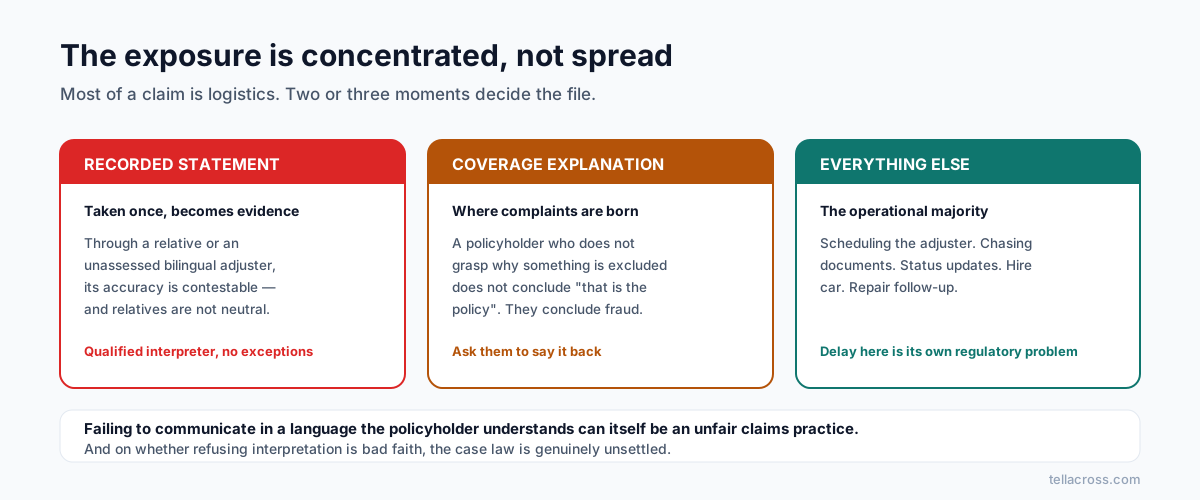
Claims handling is unusual: it's a high-volume operational process where a small number of moments carry nearly all the legal risk. The language question follows the same shape — most of a claim is logistics, and one or two conversations decide whether you have a defensible file.
The regulatory position is closer than adjusters think
State unfair claims practices acts require prompt and fair communication with policyholders, and failing to communicate in a language the policyholder understands can constitute an unfair claims practice.
That framing matters. The duty isn't "provide an interpreter if asked" — it's the general obligation to communicate fairly, which a language gap can breach on its own.
On the sharper question — whether refusing interpretation to an insured who doesn't understand English amounts to bad faith — the law is genuinely unsettled, and courts have gone different ways. That's not reassurance. An unsettled question is one you'd rather not be the test case for.
The recorded statement is the moment that matters
Everything else in a claim can be corrected. A recorded statement is taken once, becomes evidence, and gets read back to you later by someone whose job is to find a problem with it.
Take that statement through the claimant's cousin, or a bilingual adjuster who was never assessed as an interpreter, and you have created a document whose accuracy is contestable. The claimant's later position — "that isn't what I said" — is not obviously wrong, and you have no way to disprove it.
There's an adverse-interest problem too. Family members are not neutral about the outcome of a claim, and a claimant's relative interpreting their account of an accident is in a position no court would consider impartial.
The comprehension problem underneath it
Insurance language is dense and jargon-heavy in ways that cause misunderstandings, delayed claims and damaged trust even for native speakers — and considerably more so for people operating in a second language.
Two specific risks follow:
Coverage explanations that aren't understood. A policyholder who doesn't grasp why something is excluded doesn't conclude "that's the policy" — they conclude they were cheated. That's a complaint, a regulator letter, or a lawyer.
Signatures without comprehension. Releases, proofs of loss, settlement agreements. If a claimant signs something they didn't understand, the signature is worth much less than the file suggests.
There is also a reputational dimension worth naming plainly: insurers are already accused of using complex jargon against claimants who don't speak English. Handling these claims visibly well is a differentiator in communities that assume the opposite.
What actually works
Flag language preference at first notice of loss, and carry it through the file. Most carriers capture this nowhere, so every subsequent handler rediscovers it.
Use qualified interpreters for recorded statements, examinations under oath, and any settlement discussion. No exceptions, no relatives, no untrained bilingual staff.
Note in the file which language was used and how interpretation was provided. If it isn't recorded, it didn't happen.
Translate the documents that carry a signature. Releases and proofs of loss especially.
Check comprehension on coverage decisions by asking the policyholder to say back what they understood, through the interpreter. This is where complaints are prevented.
Where a translation tool fits — and where it doesn't
Not for recorded statements. Not for examinations under oath, coverage denials, or settlement negotiation. These are evidentiary or adversarial, and they need a qualified human interpreter whose competence is on the record. Using software here would be a false economy measured against a single bad-faith allegation.
It fits the operational majority of a claim. Scheduling the adjuster visit. Confirming which documents are still outstanding. Explaining where the claim currently sits. Arranging the hire car. Following up on a repair.
That's most of the contact volume on any claim, it's currently a significant source of delay when the policyholder can't easily be reached, and delay is itself the thing unfair claims practices acts are most concerned with. TellAcross covers it — browser link with nothing to install, 60+ languages both directions, exportable transcripts, per-minute pricing suited to bursty contact. Ten free minutes a month is enough to test on a few status calls.
And it is not a compliance record. Don't treat any live translation as evidence that a coverage decision was understood.
The honest summary
The exposure in a cross-language claim is concentrated in a handful of moments — the recorded statement, the coverage explanation, the signature — and diffuse everywhere else.
Spend properly on the concentrated ones. Then fix the diffuse part, because a claim that stalls for three weeks because nobody could reach the policyholder is its own kind of regulatory problem, and it's the one you can solve cheaply.