Parent–teacher conferences across a language barrier — what schools are actually required to do
Under Title VI, schools must communicate with limited-English-proficient parents through competent interpreters — and may not use the student, a sibling, a friend, or untrained staff. Most schools do all four.
Prakash Vakhesa · September 24, 2026 · 4 min read
Disclosure: we make TellAcross, a call translation tool. This is the post where I'm going to spend most of the space telling you our product doesn't satisfy your obligations. That's not false modesty — it's the accurate answer, and a vendor who told you otherwise would be selling you a civil rights complaint.
Almost every school does the same thing when a parent doesn't speak English: the child translates.
It's practical, the child is right there, and everyone in the room is trying to do the right thing. It is also specifically what schools are told not to do.
The rule, plainly
Title VI of the Civil Rights Act prohibits national-origin discrimination in programs receiving federal funding. Applied to schools, it means districts must adequately communicate with limited-English-proficient parents about important school-related information in a language they can understand.
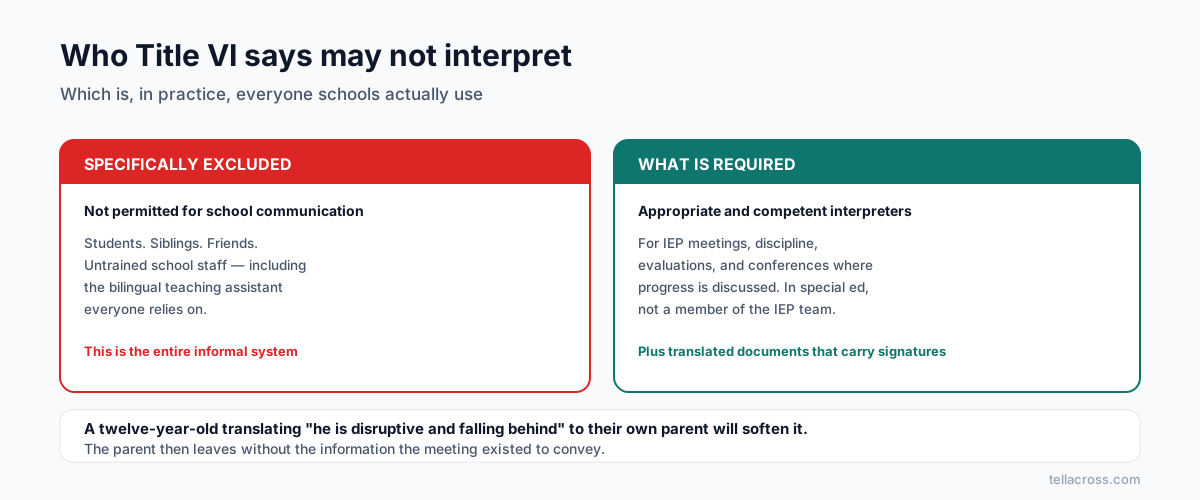
And the part that surprises people: schools must provide interpretation from appropriate and competent individuals, and may not rely on or ask students, siblings, friends, or untrained school staff to provide it.
Read the list again. Students. Siblings. Friends. Untrained school staff. That covers essentially every informal arrangement a school actually uses — including the bilingual teaching assistant everyone relies on, if they haven't been trained and assessed as an interpreter.
For special education specifically, there's a further constraint: to preserve impartiality, the interpreter should not be a member of the IEP team or otherwise involved in the student's programme.
Why the child-as-interpreter habit is worse than it looks
Set the legal position aside for a moment, because the practical case is just as strong.
You're asking a child to deliver bad news about themselves. A twelve-year-old translating "he's disruptive and falling behind in maths" to their own parent is being asked to do something no adult would volunteer for. The predictable result is a softened, partial translation — and the parent leaves without the information the meeting existed to convey.
It inverts the family's authority, in front of a teacher, which in many cultures is a significant indignity for the parent.
It makes the child responsible for the outcome. If the parent doesn't act on what was said, the child carries that.
And you have no idea what was actually communicated. Your notes say the concerns were explained. The only person who knows whether they were is the student.
For an IEP meeting — where the parent is consenting to a legally significant plan — this is not a defensible record.
What compliance actually requires
Identify the languages in your community and plan for them. Not reactively, per meeting.
Use trained, competent interpreters for anything consequential: IEP meetings, disciplinary proceedings, special education evaluations, safeguarding conversations, parent–teacher conferences where progress or behaviour is discussed.
Translate the documents that matter — enrolment forms, discipline notices, IEP documents, anything requiring a signature. A signature obtained without comprehension is the thing that unravels later.
Write a policy saying students don't interpret, and mean it. Without a written policy the informal practice wins every time, because in the moment it's faster and the child is standing right there.
Train and assess bilingual staff properly if you're going to use them. Being bilingual is not the same as being an interpreter — educational and clinical vocabulary is specialised, and impartiality is a skill.
Where a tool like ours fits — narrowly
I want to be exact here, because this is a domain where vague vendor claims cause real harm.
It does not satisfy your Title VI obligations. Not for conferences, not for IEP meetings, not for disciplinary matters, not for anything you'd describe as "important school-related information". Those need competent human interpreters, and using software instead is the same category of error as using the student.
Where it does fit is the day-to-day contact that isn't the formal meeting: the call about a forgotten lunch, a schedule change, confirming a pickup, a quick "is everything alright at home this week?". This volume is real, it currently either doesn't happen or runs through the child, and it isn't what the regulations are aimed at.
TellAcross covers that — browser link, nothing to install, 60+ languages both directions, per-minute pricing. Ten free minutes a month is enough to try it on a few routine calls.
And that's the whole claim. If your interpretation budget is zero and you were hoping software would close the gap, the honest answer is that it won't, and the exposure you're carrying is larger than the cost of fixing it.
The honest summary
Schools are one of the few settings where the language question is genuinely settled: you must communicate with parents competently, and the people you're currently using — the student, a sibling, a helpful colleague — are specifically excluded.
Write the policy. Budget for real interpreters at consequential meetings. Translate the documents that carry signatures. And stop asking twelve-year-olds to tell their parents they're failing.