Real estate agents and buyers who don't speak your language
Overseas and immigrant buyers are often your least price-sensitive clients and your hardest to serve. The viewing isn't the problem — the forty conversations between offer and completion are.
Prakash Vakhesa · September 19, 2026 · 4 min read
Disclosure: we make TellAcross, a call translation tool. It fits part of this and is explicitly wrong for other parts — I'll say which.
Overseas and immigrant buyers are a strange segment. They're frequently cash-strong, motivated, and less price-sensitive than local buyers. They're also the clients most agents quietly avoid, because the transaction takes twice as long and half the conversations are exhausting.
The interesting thing is that the difficulty isn't where agents expect it.
The viewing is the easy part
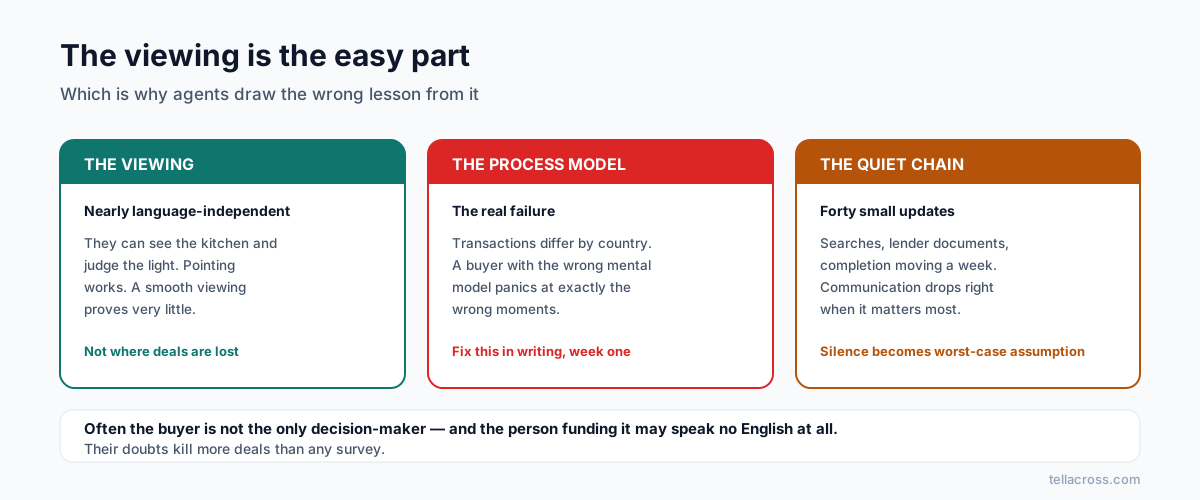
A property viewing is remarkably language-independent. The buyer can see the kitchen. They can tell whether the light is good and whether the third bedroom is really a bedroom. Pointing works.
Agents who conclude from a smooth viewing that language won't be an issue are drawing the wrong lesson from the easiest interaction in the process.
Where deals actually get lost
The financing conversation. Mortgage products, deposit requirements, proof of funds, what a lender will and won't accept from foreign income. This is dense, consequential, and full of terms that don't translate cleanly. A buyer who doesn't fully understand their financing position makes commitments they can't keep, and you find out late.
Explaining the process itself. Property transactions differ enormously between countries — what a deposit means, when it becomes binding, who holds the money, what a survey is for, how long completion takes, what can still go wrong. A buyer from a market where the sequence is different isn't confused about vocabulary; they have a wrong model of what's happening, and it produces panic at exactly the wrong moments.
The negotiation. Nuance is the whole job here. "They might consider something close to asking" is a very different message from "they'll take less", and an approximate translation flattens it into whichever one causes a problem.
The chain of small updates. Searches came back. The lender wants another document. Completion moved a week. Individually trivial, cumulatively the entire relationship — and this is where an agent who can't easily call their buyer starts communicating less, which is exactly when an anxious overseas buyer starts assuming something has gone wrong.
The family conversation. Often the buyer is not the decision-maker, or not alone. A spouse, a parent, or the family member funding the purchase may speak no English at all. That person's questions never reach you, and their doubts kill more deals than any survey.
The relative who translates
The default solution is a bilingual family member or friend. It's better than nothing and it has real costs.
They're not a property professional, so financial and legal terms get approximated. They have their own opinions about the purchase, which enter the translation invisibly. They're not available for the Tuesday-afternoon call from your solicitor. And when something goes wrong, their summary of the conversation is what the buyer acts on — you have no visibility into what was actually conveyed.
If a deal collapses over a misunderstanding, "the client's cousin translated it" is not a comfortable position.
What actually works
Establish the process model early, in writing, in their language. One document explaining the sequence and what each stage commits them to. Professionally translated. This single artifact prevents more problems than anything else on this list, because it fixes the wrong mental model before it causes panic.
Find out who else is deciding, in the first week. Then make sure that person can actually ask you questions.
Confirm every financial number in writing. Deposit amounts, fees, timelines, exchange assumptions if funds are coming from abroad.
Over-communicate during quiet periods. An anxious buyer with a language barrier fills silence with worst-case assumptions.
Keep records of what was explained and when. In a cross-language transaction this protects both of you.
Where a translation tool fits
The update calls and the general questions. These are frequent, informal, and currently either don't happen or happen through a relative. Being able to call the buyer directly — or the parent funding it — changes the relationship substantially. That's what TellAcross does: browser link, nothing for them to install, Chinese, Arabic and 60+ other languages both directions, exportable transcripts. Ten free minutes a month covers a few real calls.
Not for contracts, disclosures or anything you sign. Property documents need certified human translation, and in many jurisdictions that's a legal requirement rather than a preference.
Not for formal legal advice. That's the conveyancer's or attorney's job, with their own qualified interpreter.
Not to replace the written process document. A buyer needs something they can re-read at midnight, not a conversation they half-remember.
The honest summary
The overseas buyer segment isn't hard because of the viewings. It's hard because a property transaction is a long chain of consequential updates, and the language barrier quietly reduces how often you communicate at exactly the point where more communication is what holds the deal together.
Fix the process document first — it's one-time and it prevents the panic. Then make sure that when the buyer's father has a question about the deposit, there's a way for him to ask you directly.