Selling to Korean clients — hierarchy, speed, and the gap between reading and speaking
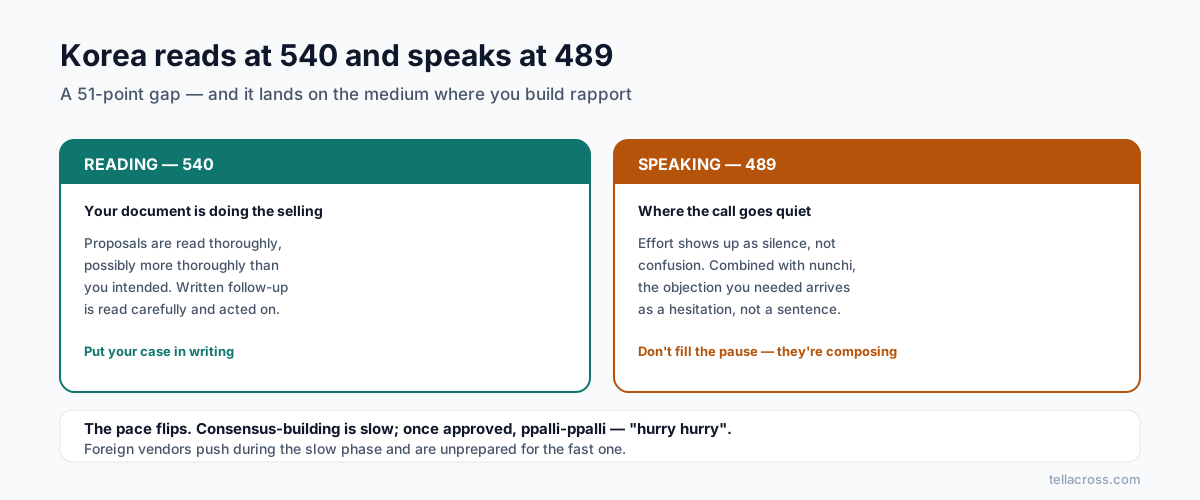
Korea reads English at 540 and speaks it at 489. That 51-point gap explains why your proposal lands well and the call goes quiet — and why the pace flips from glacial to frantic the moment a decision is made.
Prakash Vakhesa · September 12, 2026 · 4 min read
Disclosure: we make TellAcross, a call translation tool. It appears once. Most of this is about how Korean business actually operates, which matters more.
Korea is not a low-English-proficiency market, which is exactly why foreign vendors misread it. It ranks #48 globally with a score of 522 — comfortably above the global average of 488.
Then you get on a call and it's harder than the number suggested.
The number that actually explains your calls
Break the score into skills and the picture changes completely. Korea scores 540 on reading and 489 on speaking — a 51-point gap between taking English in and producing it live.
That single fact explains most foreign vendors' experience in this market:
- Your written proposal is understood thoroughly. Possibly more thoroughly than you intended.
- The live call is effortful, and the effort shows up as silence rather than confusion.
- Detailed written follow-up is read carefully and acted on.
So the failure isn't comprehension. It's that the medium where you build rapport and handle objections — the call — is the one where your counterpart is least comfortable, while the medium where they're strongest is the one you probably treat as an afterthought.
There's regional variation too: Seoul scores 550, well above Daejeon, Daegu and Incheon. A Seoul-headquartered conglomerate contact is a different proposition from a supplier in a manufacturing region.
Silence is not agreement, and it is not confusion
Korean business runs on nunchi — the ability to read the room by observing tone, body language and what is left unsaid. Good nunchi means understanding what wasn't said and responding without being told.
For a foreign vendor this cuts both ways. Your counterpart is reading you far more closely than you're reading them. And their own signals are deliberately understated, so the objection you needed to hear arrives as a slight hesitation rather than a sentence.
Combine that with the speaking gap and you get the characteristic Korean call: it went fine, everyone was polite, nothing was resolved, and you don't know why.
The practical fix is to move objection-handling into writing. Send a short, specific follow-up that names the likely concerns and answers them. In a market that reads at 540, this is where the actual negotiation happens.
Hierarchy is not a formality
Seniority strongly determines who speaks, how, and who decides — and the senior-junior (seonbae-hoobae) relationship is established by as little as a year's age difference.
Two consequences that cost deals:
The person answering your questions may not be permitted to decide anything, and pressing them for a commitment puts them in an impossible position. They will not tell you this.
Junior attendees may not contradict a senior colleague in front of you, even when they know something important. If the useful information exists at a level below your main contact, you will not hear it in a group meeting.
The pace flips, and vendors get caught out
The characteristic Korean pattern is a deliberate, consensus-oriented decision process followed by remarkable speed of execution. Senior approval is required, but input is gathered from below first — which takes time.
Then it lands, and the pace becomes ppalli-ppalli — "hurry hurry" — with expectations of rapid turnaround.
Foreign vendors consistently get this backwards. They push hard during the slow phase, which achieves nothing and signals impatience, and then they're unprepared when it flips and a two-week response time suddenly reads as incompetence.
Plan for it: be patient early, and have delivery capacity ready before you think you need it.
What actually works
Lead with the written document. In a 540-reading, 489-speaking market, your proposal is doing more of the selling than your call is.
Follow every call with written specifics. Decisions, numbers, next steps. This isn't bureaucracy — it's meeting them in their stronger medium.
Find out who decides, early, and don't push your contact to commit beyond their authority.
Don't fill silences. A pause is often someone composing a sentence in a second language, and talking over it costs you the point they were about to make.
Be ready to move fast after approval.
Where translation fits
On calls with the people who don't operate in English — plant managers, engineers, senior executives outside the international team. Letting them speak Korean removes the disadvantage rather than asking them to absorb it. That's what TellAcross does: browser link, nothing to install, Korean both directions, exportable transcripts. Ten free minutes a month covers one real discovery call.
Not for contracts or formal documentation — professional human translation, given how carefully written material is read here.
Not as a substitute for the written follow-up. In this market that document is doing the heavy lifting, and it should be well-translated and precise.
The honest summary
Korea's headline English score makes it look like an easy market and its skill breakdown tells you why it isn't. Your counterparts read better than you write and speak less comfortably than you assume.
Adjust accordingly: put your case in writing, treat the call as relationship-building rather than decision-making, respect the hierarchy when identifying who actually decides, and be ready to sprint the moment the slow phase ends.