Running a construction site where the crew doesn't share a language
On a mixed-language site, the safety briefing everyone nodded through is the one nobody understood. What actually works for toolbox talks, incident reporting and subcontractor coordination — and where translation tools have no business being.
Prakash Vakhesa · September 3, 2026 · 4 min read
Disclosure: we make TellAcross, a real-time call translation tool. It fits one narrow part of this problem and is useless for most of it. I'll be specific about which is which, because on a construction site getting that wrong has consequences beyond a bad meeting.
Ask a site manager whether language is a problem and you'll usually get "we manage". Ask how the last toolbox talk went and you'll often get a description of fifteen people nodding.
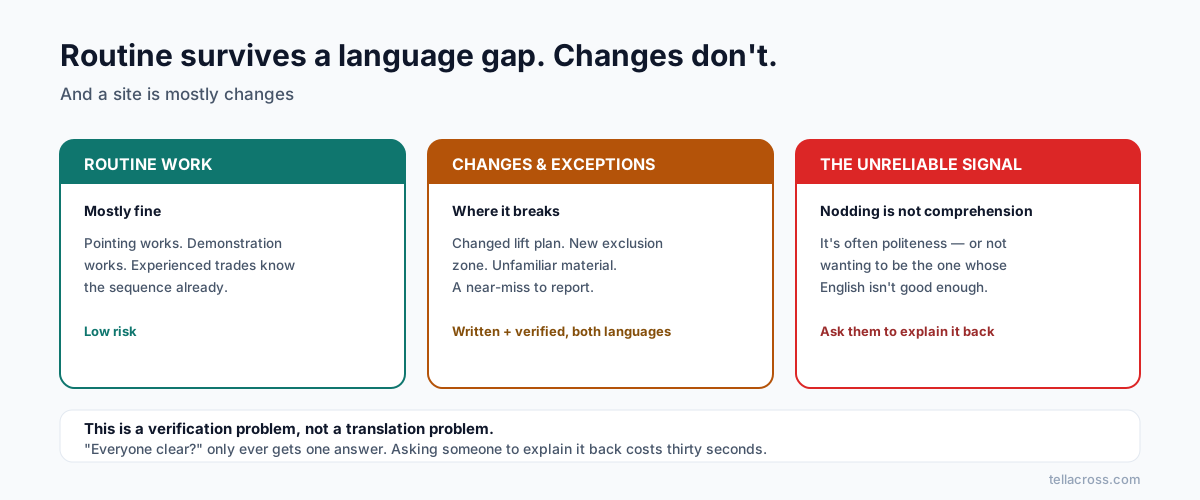
Nodding is not comprehension. On a site it's frequently politeness, or not wanting to be the one who asks, or not wanting to look like the person whose English isn't good enough to keep the job.
The specific risk
Most site communication is fine without shared language. Pointing works. Demonstration works. Experienced trades understand the sequence of work without being told.
The problem is concentrated in a narrow band: anything that is new, non-obvious, or an exception. A changed lift plan. An unusual exclusion zone. A material that behaves differently from the one used last week. A near-miss that needs reporting accurately enough to prevent the next one.
Routine work survives a language gap. Changes don't. And a site is mostly changes.
Why the usual fix doesn't hold
The default solution is a bilingual crew member who translates. This works, right up until the moment it matters most.
That person has their own job. They're not available at 6am when the plan changed overnight. They're not there when the incident happens. And they're being asked to translate technical safety information with no training and no authority — which means when something is unclear, they'll often smooth it over rather than escalate, because that's what a helpful colleague does.
Relying on them is also unfair to them. It's an unpaid second job with liability attached.
What actually works
Write the safety-critical things down, in both languages, before the day starts. Method statements, exclusion zones, permit conditions. Professional written translation, not machine output — this is the one place to spend money, and it's cheap relative to a single incident.
Use pictures and demonstration for anything you can. A photograph of the correct exclusion zone outperforms a paragraph in any language.
Confirm understanding by asking someone to explain it back, not by asking "everyone clear?". The second question only ever gets one answer. This costs thirty seconds and is the single highest-value habit on this list.
Name who is responsible for language on each shift. Not "someone who speaks Polish" — a specific person, with the time allocated and the authority to stop work if something isn't understood.
Run the pre-start briefing slower than feels necessary. Most comprehension failures on site aren't vocabulary, they're pace.
Where a translation tool fits — and where it doesn't
It does not belong in the toolbox talk. Safety briefings need to be delivered in a form everyone can verify they understood, with written backup and a competent person present. Piping a live translation into a group of fifteen people standing in the wind is not that.
It does not belong in an incident investigation where the account may end up in an insurance claim or a regulatory file. Get a qualified interpreter. The cost is trivial against the exposure.
It does fit the calls around the work. Coordinating with a subcontractor's office. A supplier call about a delivery that's gone wrong. The scheduling conversation with a crew lead who is comfortable in Spanish or Polish and merely functional in English. A conversation with a worker about their hours, their pay, or a problem they're having — where their being able to speak precisely is the entire point, and where nobody's safety turns on the next sentence.
That's a real category and it's most of a site manager's phone time. TellAcross covers it — browser link, nothing to install, both directions, English–Spanish and English–Polish among 60+ pairs. Ten free minutes a month is enough to test it on one supplier call.
But I'd rather you took one thing from this post, and it isn't the tool. It's asking people to explain the plan back to you.
The honest summary
Language on a mixed-language site is not primarily a translation problem. It's a verification problem — you don't actually know what was understood, and the usual signals (nodding, "yes", no questions) are unreliable in exactly the situations where being wrong is expensive.
Translate the written safety material properly. Verify comprehension out loud. Use tools for the logistics conversations where precision helps and nobody's at risk. And stop asking "everyone clear?".