Can AI make you speak another language in your own voice?
Partly, and less well than the demos suggest. What voice cloning actually does to your accent across languages, why the language you record in matters more than anything else, and how to test it before you trust it.
Prakash Vakhesa · October 20, 2026 · 5 min read
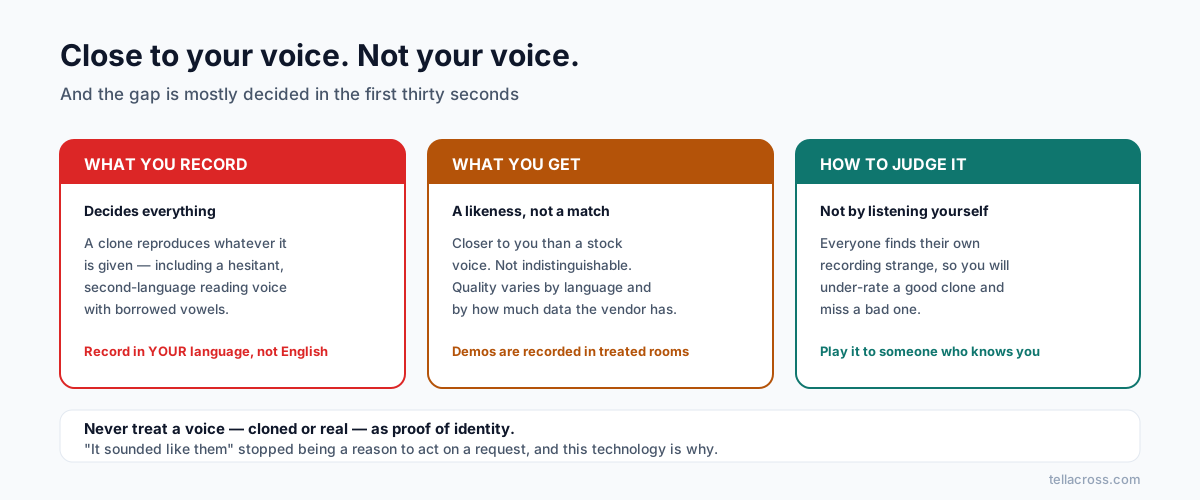
Disclosure: we build TellAcross, which includes voice matching — currently in beta, and honestly around half-convincing. I'm going to explain why rather than sell it, because this is a category where the gap between the demo and your own recording is unusually wide.
The pitch is irresistible: record thirty seconds, and from then on you speak Japanese, Portuguese and Arabic in your own voice.
The reality in 2026 is that you get a voice recognisably related to yours — better than a stock voice, not indistinguishable from you, and highly dependent on things nobody mentions up front.
The short answer
Yes, partially. Instant voice cloning takes a short sample and produces a synthetic voice that carries your pitch, timbre and speaking rhythm. Played next to a generic voice, most listeners would pick yours as the closer match. Played to someone who knows you well, most would say "that's close, but it isn't him."
Quality depends on the input recording and the specific tool, and — the part that catches people out — it is not uniform across languages, because it depends on how much training data the vendor has for that language and how closely your recording matches the target.
That same source makes the point more bluntly than most vendors will: accuracy varies by language and tool, and most vendors won't tell you until after you've bought a seat.
The accent problem, which is the real one
Here is the thing that determines your result more than any other single factor, and almost nobody explains it.
A clone reproduces whatever it was given. As one analysis puts it, the AI will clone whatever accent it's given, including your own mistakes.
So if you are a native Gujarati speaker and you record your sample reading English prompts, you have not captured your voice. You have captured your English-reading voice — a different pitch range, a more hesitant rhythm, vowels placed where your second language puts them. Every language the system then produces inherits that, and the result sounds like a stranger to the people who know you.
In theory this shouldn't happen. Modern cross-lingual systems are supposed to substitute target-language phonology while preserving the speaker — a native English clone speaking Japanese should sound like a competent Japanese-speaking version of that person, not an English speaker mispronouncing Japanese.
In practice the substitution is imperfect, and the guidance from people who do this professionally is unambiguous: if recording in a non-native language, you're better off having a native speaker record the source clip, because otherwise you clone a heavily accented version.
The practical rule: record in the language you speak most naturally. Not the language you'll be translated into, and not English because the prompts happened to be in English. This is free, it takes no extra effort, and it is the single biggest quality decision you'll make.
Why your result will differ from the demo
Demo audio is recorded in a treated room, on a good microphone, by someone reading fluently. Yours probably won't be. Four things move the needle, in rough order:
The language you recorded in. See above. Dominant.
Sample length. Thirty seconds is the bottom of the usable range. More clean audio measurably helps, which is why tools that let you add takes produce better results than tools that don't.
Background noise. Room tone, keyboard, air conditioning — all get modelled as part of "your voice" and reappear as artefacts in every sentence. Recording somewhere quiet beats any setting.
The target language. Widely-supported languages come out better than under-resourced ones. If your pair is English–Spanish you'll do well; if it's English–Gujarati, temper expectations.
How to judge it honestly
Don't evaluate it yourself. You are the worst possible judge of your own recorded voice — everybody finds their own recording strange, so you'll under-rate a good clone and can't spot a bad one.
Play it to someone who knows you, without warning, and ask what they think. That answer is the only one that matters.
Test your actual language pair, both directions. Quality is asymmetric and vendors quote the good direction.
Test it in a real conversation, not on one sentence. Artefacts that are tolerable in a single line become grating over ten minutes.
Where it genuinely doesn't belong
Voice cloning is a capability with an obvious dark side, and the honest framing matters as much as the accuracy.
Never as proof of identity. No voice — cloned or real — should be treated as authentication. If a bank, a colleague or a family member is being asked to act on a request because "it sounded like them", the technology in this article is exactly why that reasoning no longer holds.
Not without the speaker's consent. Cloning someone else's voice, even in fun, is a serious thing to do. Use your own, and only your own.
Not where the listener needs certainty about who is speaking — legal proceedings, clinical consent, anything recorded as evidence. Use a stock voice, or a qualified human interpreter.
What we do, specifically
TellAcross includes optional voice matching. You record thirty seconds, and translations are spoken in a voice modelled on yours.
Being concrete: it is in beta, and it currently produces a partial likeness rather than a match. It sounds meaningfully more like you than a stock voice does, and it will not fool anyone who knows you. We prompt you to record in your own language rather than English, for the reason above. Your sample is stored so a voice can be built at the start of each call, and deleting it removes it.
If you want to try it, the free plan includes it — ten minutes a month is enough to record a sample and let someone who knows you judge the result. That's a more useful test than anything we could claim here.
The honest summary
Can AI make you speak another language in your own voice? It can make you speak another language in something close to your voice, and how close depends mostly on a decision you make in the first thirty seconds: which language you record in.
Anyone promising an indistinguishable match today is describing a demo, not your recording. Record in your own language, in a quiet room, for as long as they'll let you — then play it to a friend and believe them.