Freight and logistics calls when nobody shares a language
Shipping runs on exception calls — the delay, the customs hold, the damaged pallet. Those are precisely the conversations that email and templates can't handle, and precisely where the language gap costs real money.
Prakash Vakhesa · September 4, 2026 · 4 min read
Disclosure: we make TellAcross, a real-time call translation tool, and it appears once below in the place it actually fits. The rest is about why logistics has this problem worse than most industries.
Most international business runs on email, and email is the easy case for language: you have time, and machine translation is genuinely good at written text.
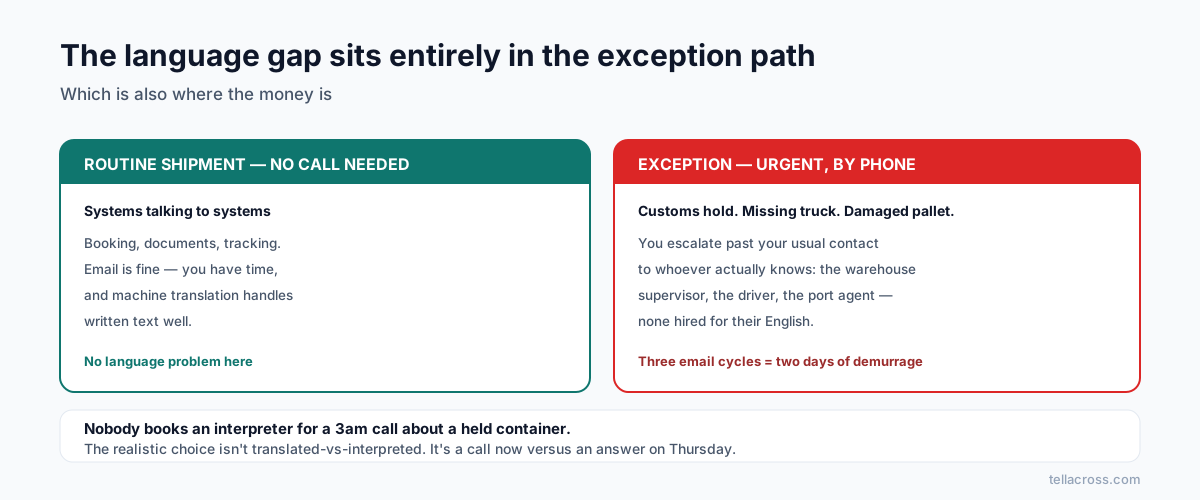
Freight is different, and the reason is structural. Routine shipments need no conversation at all — the booking, the documents and the tracking are all systems talking to systems. You only pick up the phone when something has gone wrong, and when something has gone wrong you need an answer in minutes, not in the two hours it takes to exchange three emails across a nine-hour timezone gap.
So the language barrier in logistics is concentrated entirely in the exception path. Which is also where the money is.
What an exception call actually costs
A container held at customs, a truck that didn't arrive, a pallet that's arrived crushed, a vessel rolled to the next sailing. Every hour that these stay unresolved has a price — demurrage, detention, a production line waiting, a retail delivery window missed.
The email round-trip is what kills you. Not because the translation is poor, but because a clarification takes a full cycle: you ask, they read it tomorrow morning, they answer something slightly off, you ask again. Three exchanges is two days. The same conversation by phone is four minutes — if you can have it.
Why "everyone in shipping speaks English" is only half true
It's true of the international-facing staff at forwarders and major carriers. That's who you deal with on a normal day.
It stops being true exactly when you escalate. The warehouse supervisor who actually knows where the pallet is. The driver. The customs broker's local clerk. The person at the origin factory who loaded it. The port agent at 2am local time. These are the people with the answer, and they are frequently not the people who were hired for their English.
So the pattern is: the routine contact speaks English, and the moment you need to bypass them to solve something urgently, you're talking to someone who doesn't.
What actually helps
Keep the written record in both languages for anything contractual. Claims, damage reports, delivery instructions. Professional written translation for anything you might rely on later — this is a different profession from live interpreting and worth paying for.
Standardise your exception vocabulary. A short shared glossary of the twenty terms that recur — hold, release, demurrage, short-shipped, damaged in transit, partial delivery — removes a surprising share of the confusion, because these are the words where an approximate translation causes an expensive misunderstanding.
Confirm numbers and dates by reading them back. Container numbers, quantities, dates and cut-off times are where cross-language calls go wrong most often, and they're the details with the highest cost of error. Read them back digit by digit, every time, in any language.
Be able to have the call at all. This is the one most firms haven't solved. If your escalation path depends on finding a colleague who happens to speak Mandarin or Vietnamese and happens to be awake, you don't have an escalation path — you have luck.
Where translation tools fit
The exception call is close to the ideal case for real-time translation: it's urgent, it's short, it's operational rather than legal, and the alternative isn't a professional interpreter — the alternative is not having the conversation today.
That's the honest comparison. Nobody books an interpreter for a 3am call about a held container. The realistic choice is a translated call now versus an email chain resolved on Thursday.
TellAcross fits here: a browser link the other side opens with nothing to install, both directions, English–Chinese and English–Vietnamese among 60+ pairs, exportable transcripts for the claim file, billed per minute because exception calls are unpredictable by nature. Ten free minutes a month is enough to try it on one real escalation.
Where it does not fit
Anything that becomes a claim. Cargo claims and insurance disputes turn on exact wording. Get a qualified interpreter and a human translator for the documents.
Customs declarations and compliance filings. Machine output has no place on a legal filing.
Negotiating rates or contracts. Precision and nuance matter more than speed, and the other side is preparing carefully — you should too.
The honest summary
Logistics doesn't have a general language problem. It has a narrow, expensive, badly-served one: urgent operational calls with the person who actually knows the answer, who often isn't the person you normally deal with.
Fix the glossary and the read-back habit first — they cost nothing. Then make sure that when the container is held and it's the middle of the night at origin, "we can't have that conversation" isn't the reason it stays held until Thursday.