Where dental tourism clinics actually lose foreign patients — the first phone call
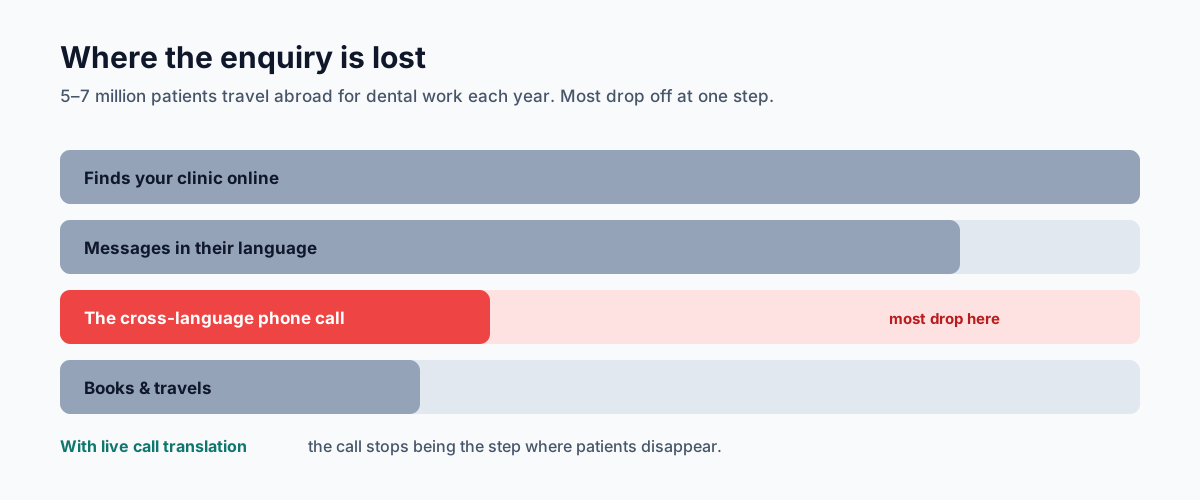
Five to seven million people travel abroad for dental work every year, and almost all of them make contact before they book. That first cross-language call is where clinics quietly lose the ones they never hear from again.
Prakash Vakhesa · August 20, 2026 · 4 min read
Between five and seven million people fly to another country for dental treatment each year. The market is worth over five billion dollars and growing double digits annually. If you run a clinic in Turkey, Mexico, Hungary, Poland, Romania, India or Thailand, those patients are your business — and most of them come from the United States, the United Kingdom and Western Europe.
The part that's easy to underestimate is where the decision actually gets made. It isn't on your website, and it isn't in the treatment chair. It's on the phone, days or weeks earlier, in a conversation held across a language gap.
The booking is won or lost before the flight
A dental tourism patient is not making a small decision. They're weighing a procedure that can run from three to fifteen thousand dollars, in a country they've never visited, based largely on how confident they feel after a few conversations. They message first, then they want to talk — about the treatment plan, the healing time, the total cost, whether they can trust you.
If that call is halting — long pauses, a coordinator switching to broken English, a question misunderstood twice — the patient doesn't file it under "language barrier." They file it under "if talking to this clinic is this hard, what will the treatment be like?" Then they message the next clinic on their list.
You never find out you lost them. There's no bounced email and no angry review — just an enquiry that silently went somewhere else. Multiply that across every call in a language your front desk doesn't fully command, and the language gap stops being an inconvenience and becomes your largest single source of lost revenue.
Why the usual fixes don't fit a busy clinic
Clinics patch this in a few ways, and each one has a hole:
- A bilingual coordinator works until they're at lunch, on holiday, or the caller speaks German instead of English. You cannot hire a native speaker for every source market.
- Phone interpreters are expensive, have to be booked in advance, and place a stranger inside a personal medical conversation.
- Typing into a translation app mid-call is slow and cold, and it kills the warmth that actually builds trust.
- "Just use a meeting platform's translation" assumes the patient is inside that platform on a paid plan. Someone calling your clinic from their own phone is not.
None of these match the reality of a clinic: fast inbound calls, from many countries, at any hour, that need to feel human.
Translate the call itself, live, with nothing for the patient to install
The approach that fits is to translate the live conversation in both directions, in real time, without asking the patient to do anything. The coordinator speaks their own language; the patient hears theirs in about a second; the patient replies and the coordinator hears it back. Over a hundred languages, both directions, and — the part that matters for a nervous first-time caller — nothing to install. They click a link in whatever browser they already have, or join the call as normal.
This is the gap TellAcross was built for. For a clinic it changes three things at once. Every enquiry gets a fluent conversation, whether the caller speaks English, German, French or Arabic, without hiring a coordinator for each language. The call stays warm, because nobody is typing into an app or waiting on a booked interpreter. And the cost is a few cents a minute — in the range of fifteen to twenty-four cents — with no booking and no minimum, rather than an interpreter's per-minute meter running through every consultation.
Trust is the real product
When someone sends money abroad for a procedure they haven't had, at a clinic they've never visited, they aren't only buying dentistry — they're deciding whether to trust you. Nearly all of that decision is made in conversation, before they ever arrive. A clinic that can hold a clear, warm, confident call in the patient's own language has already won half of it.
The clinics that understand this won't just convert more enquiries. They'll turn the language barrier — the thing quietly costing everyone else patients — into the reason patients choose them.