Posting a job online? Here's how to reach workers who don't speak your language
Job boards and freelance marketplaces are more global than most posters realize. Strong replies in another language usually get skipped at the screening stage — not because the work is weaker.
Prakash Vakhesa · November 17, 2026 · 2 min read
Disclosure: we make TellAcross, a real-time call translation tool, mentioned near the end.
You post a job online — a gig, a contract role, a local opening — and the replies come in. Some of the strongest ones come from people who clearly know the work, but write and speak in a language you don't. Most posters, understandably, move on to the next applicant. That's a missed opportunity, and a solvable one.
Job boards are more global than they look
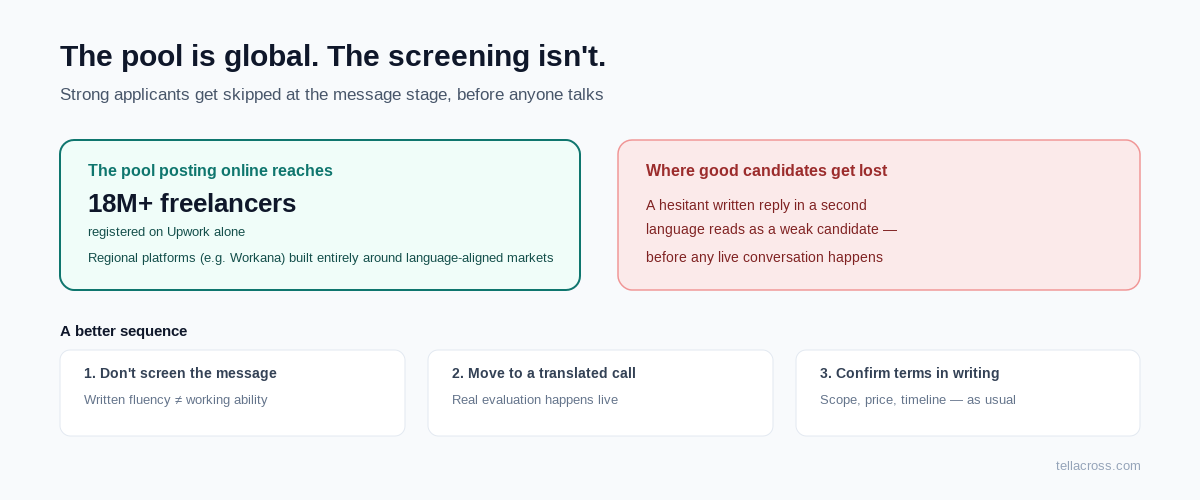
Freelance marketplaces alone carry a large, international workforce — Upwork reports over 18 million registered freelancers and more than $1 billion in freelance work completed on the platform annually, and dedicated regional platforms like Workana have built entire businesses around language and cultural alignment for Spanish- and Portuguese-speaking markets specifically because demand for workers outside the English-speaking pool is strong enough to support it. A posting for a remote bookkeeper, a renovation contractor, or a virtual assistant can reach applicants from entirely different language regions — but the screening call that follows almost always assumes a shared language.
When that call doesn't go smoothly, the applicant tends to get quietly passed over, even if their portfolio, reviews, or past work were excellent. The applicant isn't a weak candidate. The screening process just wasn't built to hear them.
A practical approach
- Don't rule candidates out at the message stage. A short, slightly awkward written reply in a second language often undersells someone who communicates perfectly well once you're actually talking.
- Move the real evaluation to a live call, with real-time translation running. This is where you actually find out whether the person understands the job — not from how polished their text messages are.
- Ask the same questions you'd ask anyone. Scope, availability, rate, past work, how they'd handle a specific scenario. The translation layer should make this feel like an ordinary conversation, not a special accommodation.
- Confirm details in writing afterward — scope, price, timeline — same as with any hire, so nothing is lost between the spoken conversation and the agreement.
Why this matters more than it looks
The workers most likely to be lost to a language barrier are often the ones with the deepest hands-on experience — people who learned a trade somewhere the working language wasn't English, and who have never needed English fluency to do excellent work. Cutting them out doesn't raise the bar on a posting. It just shrinks the options under it.
TellAcross puts live, spoken translation directly into a video call, so the first real conversation with a promising applicant isn't the moment they lose the opportunity — it's the moment you find out they were the right hire all along.
The best person for the job you posted might already be in your inbox, waiting for a conversation they can actually have.
Try real-time translation on your next call
Speak your language, they hear theirs — live, both directions. 10 free minutes every month.
Start free — no card needed