Hiring a contractor, freelancer, or household worker who speaks a different language — a practical guide
A step-by-step approach to hiring across a language gap for renovation work, freelance projects, and household help, without the trust problems a language barrier usually adds to an already uncertain hire.
Prakash Vakhesa · November 19, 2026 · 2 min read
Disclosure: we make TellAcross, a real-time call translation tool, mentioned near the end.
Hiring a contractor to renovate a kitchen, a freelancer to build a website, or a caregiver for a family member is already a trust-heavy decision. Add a language gap, and a lot of people quietly decide it's not worth the hassle — ending up with fewer, pricier, or lower-quality options than they actually had.
Why this situation is more common than it feels
Search a local classifieds site, a freelance marketplace, or a household-services app for long enough, and you'll find strong candidates — good reviews, fair pricing, a clear portfolio — whose first language isn't yours. Many people scroll past them, not because the work looks worse, but because managing a job through a language barrier feels like extra risk stacked on top of an already uncertain hire. That instinct is understandable. It's also narrowing your options more than it needs to.
A practical guide
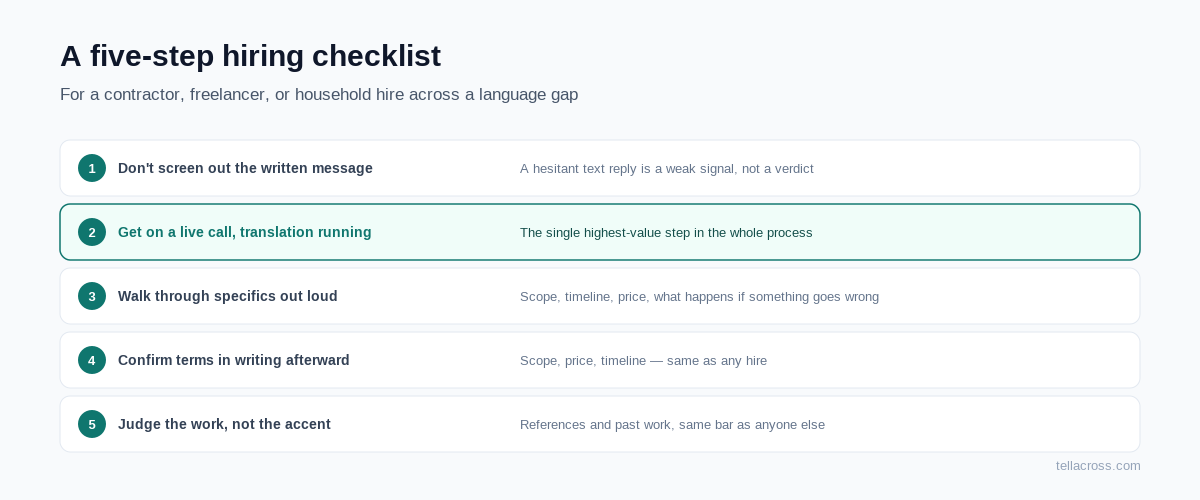
1. Don't screen out based on the written exchange alone. A stiff or hesitant text message is a weak signal. Many people write haltingly in a second language but speak and work in it — or in their own — perfectly competently.
2. Get on a live call before deciding, with real-time translation running. This is the single highest-value step. A spoken conversation, even a translated one, tells you far more about whether someone understands the job, asks good questions, and communicates clearly than any written exchange will.
3. Walk through the specifics out loud. Scope of work, timeline, materials or tools, price, and what happens if something goes wrong. Say it the way you'd say it to anyone, and let the translation carry it — you shouldn't need to simplify your own language to be understood.
4. Put the agreed terms in writing afterward. Scope, price, and timeline, confirmed in a message or contract both sides can refer back to. This matters for any hire, but especially one where you want zero ambiguity after a translated conversation.
5. Judge the work, not the accent. Once the hiring conversation is done, evaluate the same way you would anyone else — references, past work, reliability. The language barrier was a hiring-process problem, not a signal about quality.
Why this is worth the extra step
A contractor, freelancer, or caregiver who doesn't speak your language isn't a riskier hire by default — they're a hire your usual process wasn't built to evaluate properly. A short, live, translated conversation closes that gap in minutes, not weeks.
TellAcross makes that conversation as easy as any other video call: each person speaks their own language, and the other hears it translated in real time. No interpreter to coordinate, and no stilted back-and-forth texting to sort out details that are much easier to just say out loud.
Sometimes the best person for the job is one honest phone call away — in a language you don't happen to share yet.
Try real-time translation on your next call
Speak your language, they hear theirs — live, both directions. 10 free minutes every month.
Start free — no card needed