Selling to Japanese clients when you don't speak Japanese
Japan has real budgets, chronic supplier shortages, and the widest language gap of any major market. That gap is why competition is thin — and what it takes to work across it honestly.
Prakash Vakhesa · August 30, 2026 · 4 min read
Disclosure: we make TellAcross, a call translation tool. It appears once, in context. Most of this is about how Japanese business actually works, which matters more than any tool.
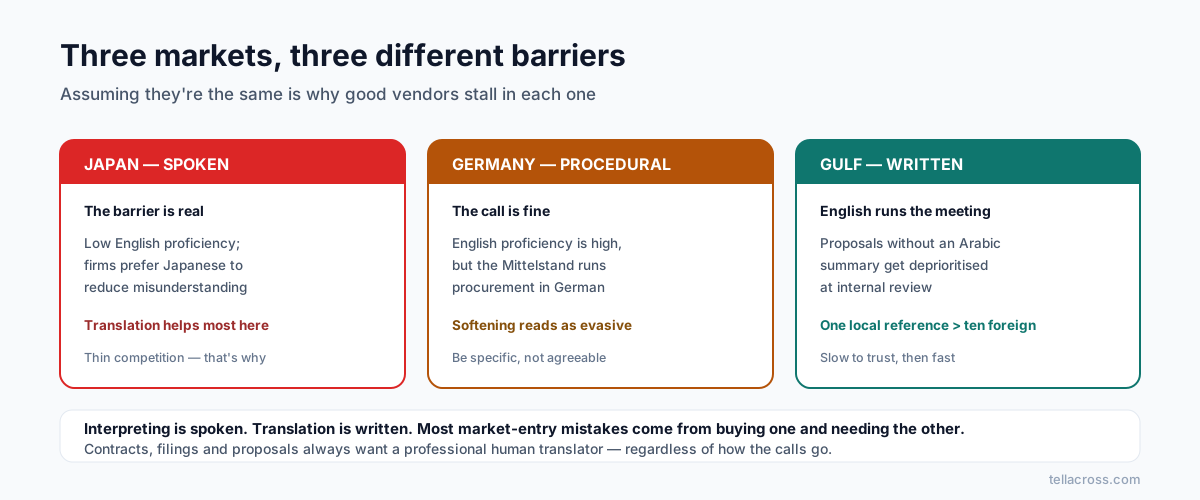
Of the three markets we've looked at closely — Japan, Germany and the Gulf — Japan is the one where the language barrier is genuinely as large as people assume. That's exactly why it's worth your attention: the barrier is what's keeping your competitors out.
The gap is real, and it's structural
Japan ranks low in global English proficiency, and the effect compounds in business. Japanese companies generally prefer to do business in Japanese to minimise the risk of misunderstanding, with corporate documents, processes and policies written exclusively in Japanese.
Notice the reasoning there: it isn't reluctance to use English, it's risk management. In a business culture where precision and reliability are core values, conducting important discussions in a language where both sides are approximating is itself seen as unprofessional. Understanding that reframes the whole thing — you're not asking them to accommodate you, you're removing a risk they're right to be worried about.
Operationally it goes further: market entry involves documentation-intensive processes and Japanese-language filings that are slow without local help.
Why the barrier is the opportunity
Japan has serious technical budgets and a well-documented shortage of suppliers. Most foreign vendors never call, because the first conversation can't happen in English. That's an unusual market condition: real demand, real money, and thin competition — not because the work is hard, but because the approach is.
If you can hold the first conversation, you're competing against a much shorter list than you're used to.
What actually works
Do the first call in Japanese, with translation. Not a Japanese-language pitch you've memorised — an actual conversation where they speak Japanese and you speak your language. The point isn't to appear fluent; it's that they can express what they actually need rather than the subset their English covers.
Send materials in advance, in Japanese. Reading is easier than listening in a second language, and — more importantly — your document will circulate internally to people who won't be on the call and don't read English. Those people often include whoever approves the budget. Use a professional human translator for anything you're being paid for.
Be explicit about the working language for delivery. This is where foreign vendors create problems for themselves. Selling in Japanese and delivering in English is a perfectly reasonable arrangement — but say so, in writing, before the contract. Discovering the mismatch in month two damages the relationship in a market where reliability is the whole currency.
Expect a longer sales cycle and more people. Decisions involve more stakeholders and more consensus-building than you're used to. This is not stalling. Rushing it is the single most common way foreign vendors lose Japanese deals.
Be precise, not enthusiastic. Confident overstatement — "we can definitely do that", "no problem" — reads as unreliable rather than reassuring. Understating and then delivering is worth far more here than the reverse.
Where translation genuinely helps, and where it doesn't
Helps: first contact, discovery, requirements gathering, status calls, and any conversation with a stakeholder who doesn't speak English. Real-time translation means both sides speak their own language and neither is operating at a disadvantage. That's what TellAcross does — browser link, nothing for them to install, Japanese both directions, exportable transcript. Ten free minutes is enough for one real discovery call.
Doesn't help: contracts, filings, formal documentation. Those need professional human translation with accountability, and Japan takes documentation seriously enough that machine output would be a genuine liability.
Doesn't replace: local presence, references, and time. Translation gets you into the conversation. It doesn't make you a known quantity in a market that weights that heavily.
One thing that changed recently
If your plan involves placing people in Japan rather than selling remotely, note that from 15 April 2026 certain applicants for the Engineer/Specialist in Humanities visa must prove Japanese language ability, with JLPT N2 the threshold under discussion. That's a meaningful change for staffing plans, and it doesn't affect remote vendor relationships — but it's worth knowing which model you're pursuing.
The honest summary
Japan rewards patience, precision and evident effort, and penalises the opposite more than most markets. Translation removes the reason the first conversation never happened. Everything after that is the ordinary work of earning trust — it just takes longer here, and it's more durable once you have it.
Start with one prospect, one properly translated document, and one call where they speak Japanese. The quality of that conversation will tell you whether the market is worth the longer investment.