Selling to German clients — the language barrier isn't where you think
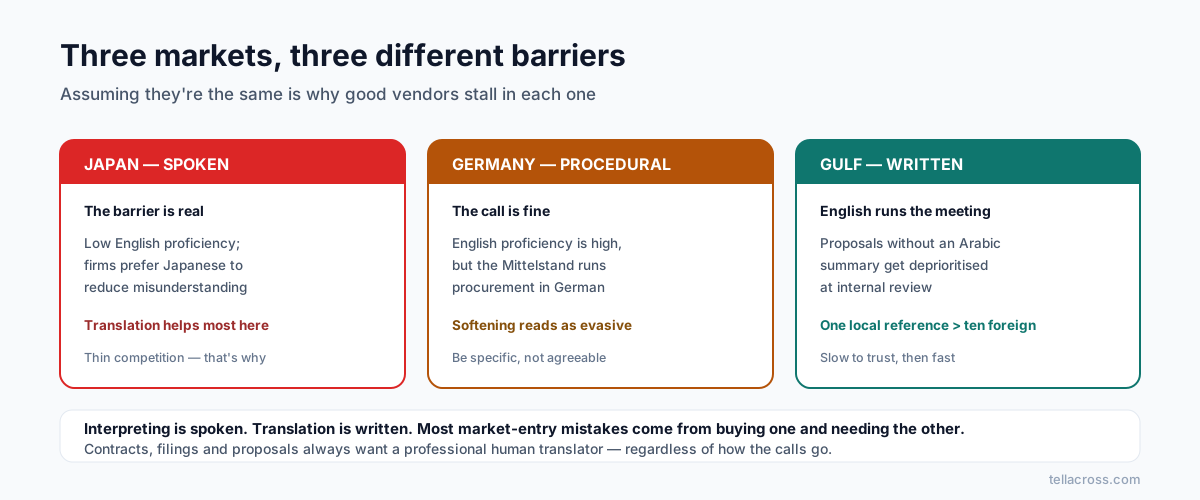
German English proficiency is high, so the call goes fine. The Mittelstand still runs procurement and contracts in German, and softening your language reads as evasive. What actually matters.
Prakash Vakhesa · August 31, 2026 · 4 min read
Disclosure: we make a call translation tool. This post argues you probably don't need it for German sales calls — which is the honest answer, and the useful one.
Start with the part most "doing business in Germany" articles get wrong: English proficiency in Germany is high. Your discovery call will almost certainly be fine in English. If you were planning to solve a language problem before approaching German prospects, you may be solving the wrong one.
The real friction is in three specific places, and none of them is the sales call.
1. The Mittelstand runs in German
The Mittelstand — Germany's small and medium-sized industrial firms — is the backbone of the economy, full of world-leading specialists, and runs almost entirely in German, including procurement and contracts. Government offices and most professional services default to German too.
So the pattern is: the call happens in English, and then the process happens in German. Tenders, procurement portals, supplier onboarding forms, terms. If your plan stops at "we can do the meeting in English," you'll get through the meeting and stall at the paperwork.
2. Proficiency isn't fluency, and the gap costs you credibility
German English is good but generally not at Dutch or Scandinavian level, and subtle language gaps slow negotiations and weaken credibility.
That word credibility is the important one. The failure isn't misunderstanding — it's that a negotiation conducted in someone's second language moves slower, and slowness in a German procurement context reads as uncertainty about your own offer.
3. Directness is not rudeness, and softening is not politeness
This is where English-speaking vendors do the most self-inflicted damage. German business communication is direct, clear and grounded in logic — and the common mistake is treating that directness as rudeness, then softening your own language until it becomes vague. German counterparts read that vagueness as evasiveness.
Concretely: "we'd probably be able to look at getting that done for you fairly soon" is intended as polite flexibility and received as this vendor is avoiding a commitment. "We can deliver that in six weeks. Not sooner." is received as competent.
If you're from a business culture that cushions bad news — most of South Asia, much of the English-speaking world — this is the adjustment that matters most, and it costs nothing to make.
4. Contracts mean what they say
Contracts are expected to be detailed and legally sound, and adhered to closely. Once agreed, they don't drift.
Coming from markets where a contract is a starting point for an ongoing conversation, this is a real adjustment. Negotiate hard before signing, because after signing you're expected to perform exactly what's written. The upside is symmetric: they will do exactly what they promised, and you can plan around it.
So what do you actually need?
For sales calls: English is fine. Speak plainly, commit to specifics, and don't soften. That's the whole playbook, and it's free.
For procurement and contracts: professional German translation — human, not machine, for anything legally binding. This is document translation, a different profession from interpreting.
For the Mittelstand specifically: a German-speaking partner, agent, or eventually a hire. Not because they can't speak English, but because their internal process doesn't.
Where a translation tool earns its place is narrower than you'd hope: technical conversations with engineers or plant staff who genuinely don't use English day to day, and multi-person meetings where one participant is clearly struggling and going quiet. In those cases letting each person use their own language gets you the objections and detail you'd otherwise never hear. TellAcross covers German both directions in the browser with nothing for them to install — but I'd be overselling if I told you that most German B2B calls need it.
The summary
Germany is the market where the language barrier is smallest and the cultural barrier is most underestimated. The vendors who struggle here are rarely the ones with poor English — they're the ones being agreeable when they should be being specific.
Say what you'll do, by when, and what it costs. Put it in a detailed contract. Then do exactly that. In this market, that's most of the strategy.