The hidden cost of only hiring people who speak your language
Every language requirement narrows the pool before a resume is read. The cost shows up as a smaller pool, slower hiring, and turnover — rarely as a line item anyone tracks back to the source.
Prakash Vakhesa · November 10, 2026 · 2 min read
Disclosure: we make TellAcross, a real-time call translation tool, mentioned in the last section.
"Must be fluent in English" reads as a harmless, even reasonable line in a job posting. In practice, it's one of the more expensive filters a company can apply — and the cost almost never shows up on a line anyone's looking at.
It shows up as a smaller, pricier pool
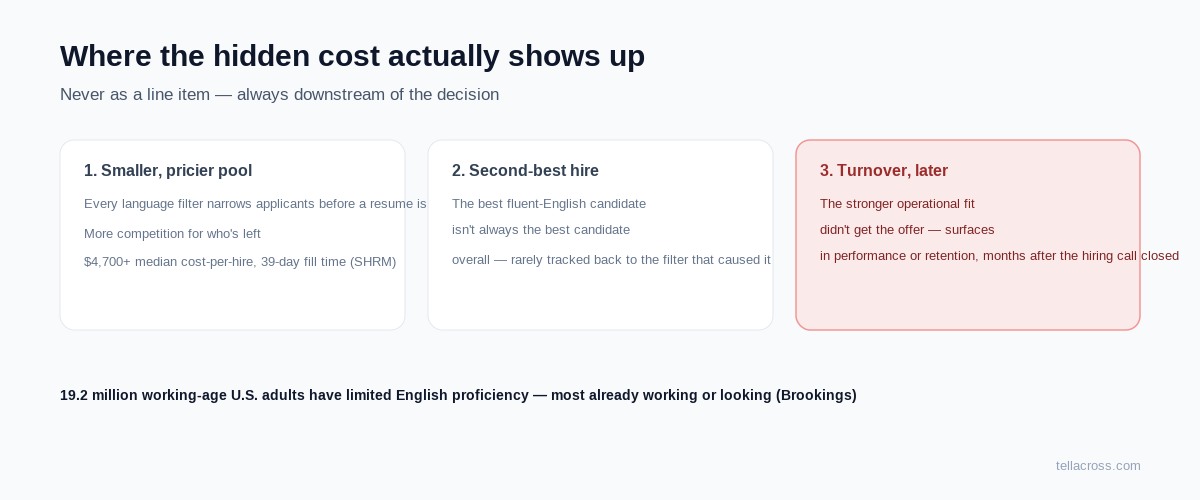
Every language requirement narrows the applicant pool before a single resume is read. A narrower pool means more competition for the candidates who do clear the bar, pushing cost-per-hire and time-to-fill up for roles that, in many cases, don't actually need live spoken fluency to be done well. The median cost-per-hire runs over $4,700 and the median time-to-fill sits around 39 days — both numbers that stretch further when a company is competing for a smaller slice of candidates than it needs to.
This shows up most in sectors already short on workers — skilled trades, caregiving, logistics, manufacturing, and technical remote roles — where employers compete for the same small pool of fluent-English candidates while 19.2 million working-age U.S. adults with limited English proficiency remain mostly unconsidered, despite the same Brookings analysis finding most of that population already working or actively looking.
It shows up as a worse hire, not a missing one
When a search is restricted to one language, the final hire is sometimes the best fluent-English candidate rather than the best candidate overall. That's a quiet kind of underperformance — the team didn't hire badly by its own process, it just hired from a smaller set of options than it needed to. A single unfilled critical role is already estimated to cost around $14,700 a month; a role filled with the second-best available candidate because the best one didn't clear a language filter rarely gets costed at all.
It shows up later, as turnover
Some companies resolve the interview-language problem by hiring whoever communicates best in the room, then discover months later that the stronger technical or operational fit was the person who didn't get the offer because the live conversation didn't work. That gap tends to surface in performance or retention — after the hiring decision is long closed and hard to trace back.
What closes the gap
The fix isn't lowering standards. It's separating "can do the job" from "is fluent in my language," and giving the interview a way to evaluate the first without requiring the second. Real-time voice translation does exactly that on a live call: each side speaks their own language, and the conversation runs as naturally as if it were in one — which is the specific thing TellAcross is built to do on a video call, candidate to hiring manager, no interpreter changing the dynamic in between.
The hidden cost of English-only hiring isn't a line item. It's every strong candidate the process never properly evaluated.
Try real-time translation on your next call
Speak your language, they hear theirs — live, both directions. 10 free minutes every month.
Start free — no card needed