Hiring globally? Here's how to run interviews across any language in real time
Interpreters change the dynamic of an interview, and subtitle tools lag behind the conversation. What running a hiring call with live spoken translation actually looks like, step by step.
Prakash Vakhesa · November 12, 2026 · 2 min read
Disclosure: we make TellAcross, a real-time call translation tool, and this post walks through using it. For the interview-design side of hiring across a language barrier — not just the tooling — see our guide to interviewing candidates across a language barrier.
Hiring globally used to mean one of three compromises: restrict the search to candidates fluent in your language, book a human interpreter for every call, or rely on subtitled video that lags behind the conversation and flattens tone into stiff, approximate text. None of those is actually necessary anymore.
Why the old workarounds fall short
An interpreter on the call works, but it changes the conversation — answers get relayed secondhand, nuance gets lost in the handoff, and the candidate ends up talking to a translator instead of the hiring manager. Subtitle-based tools solve a different problem (reading along) rather than the one an interview actually needs: hearing someone's tone, timing, and actual voice as they explain their experience.
What an interview needs is a live, spoken, two-way conversation — just one where each person can speak their own language and still be understood immediately, at normal conversational pace.
Running the interview
Here's what that looks like on a TellAcross call:
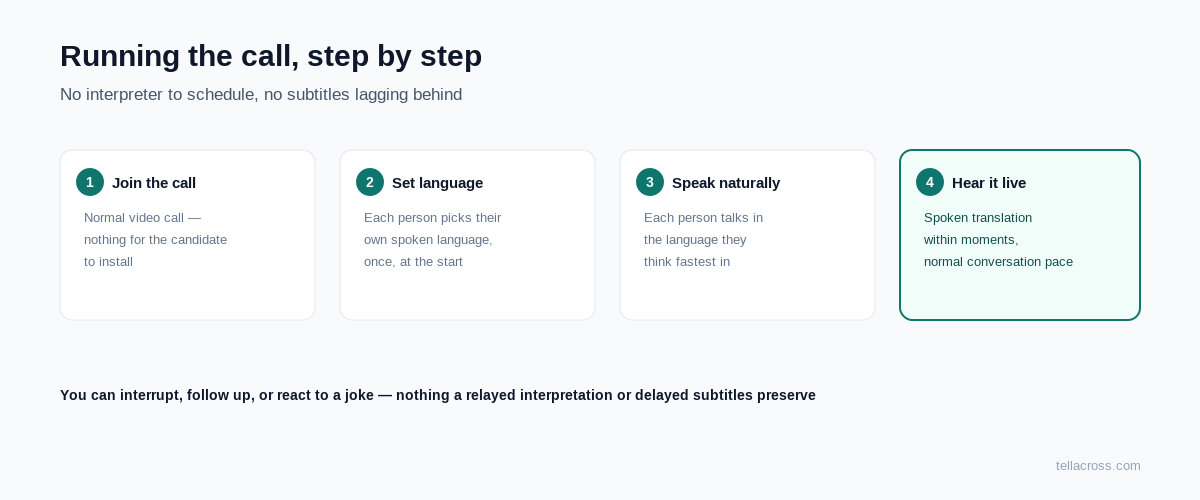
- Both people join a normal video call — no special software for the candidate to install, no interpreter to schedule separately.
- Each person sets their own spoken language once, at the start of the call.
- As each person talks, the other hears a live spoken translation within moments — not delayed subtitles, not a post-call transcript.
- The conversation runs at a normal pace: you can interrupt, ask a follow-up, or react to a joke — the things a written transcript or a relayed interpretation usually lose.
What this changes about how you hire
- You can genuinely compare candidates across language groups on the same footing, because the interview format isn't quietly favoring whoever's most fluent in your language.
- You can run reference checks, performance reviews, and onboarding conversations the same way — not just the first interview.
- You open the funnel to markets you may have ruled out simply because "we don't really interview in that language."
The bigger shift
Companies already accepted that strong talent isn't confined to one city once remote work took hold — remote-first hiring routinely reports candidate pools hundreds of percent larger than local search alone. The next step is accepting that talent isn't confined to one language either. The tooling is no longer the bottleneck; for most companies, the hiring process is the only thing still catching up.
If your next interview could run in any language without anyone needing to be a professional interpreter, what would that do to your shortlist?
Try real-time translation on your next call
Speak your language, they hear theirs — live, both directions. 10 free minutes every month.
Start free — no card needed