Hotel front desks and guests who don't share your language
Check-in works fine without shared language — it's scripted and both sides know the script. Everything that goes wrong afterwards doesn't. Where the language gap actually costs a hotel money, and what to do about it.
Prakash Vakhesa · September 17, 2026 · 4 min read
Disclosure: we make TellAcross, a call translation tool. It fits a narrow slice of hotel operations and is irrelevant to most of it. I'll be specific.
Ask a front office manager whether language is a problem and you'll hear that check-in is fine. That's true, and it's also why the problem gets underestimated.
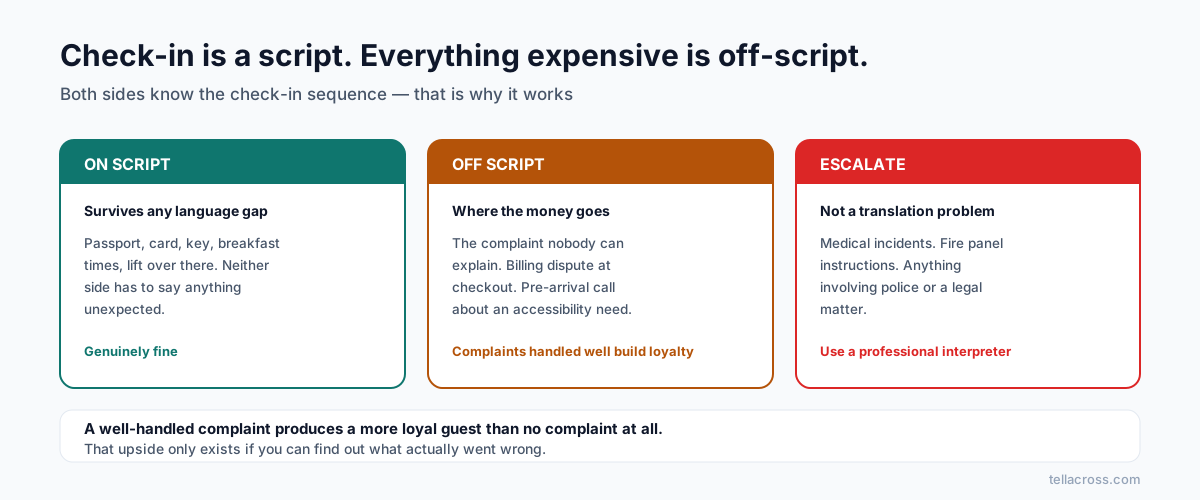
Check-in is a script. Both sides know the sequence — passport, card, key, breakfast times, lift over there. It survives almost any language gap because neither party needs to say anything unexpected.
Everything that costs you money is off-script.
Where it actually goes wrong
The complaint. A guest is unhappy about something and can't explain what. What you get is a frustrated person and a vague gesture, so you resolve the wrong thing — or you resolve nothing and it becomes a review. Complaints are the highest-value conversation in a hotel because a well-handled one produces a more loyal guest than no complaint at all. That upside is only available if you can find out what happened.
The medical or safety incident. Someone's ill, someone's locked out at 2am, there's a fire panel activation and a guest doesn't understand the instruction. These are exactly the moments where "we managed" isn't good enough.
The billing dispute at checkout. A minibar charge, a resort fee, a no-show night. The guest believes one thing, the folio says another, and there's a queue forming. This ends in a chargeback more often than it should, purely because neither side could explain their position in the ninety seconds available.
The pre-arrival phone call. Early check-in, an accessibility need, a cot, an allergy. This one's underrated: it happens before the guest is even yours, and a call that goes nowhere is a booking that goes to another property.
The special request that isn't understood. Dietary requirements are the sharp end. "No pork" heard as "no beef" is not a service failure, it's a serious one.
The bilingual-staff trap
Most hotels solve this with whoever on shift speaks the language. It works and it has the same three problems it has everywhere:
They're not on every shift, and guests have problems at 3am. They have their own job — pulling a housekeeper off the floor to translate a billing dispute costs you twice. And they're being asked to handle a complaint or a medical issue with no training in either, which is unfair to them and risky for you.
It also produces an odd inequity: guests who speak a language someone on staff happens to share get good service, and guests who don't get worse service, for reasons that have nothing to do with them.
What actually works
Translate the written material properly, once. In-room directory, safety instructions, breakfast times, wifi, checkout process, the fire notice. This is a one-time cost that removes a large share of routine questions permanently. Do it for your actual top guest nationalities, not a generic set.
Know your real language mix. Pull it from booking data rather than guessing. Most hotels are surprised — the mix is rarely what the front desk believes it is.
Put translation where the off-script moments happen: front desk, duty manager, the reservations phone line. Not everywhere.
For anything medical or safety-critical, escalate to a professional. Emergency services have interpreter access. Use it rather than improvising.
Write down what was agreed on any billing dispute, in both languages, before the guest leaves the desk. Most chargebacks are memory disputes, not fraud.
Where a translation tool fits
The hotel case is unusual in one respect: the guest is standing in front of you and the conversation is short. That's close to ideal for real-time translation — a two-minute exchange about a broken air conditioner needs no interpreter booking, and the alternative isn't a professional, it's a shrug.
TellAcross fits this: a browser link the guest can open on their own phone with nothing to install, both directions, 60+ languages, per-minute pricing that suits a handful of conversations a day rather than a subscription per seat. Ten free minutes a month is enough to try it on the next complaint you can't parse.
Where it doesn't fit: medical emergencies, anything involving police, and any conversation that could become a legal matter. Get a qualified interpreter — the cost is trivial against the exposure.
And it won't fix a service problem. If the complaint is that the room wasn't cleaned, translating the complaint faster doesn't clean the room. It just means you find out today rather than in a review next week.
The honest summary
Hotels don't have a check-in problem. They have an exception problem — and hospitality is a business where the exceptions determine the review score.
Translate the written material for your real guest mix. Stop relying on which languages happen to be on shift. And make sure that when a guest is standing at your desk at 2am unable to explain what's wrong, "we couldn't understand each other" isn't how that ends.