The immigration intake call — winning the client in the first ninety seconds
For an immigration practice the intake call is the whole ballgame, and it usually happens in a language your front desk doesn't fully speak. Here's how to stop losing clients in the first ninety seconds.
Prakash Vakhesa · August 21, 2026 · 3 min read
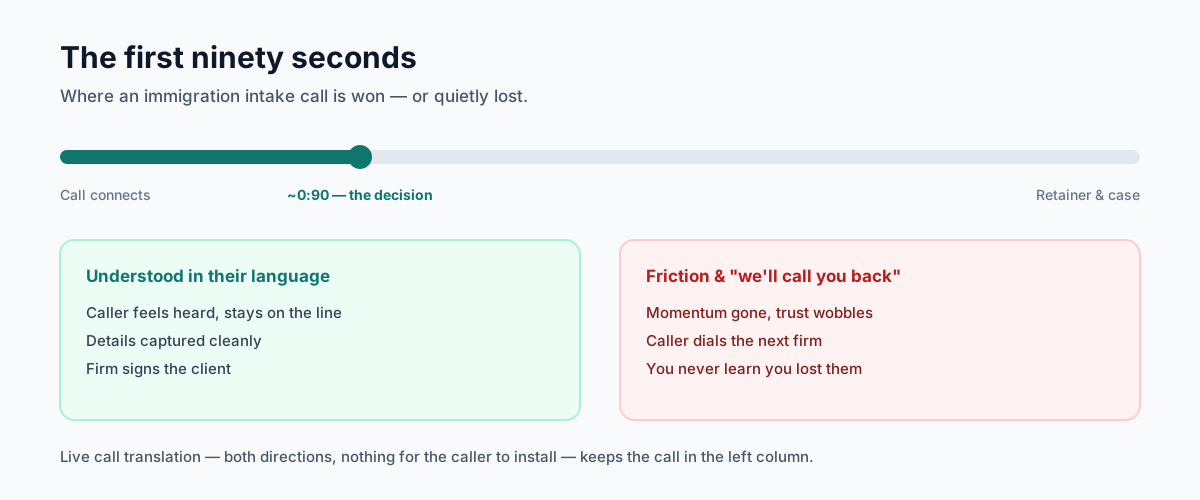
Ask an immigration attorney where cases are really won and it isn't the courtroom. It's the intake call. That first conversation decides whether a frightened, hopeful person on the other end trusts your firm with the most important paperwork of their life — or hangs up and calls the next firm on the list.
What makes immigration different from almost every other practice area is that your callers, by definition, often don't speak English. The language barrier isn't an occasional edge case. It's the centre of your client base. So the real question isn't whether you'll get intake calls in Spanish, Mandarin, Vietnamese, Haitian Creole or Arabic — you will — it's what happens in the ninety seconds after you pick up.
(For the compliance and ethics side of this — interpreters versus translators, the risk of using a client's family member — see working with clients who don't speak English. This post is about the business end: converting the call.)
The hidden leak in your intake pipeline
Most firms handle non-English calls in one of a few ways, and each quietly loses clients:
- "Let me call you back with someone who speaks Spanish." The caller is now off the phone, the momentum is gone, and a competitor is one tap away.
- A bilingual staffer covers one language — until the caller speaks Mandarin, or that staffer is in court, at lunch, or out sick.
- A per-minute phone interpreter works, but it costs a few dollars a minute, has to be dialled in, and puts a stranger into a sensitive, often traumatic conversation.
- The caller's child translates. Ethically fraught, wildly inconsistent, and no basis for a professional intake.
Every one of these adds friction at the exact moment trust is most fragile. And unlike a bounced email, you never see the lost client. They simply called someone else.
Why "the client can use Google Translate" isn't the answer
Live translation got genuinely good — but every mainstream tool assumes the caller set something up in advance: a specific app, a paid account, a Pixel phone, or a Google Meet everyone has joined. Your intake caller has none of that. They're a stranger dialling your front desk from whatever phone they own, often stressed and unfamiliar with the technology. Asking them to install something before you'll talk is how you lose the call, not save it. The translation has to happen on your side, invisibly, with nothing required from the person calling you.
Translate the intake call live — nothing for the client to install
This is the gap TellAcross was built for. When a non-English caller reaches your intake line, it translates the conversation both directions in about a second. Your coordinator speaks English; the client hears their own language; the client responds and your coordinator hears it back in English.
Three things make it fit an immigration practice specifically. Nothing for the client to install — they click a link in any browser, which for a nervous first-time caller is the difference between a conversation and a hang-up. Legal terminology stays intact — "notice to appear," "adjustment of status," "priority date," "asylum" can't get garbled. And it covers every language on demand — over a hundred, both directions — so you're not limited to the languages your current staff happen to speak. Your team already handles Spanish; this covers everyone else, at a few cents a minute with no booking and no minimum.
The first ninety seconds are the whole decision
The next non-English speaker who needs an immigration attorney will choose the firm that made the opening of the call feel human. Everything downstream — the retainer, the case, the referral to their cousin — starts with whether those ninety seconds felt like being understood. That's not a technology problem to solve someday. It's the most winnable moment you have, on every call, today.