A skilled worker, zero English — what actually happens when you apply for a job
Credentials and work history travel fine. The breakdown happens at the first live call. What the research on immigrant "brain waste" shows about where qualified workers actually get stuck.
Prakash Vakhesa · November 3, 2026 · 3 min read
Disclosure: we make TellAcross, a real-time call translation tool, mentioned near the end. Most of this is about what happens before anyone gets to a tool.
Picture a licensed electrician with twelve years on commercial sites, or a backend developer who has shipped production systems for a mid-size company. Neither speaks more than a few words of English. Here's what the research says actually happens when workers like this look for jobs outside their home language region — and it isn't that they lack the skill.
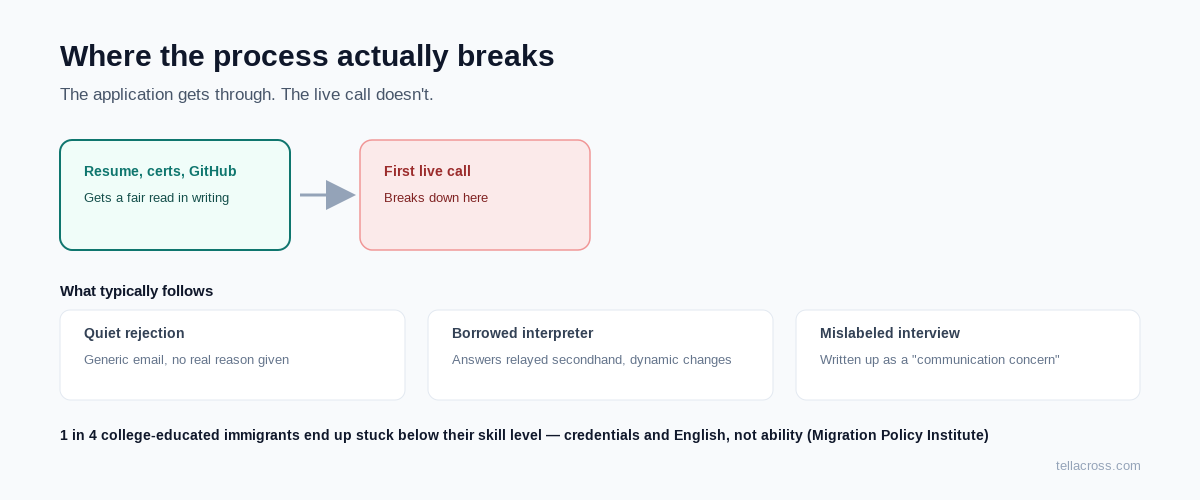
The application gets through. The call doesn't.
Resumes, certifications, GitHub repositories, and reference letters mostly speak for themselves in writing. The breakdown happens at the first live conversation — a screening call, a "quick chat" with a hiring manager. The Migration Policy Institute's research on highly skilled immigrants found that the two biggest barriers to working at their actual skill level were foreign credentials not being recognized, and limited English proficiency — not a lack of ability. Across the group studied, one in four ended up in low-skilled jobs or unable to find work at all, a pattern researchers term brain waste, costing those workers and the wider economy an estimated $39 billion a year in wages that were never paid out and $10.2 billion a year in forgone tax revenue.
What typically happens next
When the live call doesn't go well, one of three things tends to follow: the candidate is quietly dropped with a generic rejection, they're asked to bring their own interpreter (which changes how they're perceived — answers get relayed secondhand, and the hiring manager ends up talking to a third person instead of the candidate), or the interview happens anyway, badly, and gets written up afterward as a "communication concern" rather than what it actually was: a language-access problem.
In every version of this, the real question — can this person safely rewire a panel, can this person design a scalable API — never gets properly asked.
Why this is a process gap, not a talent gap
None of this is about whether the candidate can do the job. It's about whether the hiring process has any way to find out. That distinction matters, because a process gap is fixable in a way a skills gap isn't.
With real-time spoken translation on the call, the electrician explains torque specs and safety protocol in their own language and the hiring manager hears it clearly, translated live, in theirs. The developer walks through architecture decisions the way they would with any colleague who happened to share a language — because for the length of that call, they effectively do. That's the specific case TellAcross is built for: a direct, one-to-one conversation between candidate and hiring manager, not a relay through a third person.
- A candidate's technical skill shouldn't be evaluated through the fog of a language neither side speaks fluently, improvised in real time.
- A human interpreter helps, but changes the dynamic — answers shorten, nuance drops, and the conversation stops being between the two people who actually need to understand each other.
- Live voice translation keeps it one-to-one: candidate and hiring manager, each speaking the language they think in.
The skill was never the problem. The conversation was. Fix the conversation, and the hiring decision gets made on the thing that was supposed to matter all along.
Try real-time translation on your next call
Speak your language, they hear theirs — live, both directions. 10 free minutes every month.
Start free — no card needed