What a phone interpreter actually costs per minute in 2026
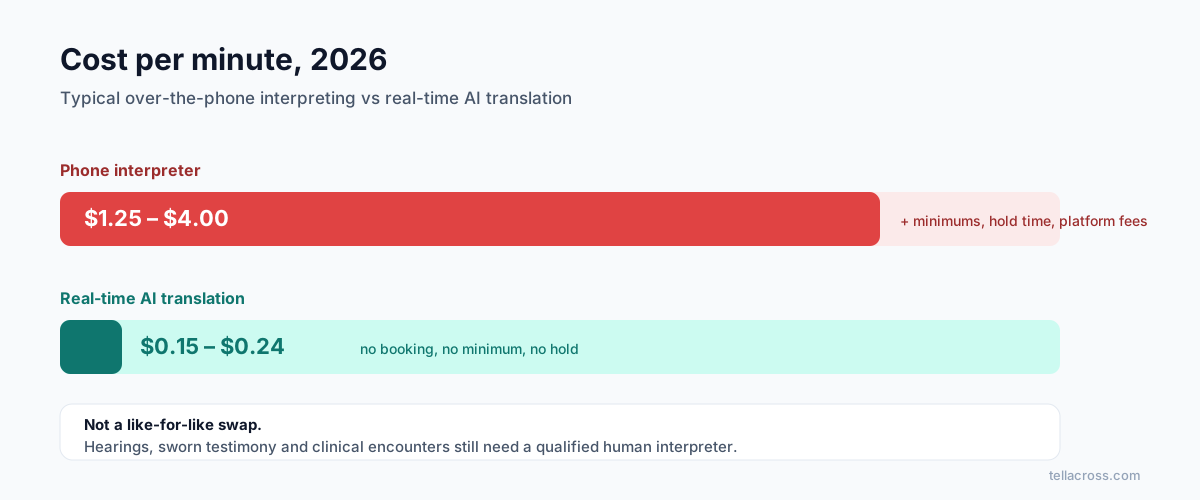
Over-the-phone interpreting runs roughly $1.25–$4.00 a minute once you include the fees vendors don't put on the pricing page. Here's how the numbers break down, and when paying it is still the right call.
Prakash Vakhesa · August 18, 2026 · 3 min read
If you've ever tried to compare interpreting vendors, you'll have noticed the headline rate is the least useful number on the page. Here's what the market actually looks like in 2026, and where the extra money goes.
The range
Over-the-phone interpreting (OPI) generally falls between $0.80 and $5.00 per minute. For business, legal, education and public-sector work, the realistic band is $1.25 to $4.00 per minute. Some vendors advertise from around $1.70 per minute.
Three things move you within that range:
Language. Spanish sits at the bottom — supply is deep and interpreters are always available. Less common languages cost more, and for some you're paying partly for the fact that someone is on call at all.
Certification. A certified medical or legal interpreter costs meaningfully more than a general one. That premium is real work: terminology, ethics training, and liability.
Platform fees. This is the one that surprises people. Phone and video platforms add licensing, routing and integration charges on top of the per-minute rate. A low headline number often means those costs are itemised somewhere else on the invoice.
The costs that don't appear on the invoice
Per-minute pricing hides the shape of how you actually use interpreting.
Minimums. Many vendors bill a minimum connection — often 10 or 15 minutes. A two-minute call to confirm an appointment costs the same as a twelve-minute one.
Connection time. You're frequently on hold while the vendor finds someone who speaks the language. For a common language that's under a minute. For a rarer one it can be several — and depending on the contract, that wait may be billable.
Scheduling friction. The bigger cost is usually not money. If a client calls with a quick question and you have to book an interpreter and call back tomorrow, the conversation you'd have had in ninety seconds becomes a two-day loop. Multiply that across a caseload.
When a human interpreter is worth every cent
It's worth being direct about this, because the answer isn't "always use software."
For court hearings, sworn testimony, formal depositions and medical consent, you want a certified human interpreter. Those settings demand accountability, legal standing, and someone who can flag ambiguity and be questioned about their rendering. Many are legally required to have one — competent interpreters must be provided at hearings and trials where a non-English speaker is present.
Nobody should be swapping a certified interpreter for an app at a hearing. That's not the decision in front of you.
Where the real volume is
The decision that actually matters is what to do about the other ninety percent of calls: intake, scheduling, status updates, chasing a missing document, explaining what happens next, checking someone understood the form you sent.
These conversations are short, frequent and low-stakes individually. Collectively they're most of the relationship. They're also exactly the calls that get skipped, delayed, or handled badly through a family member acting as an ad-hoc interpreter — which brings its own confidentiality problems.
At $2 a minute with a 10-minute minimum, a 90-second status call costs $20. Booked in advance. Most practices simply don't make that call, and the client is left wondering.
The arithmetic that changed
AI speech translation now handles this middle tier at a per-minute cost roughly an order of magnitude lower — TellAcross runs in the range of $0.15–$0.24 per minute with no booking, no minimum, and no hold time. That's not a claim about replacing certified interpreters. It's a claim about the calls that currently don't happen at all.
The right mental model is triage:
- Hearings, testimony, consent → certified human interpreter, always.
- Intake, updates, scheduling, quick questions → real-time translation, immediately, at conversational speed.
- Documents → a translator, not an interpreter. These are different professions: interpreting is spoken, translation is written.
Most organisations pay interpreter rates for the middle tier because it was the only option, or skip those conversations entirely because it wasn't worth the cost and delay. That's the money — and the client experience — that's actually on the table.