Can AI replace interpreters? What the evidence actually says
The WHO tested AI interpreting and passed one attempt out of ninety. Here's an honest read of where AI translation is genuinely ready, where it clearly isn't, and why the answer is a split rather than a winner.
Prakash Vakhesa · August 13, 2026 · 3 min read
We build AI translation software, so treat what follows accordingly — but the honest answer is more useful to you than the flattering one, and the evidence isn't ambiguous.
The finding people should know
The World Health Organization evaluated AI interpreting and concluded it remains experimental and not fit for important meetings. In their testing, one out of ninety tests received a passing grade — and that one still contained errors.
That is a striking number, and anyone in this industry who doesn't engage with it isn't being straight with you.
Why high-stakes settings are different
The obvious reading is "AI translation isn't accurate enough yet." That's part of it, but it misses the more interesting part: accuracy isn't the only thing an interpreter provides.
A human interpreter can:
- Ask a clarifying question. When a phrase is genuinely ambiguous, they stop and check. Software commits to its best guess and moves on, with no signal that a choice was made.
- Flag that something didn't translate. Concepts without clean equivalents get noted rather than silently approximated.
- Make cultural judgements. How directly bad news is delivered varies enormously, and getting it wrong damages the encounter even when the words are correct.
- Be accountable. A human can be questioned about their rendering afterwards. That matters in a deposition, and it matters in an adverse clinical event.
In diplomacy, courtrooms and hospitals, one mistranslated phrase can change the outcome. That's not a rhetorical flourish — it's the reason those settings have professional standards at all.
Where AI genuinely works
The same body of analysis is equally clear in the other direction. AI translation is appropriate for casual conversation, travel, routine meetings and everyday communication, and document translation is now the most automated language task of all, around 85%.
The 2026 consensus among language professionals and enterprise teams is a hybrid model — AI for speed and coverage, humans where errors are expensive.
The distinction that actually decides it
Forget "is AI good enough" as the question. Ask this instead:
What happens if this particular sentence is rendered wrong?
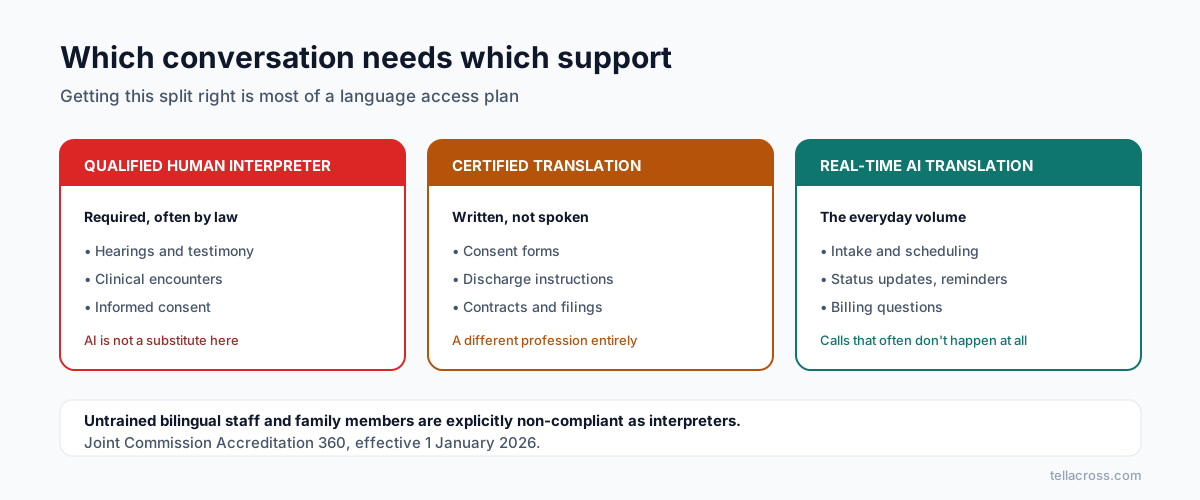
If the answer is a deportation, a misdiagnosis, an unenforceable contract or an inadmissible statement — you want a qualified human, and in many of those settings the law agrees. In healthcare, untrained interpreters are now explicitly non-compliant, which puts a regulatory floor under the judgement.
If the answer is "we'd rephrase and carry on" — a scheduling call, a status update, a routine team meeting, a first conversation with a prospective customer — then AI is not a compromise. It's the only option that actually happens, because the alternative isn't a human interpreter, it's the conversation not taking place.
The comparison that's usually wrong
Most debate compares AI translation against a professional interpreter, and AI loses. But that's rarely the real-world choice.
For the vast majority of everyday cross-language conversation, the alternatives are: a family member interpreting badly, a colleague pulled away from their actual job, typing into a translation app and turning the screen around, or simply avoiding the conversation.
Against those options — which is what genuinely happens in clinics, law offices and small businesses every day — real-time translation is a clear improvement. Against a certified interpreter in a courtroom, it isn't close, and won't be soon.
What we tell our own customers
TellAcross covers 60+ languages with live spoken translation in both directions. We think it's good, and we think you should use it for intake calls, scheduling, status updates, team meetings and first contact with customers.
We also think you should book a certified human interpreter for hearings, sworn testimony, informed consent and clinical encounters — and if a vendor tells you their software satisfies your interpreter obligations in those settings, be sceptical of everything else they've told you.
The interesting question was never whether AI replaces interpreters. It's how many conversations currently don't happen at all, and what it's worth to make those possible.