Is AI call translation private? Where your audio actually goes
70% of people worry about AI tools and their data — and for voice, the worry is reasonable. The questions that actually determine whether a translation tool is private, answered for our own product too.
Prakash Vakhesa · August 20, 2026 · 3 min read
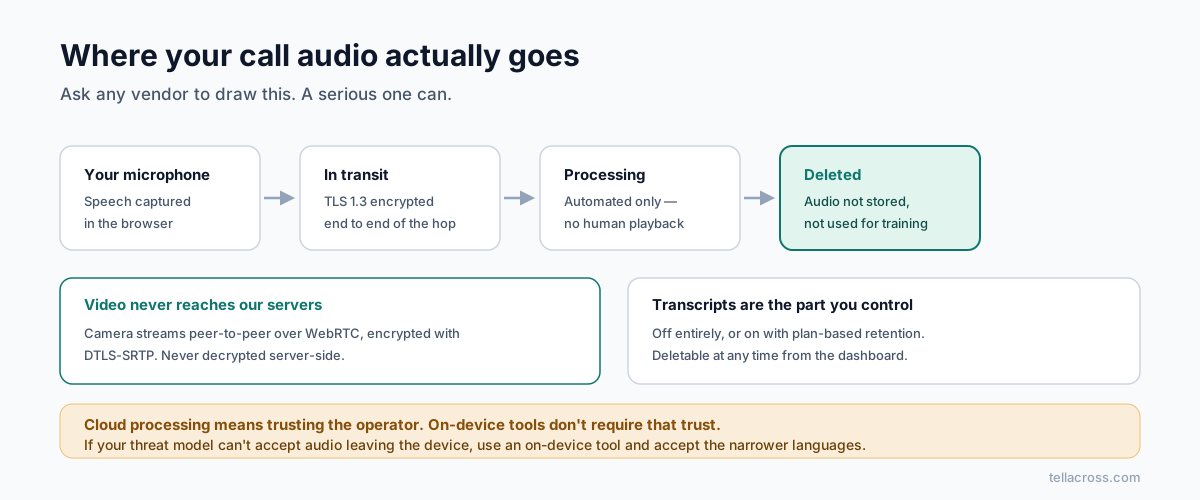
Voice is unusually sensitive data. A call contains not just what you said but your voice itself — and if you're a lawyer, doctor or adviser, it contains someone else's confidences too. So when 70% of people say they're worried about the data privacy of AI tools, that's not paranoia. It's the right question asked broadly.
Here's how to ask it precisely — including of us.
Where the audio goes, in general
Every live translation tool does some version of the same pipeline: your speech is captured, converted to text, translated, and synthesised into speech. The privacy question is where each step runs and what survives afterwards.
On-device (Apple's AirPods translation, some Samsung modes): audio never leaves the phone. Strongest privacy, narrowest language coverage — the models that fit on a phone are smaller.
Cloud processing (most tools, including ours): audio is streamed to servers, processed, and results streamed back. Here everything depends on the operator's choices, which is why the checklist below matters.
The five questions that actually decide it
Evaluations of privacy-first translation tools keep coming back to the same criteria: processing location, retention, encryption, transparency, and certification. Turned into questions you can ask any vendor:
- Is audio stored after processing, or deleted immediately? "Deleted immediately, unrecoverable" is the right answer. "Retained to improve our services" means your calls become training data.
- Is your data used to train models? This should be a written no, or an explicit opt-in — not buried consent.
- Can staff access or replay calls? Automated processing with no human playback path is the standard to look for.
- What encryption is in transit? TLS 1.2+ at minimum; TLS 1.3 is current good practice.
- Who controls transcripts and for how long? Transcripts are the long-lived artifact. You should decide whether they exist and be able to delete them.
A vendor that answers all five plainly, in writing, is telling you they've done the work. A vendor that answers with the word "military-grade" and no specifics is telling you something too.
Our own answers
We'd be writing this dishonestly if we didn't apply the checklist to TellAcross:
Processing: audio is processed in real time in the cloud — that's what makes 60+ language coverage possible. It's handled by automated systems only; there is no playback, no human review, and call audio is not accessible to staff.
Video never touches our servers. Camera streams are peer-to-peer WebRTC, encrypted with DTLS-SRTP, and are never decrypted server-side. We physically cannot watch your call.
In transit: everything is TLS 1.3.
Transcripts are yours to control. Saving transcripts is a per-account setting you can turn off entirely. When on, retention is time-limited by plan rather than indefinite, and you can permanently delete any session's transcript from the dashboard.
Passwords are bcrypt-hashed; standard, but worth stating since account security is part of call privacy.
The honest caveat: cloud processing means trusting the operator's practices in a way on-device translation doesn't require. If your threat model can't accept any audio leaving the device, use an on-device tool and accept its language limits — that's a legitimate trade-off, and it's the right call for some users.
Special cases worth flagging
Regulated conversations. For clinical encounters and legal proceedings, privacy isn't the only constraint — interpreter requirements apply regardless of how private the tool is. Privacy compliance and language-access compliance are separate tests; passing one doesn't pass the other.
Recording consent. A transcript is a record of the conversation. Consent rules for recording vary by jurisdiction and apply to transcription too — if you keep transcripts of calls with clients, tell them, in whatever language they speak.
The other person's privacy. Their voice is processed just like yours. If you'd want to be told, tell them.
The short version
Ask where audio goes, what survives, who can see it, and who controls the transcript. Any serious vendor can answer in four sentences. And if a tool is free with no visible business model — the answer to "what happens to my audio" may be the business model.