Language access compliance in 2026 — what actually changed
From January 2026 the Joint Commission treats language access as a patient safety requirement, and untrained bilingual staff or family interpreters are explicitly non-compliant. Here's what that means in practice.
Prakash Vakhesa · August 14, 2026 · 4 min read
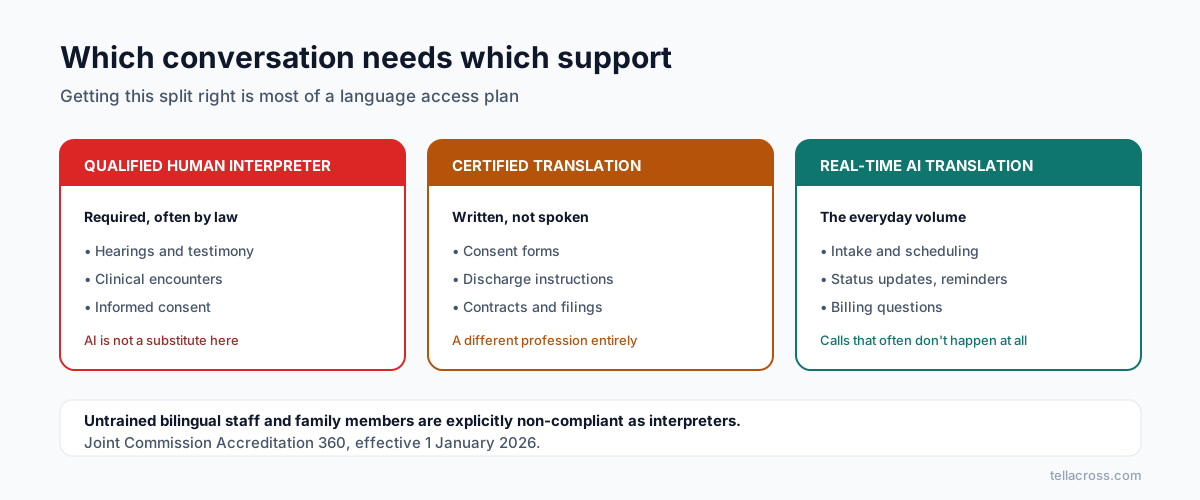
If you run or advise a healthcare organisation, language access moved from "good practice" to "audited requirement" this year. Here's the plain version of what changed and what it demands.
The two rules that matter
Section 1557 of the Affordable Care Act prohibits discrimination on the basis of national origin in covered health programs. The 2024 Final Rule requires covered institutions to provide qualified interpreter services. Non-compliance can mean lawsuits, federal penalties, and loss of federal funding.
The Joint Commission's Accreditation 360 framework, effective 1 January 2026, goes further: language access is now a formal patient safety requirement. Organisations must show evidence that language services are timely, effective and contribute to measurable patient outcomes.
That word evidence is the shift. Having a vendor contract is no longer the standard — you're expected to demonstrate the service was actually delivered and worked.
"Qualified interpreter" is a defined term
This is where most organisations are exposed, because the everyday meaning and the regulatory meaning differ.
A qualified interpreter must be proficiently bilingual, able to interpret effectively, accurately and impartially, familiar with specialised vocabulary, able to keep the message intact including tone and sentiment, and bound by interpreter ethics.
Critically: being bilingual does not make an employee a qualified interpreter. A fluent nurse who has never been trained or assessed in interpreting does not satisfy the requirement, however good their Spanish is.
What is now explicitly non-compliant
The 2026 guidance is unusually direct. Using untrained bilingual staff or family members as interpreters is explicitly non-compliant.
If your practice relies on "Maria at the front desk speaks Spanish" or on a patient's adult son translating, that is not a grey area under the current framework. It is the specific practice the rules name.
The reasoning is patient safety rather than paperwork. Family members soften bad news, omit details they find embarrassing, and answer on the patient's behalf. Untrained bilingual staff miss clinical terminology in ways that don't announce themselves — the patient nods, the encounter proceeds, and the error surfaces later.
Documents are separate
Certified translations of vital documents are required for informed consent and discharge instructions. Note this is a translation requirement, not an interpreting one — different profession, different deliverable. An interpreter who handled the consultation has not thereby produced a certified document translation.
Where AI fits — and where it does not
Being direct, because it matters more than a sale: AI translation is not the compliance answer for clinical encounters. Qualified human interpreters are what the rules require, and there's active legislative movement in the other direction — Congress is considering a Language Access for All Act that would restrict AI translation in federal agencies.
Anyone selling you AI as a way to satisfy Section 1557 in the exam room is selling you a compliance problem.
What AI legitimately covers is the large volume of non-clinical contact that surrounds care:
- appointment scheduling and reminders
- confirming which documents to bring
- billing and insurance questions
- following up on whether a prescription was collected
- general enquiries before a patient is even a patient
These conversations aren't clinical encounters, they're not covered by the interpreter mandate in the same way, and today they're mostly handled by whoever happens to speak the language — or not handled at all. That's where TellAcross fits, and we'd rather say so precisely than imply more.
A practical audit
Ask these five questions about your own organisation:
- Can you produce evidence that language services were delivered for a given encounter, not just that a contract exists?
- Is every person interpreting in clinical settings a qualified interpreter by the definition above — including your own bilingual staff?
- Are consent and discharge documents certified translations?
- Is there a written policy that family members do not interpret, and does the front desk know it?
- Who handles the non-clinical calls, and is that a deliberate choice or an accident?
Most organisations pass one and two, fail four in practice, and have never thought about five.