What a single missed non-English call actually costs
Nobody can give you a credible universal figure, and anyone who does is selling something. Here's a model you can run on your own numbers in twenty minutes — including the term most calculations leave at zero.
Prakash Vakhesa · October 17, 2026 · 5 min read
Disclosure: we make TellAcross, a call translation tool, so we benefit if this number looks large. That's exactly why I'm not going to give you a headline figure — I'm going to give you the arithmetic and let you fill it in. If the answer comes out small for you, that's a legitimate result.
Search for the cost of a missed call and you'll find confident numbers. Most are one industry's average, from one vendor's dataset, presented as universal. They're not useful for a decision.
The honest position is that this number is highly organisation-specific and entirely computable from data you already have. Here's how.
First: define "missed"
Most people picture an unanswered phone. That's the smallest category.
A missed non-English call is any of:
- Never placed. The person didn't call because previous attempts went nowhere. Invisible in every system you own.
- Abandoned. They called, couldn't be understood, and hung up.
- Deflected. Handled by asking them to call back with someone who speaks English. Logged as handled.
- Half-handled. The conversation happened badly and the wrong thing was recorded — the worst kind, because it looks like success and produces a downstream failure.
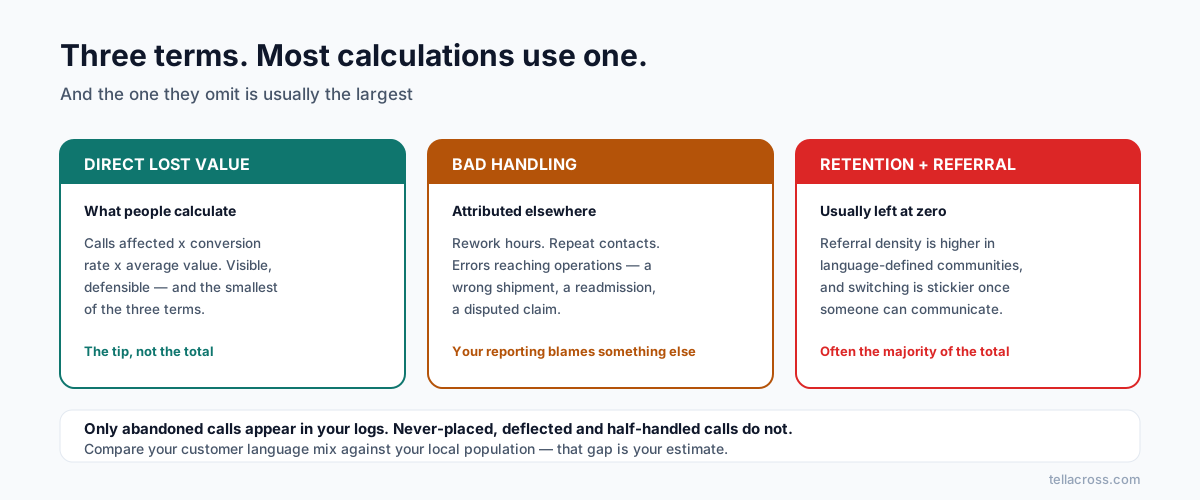
Only the second is visible in call logs. Any estimate built solely on abandonment is measuring the tip.
The model
Three terms. The third is the one that matters and the one usually omitted.
Term 1: direct lost value
(calls affected per year) × (conversion rate for comparable calls) × (average value)
Use your own conversion rate and your own average value. For a dealership that's gross per unit; for a clinic it's the contribution of a filled appointment; for a claims operation it's the cost of a claim resolving late rather than the claim itself.
Where to find the call count: the honest answer is you probably can't count them exactly, because most aren't logged. Estimate from the gap instead — compare the language mix of your customer base against the language mix of your service area's population. If your county is 14% Spanish-speaking and your customers are 3%, that difference is your starting estimate. It's rough. It's much better than zero.
Term 2: the cost of handling it badly
Calls that happened but went wrong generate cost rather than lose revenue:
(rework hours) × (loaded hourly cost)
+ (repeat contacts caused)
+ (errors reaching operations)
A supplier call misunderstood becomes a wrong shipment. A patient instruction misunderstood becomes a readmission. A claim detail misheard becomes a dispute. These are usually attributed to something else entirely in your reporting, which is why this term looks small until you go looking.
Term 3: the retention and referral term
This is the one that dominates in practice and gets left out because it's uncomfortable to estimate.
(customers lost) × (lifetime value)
+ (referrals not made) × (acquisition cost avoided)
Two things make this larger than intuition suggests in language-defined communities:
Referral density is higher. People who share a language and a place of origin talk to each other about who treated them well. This cuts both ways, and it's why one badly-handled interaction rarely stays one interaction.
Switching is stickier. Someone who finds a provider they can actually communicate with tends to stay, and tends to bring others. So the value of winning here is durable, and the cost of losing is too.
You cannot measure this precisely. Estimate it anyway — leaving it at zero is itself an estimate, and a worse one.
A worked example
Not a claim about your business. An illustration of the shape.
A clinic in a county with a substantial Vietnamese-speaking population sees Vietnamese patients at a third of the local rate. They estimate 200 affected contacts a year.
- Direct: 200 × 40% would-have-booked × $180 contribution = $14,400
- Bad handling: 60 contacts requiring rework × 25 minutes × $45/hr = $1,125
- Retention/referral: 25 patients lost × $900 lifetime = $22,500
Total: roughly $38,000/year — and about 60% of it sits in the term most calculations omit entirely.
Change any input and the answer changes a lot. That's the point: run it on your numbers, not mine.
Then compare against the actual alternative
Once you have a figure, compare it against what closing the gap costs. The comparison people make is against an interpreter service. The comparison that usually matters is against how your calls are actually shaped — because if your affected calls are short and unscheduled, an interpreter booking process won't capture them either.
The relevant question is not "is an interpreter cheaper than software". It's "which of these actually converts a missed call into a call?" A solution that's cheaper per minute but doesn't fit the moment recovers nothing.
Three ways to sanity-check your estimate
Compare your customer language mix to your local population. Cheapest and most revealing diagnostic available. A large gap is not a coincidence.
Ask your front-line staff. They know how often this happens and are rarely asked. Their estimate will be closer than your call logs.
Look at abandonment by language, if your phone system captures it. It's a floor, not a total — but a floor you can defend.
The honest summary
The cost of a missed non-English call is genuinely unknowable in general and quite knowable for you specifically. The mistake isn't using a rough number; it's using zero for the terms that are hard to measure, which is what happens by default.
Run the three terms. If the answer is small, you've saved yourself a purchase and learned something. If it's large, you now have a figure you can defend internally — which is worth more than any statistic a vendor could have given you, including this one.