You're losing great hires to a language barrier you didn't need to have
A third of businesses report unfilled roles and the median search runs 39 days, while accent bias quietly screens out qualified candidates at the interview stage. The two problems are connected.
Prakash Vakhesa · November 5, 2026 · 3 min read
Disclosure: we make TellAcross, a real-time call translation tool, mentioned in the last section.
Somewhere in your rejected-candidates folder is probably someone who could have been your best hire this year. They didn't lack the skills. They lacked fluency in whatever language your interview happened to be conducted in — and that was enough to end the conversation before it properly started.
The filter nobody meant to apply
Most companies don't set out to exclude capable non-native speakers. It happens by default: the job posting is in English, the first screening call runs in English at full speed, and nobody questions whether the role actually requires live spoken fluency or whether the process has ever been built for anything else.
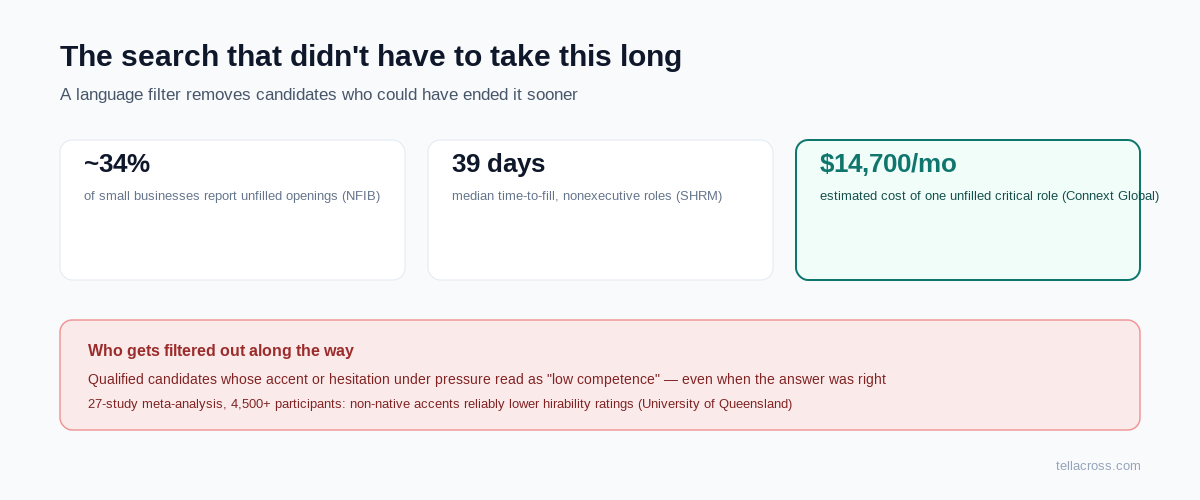
That default has a measurable cost. NFIB's small-business survey has repeatedly found roughly a third of owners reporting job openings they can't fill, and SHRM puts the median nonexecutive time-to-fill at around 39 calendar days — both numbers that get worse, not better, when a process screens out qualified candidates for reasons unrelated to the job.
What the screen is actually catching
It isn't incompetence. A 2025 IZA Institute study on foreign accents and employer hiring decisions found discrimination tied to accent specifically — separate from whether the candidate was understood. A meta-analysis of 27 studies and over 4,500 participants, out of the University of Queensland, found non-native accents reliably lower perceived competence and hirability, independent of what was actually said.
So the candidates getting filtered out at the interview stage aren't necessarily weaker. They're being judged on how fluent they sounded under pressure — a trait with a weak relationship to whether they can do the job.
What you're actually losing
- Experienced tradespeople and technicians trained somewhere the working language wasn't English.
- Strong remote candidates in markets with lower hiring costs and less competition, who don't interview confidently on a first English-language call.
- Capable local candidates — caregivers, drivers, warehouse and hospitality staff — fluent in the job and conversational, not fluent, in the hiring language.
A single critical vacancy costs an estimated $14,700 a month, according to a 2026 Connext Global survey of U.S. hiring leaders — and that number doesn't include the cost of the candidate you rejected in month two who would have ended the search.
The fix is cheaper than the problem
This isn't an argument for lowering your bar. It's an argument for making sure your interview tests the bar you actually care about — skill, judgment, experience — instead of an unrelated fluency test nobody meant to administer. Real-time voice translation on the call does exactly that: your hiring manager speaks normally in their language, the candidate answers naturally in theirs, and both hear a live spoken translation. That's the specific problem TellAcross solves on a video call — not replacing judgment, just removing the language noise from around it.
The best hire you make this quarter may already have applied. The interview just never gave them a way to show it.
Try real-time translation on your next call
Speak your language, they hear theirs — live, both directions. 10 free minutes every month.
Start free — no card needed