Doing business in Mexico — nearshoring's language problem
Mexico ranks 103rd of 123 for English proficiency, and the manufacturing states pulling the nearshoring investment score "very low". Proximity solved the timezone problem. It didn't solve the conversation.
Prakash Vakhesa · September 15, 2026 · 5 min read
Disclosure: we make TellAcross, a call translation tool, and it appears in one section. The rest is about a structural problem in nearshoring that no tool fixes on its own.
The nearshoring case for Mexico is genuinely strong: shared timezones, a land border, trade agreements, and a manufacturing base that has been building for decades. Companies moving production out of Asia keep arriving at the same answer.
Then they discover the part the business case didn't model.
The number is worse than most people expect
Mexico scored 440 on the 2025 EF English Proficiency Index — 103rd of 123 economies, and the score has been falling.
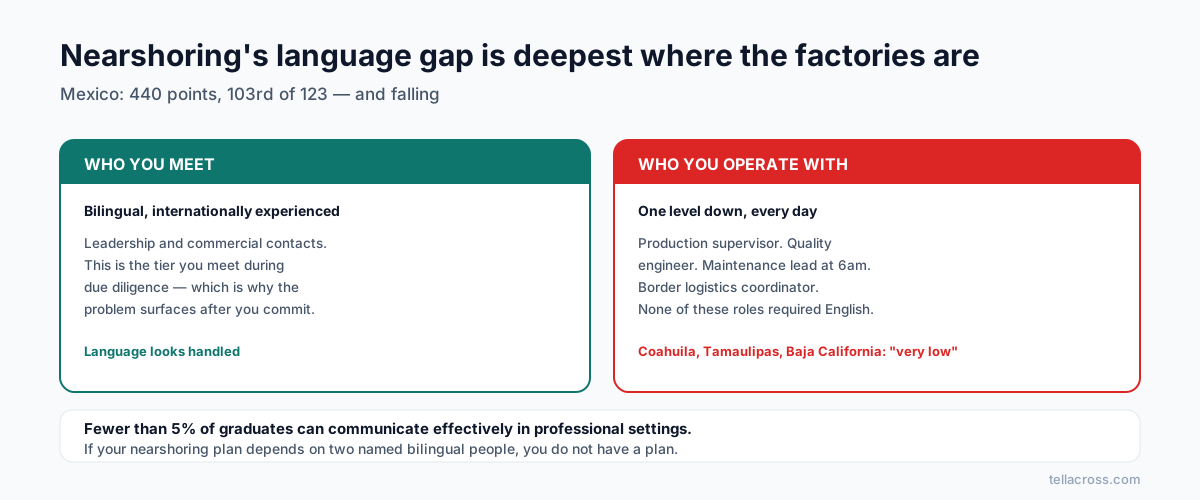
The more alarming figure in the same reporting: fewer than 5% of graduates can communicate effectively in professional settings. Not "are fluent" — can function at work.
And the skill breakdown mirrors the problem you'll actually hit: written expression at 399 and oral expression at 413, both below the overall score. The gap is widest in producing English, which is precisely what a call requires.
The part that should change your site selection
Here's the finding that makes this a structural issue rather than a staffing one. The manufacturing hub states — Coahuila, Tamaulipas, Baja California and Chihuahua — all rank "very low" for English proficiency, despite attracting billions in foreign investment and thousands of jobs that depend on daily interaction with international partners.
The language gap is deepest exactly where the factories are.
This is the opposite of the usual pattern. In most markets the internationally-facing cities are the ones with the investment and the English. In Mexico, nearshoring capital has flowed to border and northern industrial states whose workforces were never selected for English, because they were selected for manufacturing.
One assessment of the boom put it as multilingualism being the missing infrastructure — the concrete, steel and capital are in place, and the people who can operate across languages are not.
What this actually looks like day to day
Your Mexican leadership team and your commercial contacts will be fine. That tier is bilingual and internationally experienced, and it's who you meet during due diligence — which is precisely why the problem doesn't show up until after you've committed.
The friction lands one level down and never leaves:
- The production supervisor who knows why yield dropped this week.
- The quality engineer whose report explains the defect, written in Spanish.
- The maintenance lead on the call at 6am when a line is down.
- The logistics coordinator at the border, where a delay costs money hourly.
These are the people with the answers, and none of their roles required English.
The failure mode: everything routes through two people
What happens in practice is that a plant develops one or two genuinely bilingual staff who become the conduit for every cross-border conversation. It works, and then it becomes the constraint.
They're translating quality reports at 9pm. They're on every call regardless of topic. They're a single point of failure the day one of them takes leave — and they're being paid for a different job than the one they're doing. When they leave, and they do leave because bilingual manufacturing staff in Mexico are in demand, the relationship degrades overnight.
If your nearshoring plan depends on two named people, you don't have a plan.
What actually works
Assume Spanish for anything operational. Work instructions, quality procedures, safety documentation, maintenance manuals. Professionally translated. This is not optional infrastructure — it's the equivalent of wiring the building.
Stop routing every conversation through the bilingual staff. Use them where judgement is needed, not as a switchboard.
Standardise the vocabulary that recurs. Defect categories, tolerance language, machine states, shift handover terms. A short bilingual glossary removes a surprising share of daily misunderstanding.
Read numbers back. Quantities, tolerances, dates, part numbers. Same rule as everywhere, and the same reason: these are the details where an error is most expensive.
Consider English training a real line item, not a perk. If you're staying a decade, it's cheaper than the alternative.
Where a translation tool fits
In the daily operational call with the person who has the answer. The supervisor, the engineer, the maintenance lead. Today those conversations either wait for a bilingual colleague or happen badly in broken English — and the realistic alternative isn't an interpreter, it's a delay.
TellAcross covers that: browser link with nothing to install, Spanish both directions, exportable transcripts for the quality file, per-minute pricing because plant issues don't schedule themselves. Ten free minutes a month is enough to test on one shift-handover call.
Not for the work instructions or safety documentation. Those are written, permanent and consequential — pay a human translator.
Not for HR matters, discipline or anything with legal exposure. Get a qualified interpreter.
And not as a substitute for hiring bilingual supervisors if you're operating at scale. This narrows the gap; it doesn't remove the need for people who live in both languages.
The honest summary
Nearshoring to Mexico solves distance, timezone and tariffs. It does not solve the conversation, and the data says the conversation is hardest in exactly the states where the investment is going.
The companies that struggle aren't the ones who ignored language — they're the ones who checked it during due diligence, met a fluent leadership team, and concluded it was handled. Check one level down from whoever you're negotiating with. That's where you'll actually be operating.