Working with Vietnamese and Indonesian suppliers — the communication gap that costs you margin
The suppliers with good English are the ones everyone already uses. The cheaper, better-fit factories are harder to talk to — and in high-context cultures a confident "yes" is often the most expensive answer you'll get.
Prakash Vakhesa · September 10, 2026 · 5 min read
Disclosure: we make TellAcross, a call translation tool. It fits one part of this and is useless for the rest — I'll be specific about which.
Companies diversifying away from single-country sourcing land on Vietnam and Indonesia for good reasons. Then they discover that the language situation is not what the summary articles promised, and that the problem isn't where they expected it.
Vietnam: the two-tier supplier market
You'll read that Vietnamese suppliers have good familiarity with Western business practice and high English proficiency. That's true — of a specific tier.
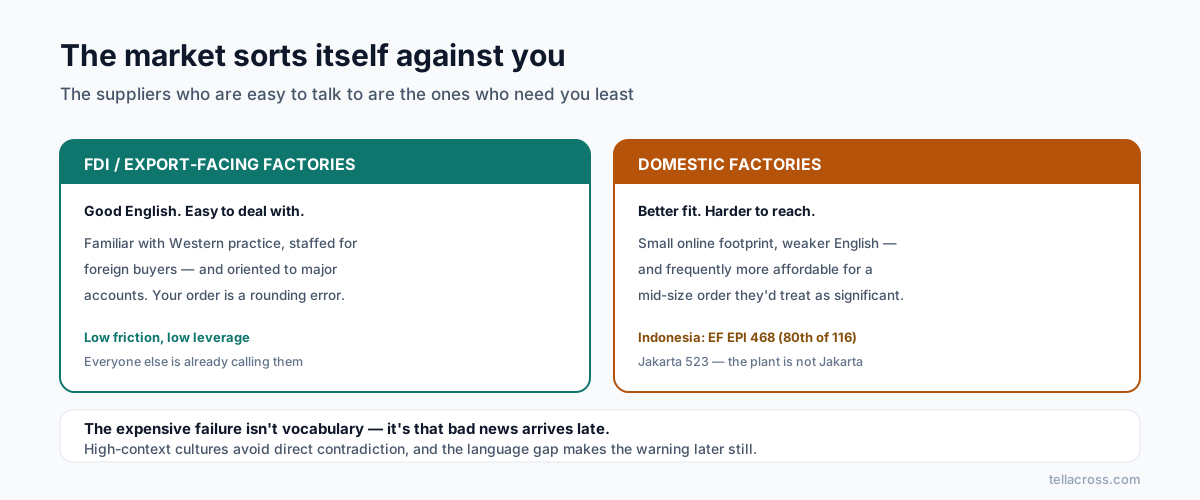
Foreign-invested (FDI) manufacturers are generally comfortable in English, but these are the larger suppliers oriented toward major buyers. Domestic Vietnamese firms are a different proposition: harder to find because of a small online footprint, and harder to deal with because of weaker English — while frequently being the more affordable and better-fit option for a mid-size order.
So the market sorts itself neatly against you. The suppliers who are easy to talk to are the ones already serving buyers much bigger than you, where your order is a rounding error and your leverage is nil. The suppliers who would treat your business as significant are the ones you can't easily hold a conversation with.
That's not a reason to avoid the second tier. It's a reason to solve the conversation.
Indonesia: a wider gap, concentrated in the cities
Indonesia is harder. English proficiency among factory staff varies widely, and the country ranks 80th of 116 on the EF English Proficiency Index with a score of 468.
The distribution matters more than the average. Proficiency is notably higher in Jakarta, at 523, and in other major cities. Your Jakarta-based trading contact will be fine. The production supervisor at the plant — the person who knows why your tolerances slipped — very often won't be.
The expensive part isn't vocabulary
Vietnam and Indonesia, like China, are high-context cultures where indirect communication is normal. This produces the single most costly pattern in Asian sourcing, and it has nothing to do with anyone's English.
Asked whether a deadline is achievable, a supplier will often say yes even knowing they probably can't make it, because directly contradicting a customer damages harmony. And a factory manager who has made a mistake will rarely raise it with a foreign buyer, because the cost of admitting failure is high — so problems get minimised and quietly worked around until they surface as a shipment that isn't what you ordered.
One bilingual project-management consultancy puts numbers on the downstream effect, citing research that communication issues cost importers an average of 12–18% in extra logistics costs and 8–15% in quality-related expenses through rework, returns and expedited freight. Treat the exact figures as indicative rather than authoritative — but the direction is one every experienced buyer recognises.
What actually works
Stop asking yes/no questions about capacity. "Can you make the 14th?" reliably returns yes. "Walk me through what happens between today and the 14th" returns a plan, and a missing step in that plan is visible to both of you without anyone losing face.
Ask about the problem indirectly. "What's the part of this order most likely to slip?" gives a supervisor permission to raise something without it being a confession.
Read numbers back, every time. Quantities, tolerances, dates, container numbers. This is where cross-language calls fail most often and where errors cost the most.
Confirm in writing after every call, in both languages, with the specifics restated. Not as a legal exercise — as a comprehension check that either side can correct cheaply.
Talk to the plant, not only the trading contact. The person who knows why quality moved is rarely the person who speaks the best English. A sourcing partner or local agent is one way to bridge this; being able to hold the call yourself is another, and it doesn't add a party with their own interests.
Video beats voice for anything physical. A walkthrough of the line resolves in two minutes what an email thread won't resolve at all.
Where a translation tool fits
It fits the production conversation. Weekly updates, quality questions, the call with the supervisor when something has moved. These are frequent, operational, time-sensitive, and today they mostly don't happen — the realistic alternative isn't a professional interpreter, it's waiting for an email that answers a slightly different question tomorrow.
TellAcross covers that: browser link with nothing for the factory to install, Vietnamese and Indonesian both directions, exportable transcripts for your quality file, per-minute pricing. Ten free minutes a month is enough to try it on one real production call.
It does not fit contract negotiation, quality claims or compliance documentation. Hire a qualified human interpreter and a professional translator. If a conversation could end up in a dispute, it needs a person who is accountable for the words.
And it does not fix the yes problem. Better translation of a face-saving "yes" is still a face-saving "yes". That one is fixed by how you ask, not by what language you ask in.
The honest summary
The language barrier in Vietnam and Indonesia is real but it's not the thing that costs you money. What costs you money is that high-context communication makes bad news arrive late — and the language gap makes it later, because the person who could have told you early is the one you can't talk to.
Fix your questions first; that's free and it's most of the benefit. Then make sure that when you need the supervisor rather than the sales contact, "we can't have that conversation" isn't the reason a problem waits three weeks.