Selling to Chinese clients when you don't speak Mandarin
China ranks in the "low" band for English proficiency, and the standard advice — bring your own interpreter — exists because whose interpreter it is changes what you're told. What that means in practice.
Prakash Vakhesa · September 8, 2026 · 5 min read
Disclosure: we make TellAcross, a call translation tool, and I'm going to spend a section explaining where it should NOT be used in this market. That's not modesty — for high-stakes negotiation in China the honest recommendation is a human interpreter you hired.
Most guides to doing business in China open with guanxi and end with advice about business cards. The thing that actually determines how your first year goes is duller and more concrete: who is doing your translating, and who pays them.
The gap is genuine
China ranks #86 globally on the EF English Proficiency Index with a score of 455 — the "low" band, having slipped from "moderate" in the early 2020s.
That headline understates the variation, which is what matters operationally. Proficiency is meaningfully higher in Shanghai, Beijing, Tianjin and Jiangsu than elsewhere. So an export-facing sales manager in Shenzhen may be entirely comfortable in English, while the factory owner in a second-tier city — who has the capacity you want and fields far fewer foreign enquiries — is not.
The pattern is the same one that shows up in every market like this: the people who speak English are the people everyone is already talking to.
The advice everyone gives, and the reason behind it
The standard recommendation for serious China negotiation is to bring your own interpreter. The reasoning is worth stating plainly, because it isn't about language quality.
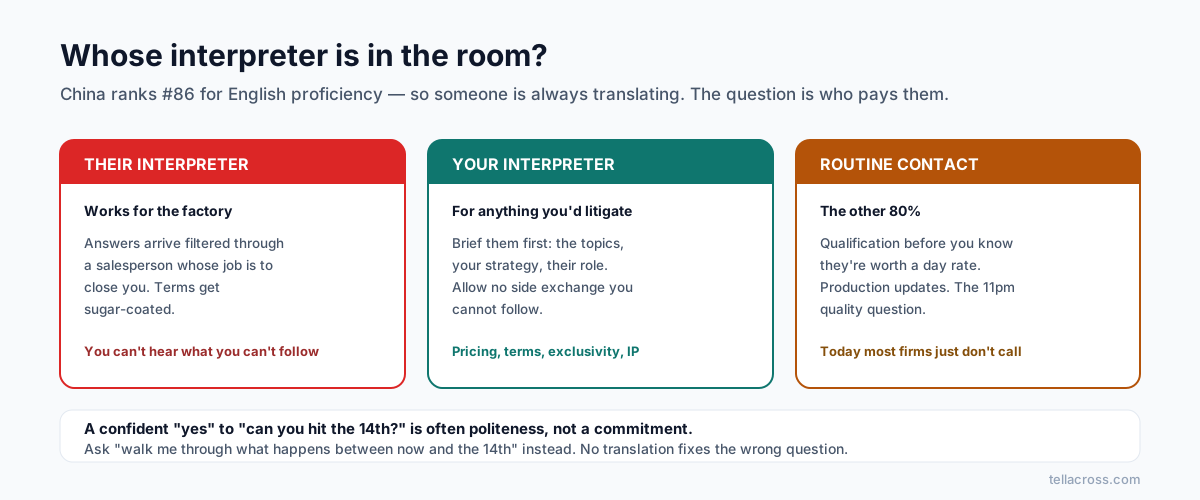
An independent interpreter doesn't work for the factory and is more likely to have your interests at heart, without sugar-coating the terms of an agreement. You also get direct answers rather than information filtered through a salesperson whose job is to close you.
The sharper version of the warning: if you hire an interpreter locally at short notice, the service may fall well short of what you need, and the specific failure to guard against is any exchange between your interpreter and the other side that you can't follow. The same source recommends briefing your interpreter beforehand on the topics, your strategy, and their role in the meeting.
That last point is the one people skip. An interpreter who doesn't know your negotiating position will smooth things over helpfully and cost you the deal terms without either of you noticing.
The "yes" that isn't
China is a high-context culture where indirect messages are normal and meaning is carried by context, relationship and tone as much as by the words.
The practical consequence is well documented and expensive: asked whether they can hit a deadline, a supplier will often say yes even when they know they probably can't, because preserving harmony and avoiding direct confrontation is the norm. A buyer who builds a production schedule on that yes is, as one sourcing consultancy puts it, three weeks from a crisis they didn't see coming.
The same dynamic means a factory manager who has made a mistake will rarely raise it directly with a foreign buyer, because the cost of admitting failure is high. Problems get minimised and worked around quietly until they can't be.
This is not a translation problem and better translation will not fix it. It's a question-design problem. "Can you hit the 14th?" invites a yes. "Walk me through what happens between now and the 14th" doesn't — it requires a description of reality, and gaps in that description are visible to both of you.
Negotiation runs longer than you planned
The classic Harvard Business Review treatment of the Chinese negotiation remains accurate on the fundamentals: relationship before transaction, patience as a genuine tactic, and an expectation that the discussion continues after the point a Western counterpart would consider it settled.
Budget for more meetings than feels reasonable, and treat a signed contract as the start of the relationship rather than the conclusion of the negotiation.
Where a translation tool fits — and where it doesn't
Not in the negotiation. For contract terms, pricing, exclusivity or anything you'd litigate over, hire a qualified human interpreter, brief them, and make sure nothing gets said that you can't follow. This is the clearest "don't use our product" case in anything I've written.
Not for contracts, filings or IP. Human translation with accountability, every time.
It does fit the volume around the deal. First contact and qualification, before you know whether this supplier is worth an interpreter's day rate. Routine production updates. The quality question at 11pm that can't wait for a scheduled interpreter. The conversation with a plant engineer who has the answer and no English.
That's a real and frequent category, and today most firms handle it by not having the conversation. TellAcross covers it — browser link with nothing to install, Chinese both directions, exportable transcripts, per-minute pricing because these calls are unpredictable. Ten free minutes a month is enough to test it on one supplier call.
The honest summary
China's language barrier is real, the English-speaking counterparts are the ones already saturated with foreign enquiries, and the highest-leverage decision you make is who translates for you when the money is on the table. Hire your own for that, brief them properly, and never let a conversation happen in the room that you can't follow.
For everything else — the eighty percent of contact that is qualification, updates and problem-solving — the realistic alternative to a translated call isn't an interpreter. It's silence until someone's schedule allows. That's the gap worth closing.