You're qualified, not fluent — why language shouldn't cost you the job
Limited English proficiency alone cuts pay by a quarter to 40 percent, and accent bias shapes interview outcomes before a word of substance is judged. What's happening, and how candidates can work around it.
Prakash Vakhesa · October 27, 2026 · 3 min read
Disclosure: we make TellAcross, a real-time call translation tool, and it's mentioned in the last section. Most of this post is about what the research says happens in interviews, which matters more than any tool.
You can rebuild an engine, close a sale, or ship production code — and still get passed over in an interview because your English isn't fluent. That's not a skills gap closing against you. It's a language gap, and the data on how it plays out in hiring is more specific than "it's harder."
The size of the gap
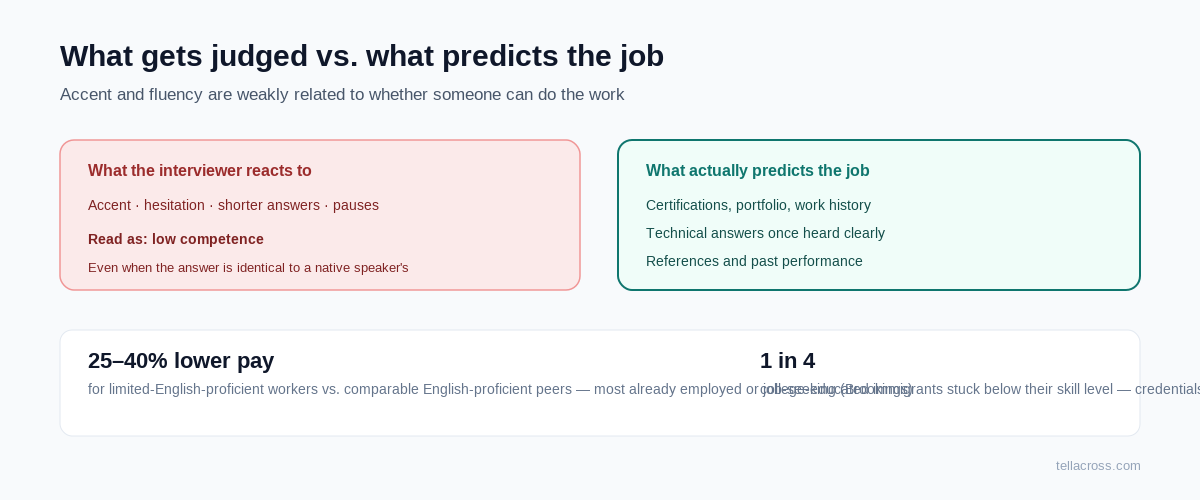
Nearly one in 10 working-age U.S. adults — 19.2 million people aged 16 to 64 — have limited English proficiency, according to Brookings. The same analysis found that working-age LEP adults earn 25 to 40 percent less than English-proficient adults with comparable backgrounds — and most of that population is already working or looking for work, not sitting out of the labor market.
Separately, among college-educated immigrants specifically, the Migration Policy Institute found that one in four were stuck in low-skilled jobs or unable to find work at all — a pattern researchers call "brain waste," driven by two factors: foreign credentials not being recognized, and limited English proficiency. That underutilization costs the U.S. economy an estimated $39 billion a year in forgone wages.
It isn't really about comprehension
A 2025 IZA Institute discussion paper on foreign accents and employer beliefs found hiring discrimination tied specifically to accent — independent of whether the candidate was actually understood. A broader meta-analysis covering 27 studies and over 4,500 participants, led by researchers at the University of Queensland, found that non-native accents trigger lower hirability and competence ratings even when the underlying answer is identical to a native speaker's.
In other words: an interviewer isn't usually rejecting a candidate because they failed to understand the answer. They're reacting to how the answer sounded, and reading hesitation or accent as a proxy for competence it has nothing to do with.
What this means if you're job hunting across a language barrier
- A written application or portfolio usually gets you a fair read. The live interview is where accent and fluency bias actually show up — so that's the stage to plan for, not the resume.
- Say upfront that you'd like to use a real-time translation tool for the conversation. Framed correctly, this reads as someone taking the process seriously, not as a weakness.
- Prepare your strongest points — experience, outcomes, specific examples — in the language you think fastest in, rather than trying to compose them live in a second language under pressure.
Where translation actually helps
A live, spoken translation tool changes what the interviewer is reacting to. Instead of parsing an accent while you search for words, they hear a clear, natural-paced translation of exactly what you said — in their own language, in real time. That's the specific gap TellAcross is built to close on a video call: each person speaks the language they're strongest in, and the conversation runs as a normal back-and-forth instead of a performance under a fluency test nobody meant to administer.
The research is consistent: fluency and competence are only weakly related, and interviews conflate them anyway. You don't need to sound like a native speaker to prove you can do the job. You need the interview to actually hear what you did.
Try real-time translation on your next call
Speak your language, they hear theirs — live, both directions. 10 free minutes every month.
Start free — no card needed