Remote work is global now — so why are job interviews still English-only?
Remote hiring routinely expands candidate pools by hundreds of percent, yet the interview itself still assumes fluent English on both sides. The mismatch is a process gap, not a necessity.
Prakash Vakhesa · October 29, 2026 · 2 min read
Disclosure: we make TellAcross, a real-time call translation tool, mentioned in the last section.
A company can hire a developer in Manila, a designer in Lagos, or a support lead in São Paulo without either side leaving their home office. Remote work settled that question years ago. So why does the interview that precedes the hire still assume both people speak the same language fluently?
Remote hiring already expanded the pool — on paper
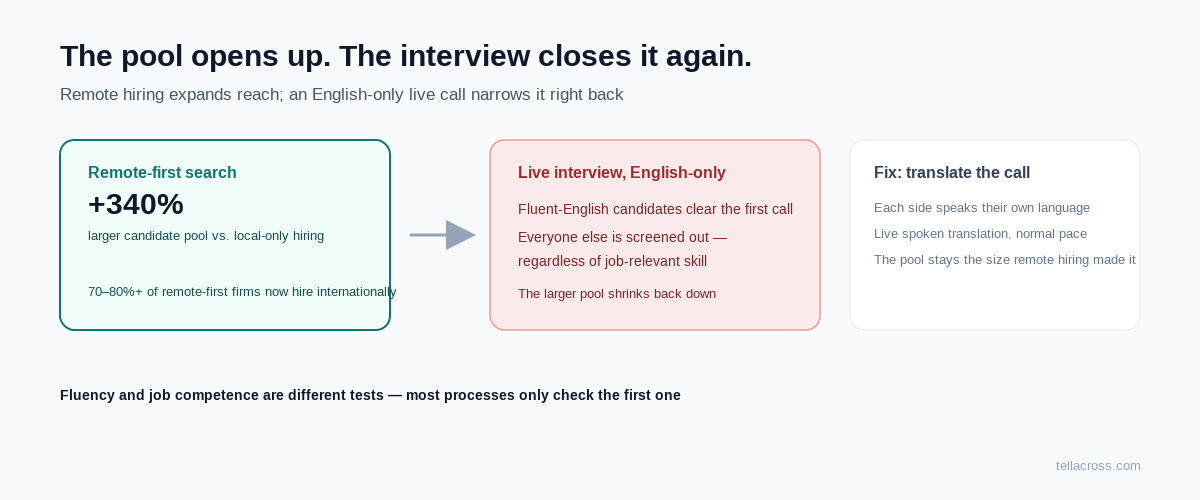
Remote-first recruiting regularly reports dramatically larger applicant pools than local hiring — one recent analysis put it at roughly 340% larger candidate pools for remote roles, and industry surveys now put the share of companies hiring internationally for remote roles above 70-80% in several reports. Companies openly compete for this talent on cost and skill. What most of them haven't changed is the interview itself, which is still conducted entirely in the hiring company's language, live, under pressure, usually on the first call.
Fluency and competence aren't the same test
Someone can read technical documentation fluently, write clean commits, and collaborate well asynchronously — and still freeze up in a live, unscripted interview conducted in their second language. That's a specific, narrow skill: live spoken fluency under time pressure. It has little to do with whether someone can do the job once hired, and the accent-bias research is clear that interviewers read hesitation as a competence signal even when it isn't one.
A company that screens on live English fluency alone is filtering for interview performance, not job performance — and doing it at exactly the stage (the first live call) where that mismatch is most likely to cost them a strong hire.
What a process built for global hiring actually does differently
- Separates "communicates clearly in writing/async" from "is fluent in live spoken English" — for most remote roles, these are genuinely different requirements, and conflating them narrows the pool for no operational reason.
- Runs the technical or judgment evaluation (code review, work sample, portfolio walkthrough) as the primary signal, rather than how smoothly someone performs live.
- Uses real-time spoken translation on the interview call itself, so each person speaks the language they're strongest in and is heard clearly and at normal pace in the other's.
That last point is where TellAcross fits: a normal video call where each side speaks their own language and hears a live spoken translation of the other, so the conversation tests what the candidate actually knows rather than how they perform under a language test nobody intended to run.
Remote work already proved that strong candidates don't have to live where you do. The obvious next step — one most companies haven't taken yet — is building an interview process where they don't have to sound like you, either.
Try real-time translation on your next call
Speak your language, they hear theirs — live, both directions. 10 free minutes every month.
Start free — no card needed