Selling to Brazilian and Latin American clients — Portuguese isn't Spanish
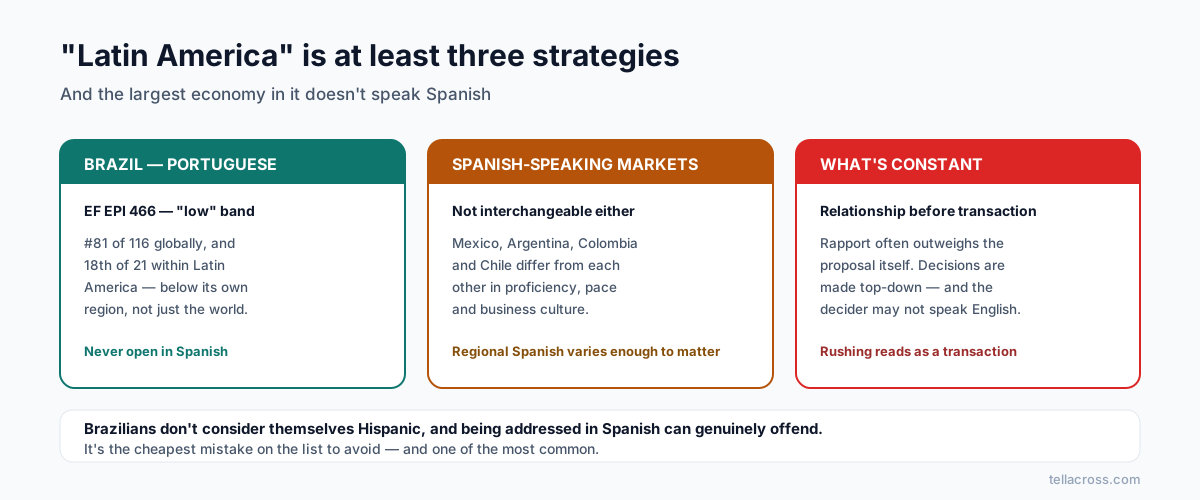
Brazil's English proficiency sits in the "low" band, and the most common opening mistake is treating Latin America as one Spanish-speaking market. What actually matters when the relationship is the product.
Prakash Vakhesa · September 5, 2026 · 5 min read
Disclosure: we make TellAcross, a call translation tool. It appears once, in the place it fits. Most of this post is about how Brazilian business actually works, which matters more than any tool.
Latin America gets treated as one market more often than any other region, and Brazil is where that assumption does the most damage. It's the largest economy in the region, it doesn't speak Spanish, and its business culture rewards a kind of patience most foreign vendors don't budget for.
Start with the mistake that costs nothing to avoid
Brazilians do not consider themselves Hispanic, and may take offence at being addressed in Spanish. Assuming Spanish reads as not distinguishing Brazil from the rest of the continent — which, to a Brazilian, is roughly like greeting a Japanese client in Mandarin.
This is the cheapest mistake on the entire list to avoid, and it happens constantly. Even a few words of Portuguese signals a willingness to adapt, and the effort is noticed disproportionately because so few foreign vendors make it.
The wider point holds too. "Latin America" spans Portuguese-speaking Brazil, Spanish-speaking markets whose business cultures differ substantially from each other, and regional Spanish that varies enough to matter. A single "LATAM strategy" is usually three or four strategies wearing a trench coat.
The language gap is real, and bigger than people expect
Brazil scores 466 on the EF English Proficiency Index — the "low" band, ranked #81 of 116 countries and 18th of 21 in Latin America.
That last number is the surprising one. Brazil isn't just below the global average; it's near the bottom within its own region. If your experience of Latin America came from Argentina or Mexico, Brazil will feel harder than you expected.
As everywhere, this varies by role. Your counterpart in a São Paulo multinational will likely be fine in English. The founder of a mid-size industrial firm in Minas Gerais, who has the budget and the need, often won't be — and nobody is calling them, which is precisely why they're worth calling.
Trust is not a step in the process. It is the process.
Brazilian business revolves around personal connections, with personal rapport often mattering more than the proposal itself. Conversations open with friendly small talk and coffee, and treating that as a delay to get through is the single clearest signal that you don't understand the market.
This is genuinely difficult for vendors from transactional cultures. The instinct is to demonstrate value quickly and respect the buyer's time by getting to the point. In Brazil, getting to the point too quickly is the failure — it reads as someone who wants a transaction rather than a relationship, and relationships are what get renewed.
A practical consequence: budget more calls than you think you need, and don't measure the early ones by whether they advanced the deal.
Know who actually decides
Decision-making is top-down, with senior management making the final call even where input is gathered widely. Identifying that person early and treating them with appropriate deference speeds everything up.
The corollary matters for language: the decision-maker is often not the English-speaking manager you've been dealing with. Your carefully-built case gets relayed to them second-hand, by someone who is translating both language and enthusiasm. That's where deals quietly die — not in your meeting, but in the summary of it you never see.
Jeitinho, and what it means for your contract
You'll encounter jeitinho — a distinctly Brazilian orientation toward creative workarounds within rigid structures. Flexibility is valued over rigid positions.
Read this correctly. It doesn't mean commitments are loose. It means that when an obstacle appears, the expected response is to find a way around it together, rather than to point at the contract. A vendor who responds to every complication with "that's out of scope" will be seen as difficult in a way that damages the relationship well beyond the specific issue.
What actually works
Portuguese for Brazil. Always. Materials, proposals, the first email. Professional human translation for anything you're paid for.
Invest in the relationship before the pitch. Multiple conversations, real interest, patience. The transactional approach actively harms you.
Get to the actual decision-maker, and accept that this may mean a conversation in Portuguese rather than English.
Be flexible when problems arise. Solve first, allocate blame never.
Don't assume Spanish works anywhere it wasn't invited — including in the Spanish-speaking markets, where regional differences are real.
Where translation fits, honestly
On calls with the people who don't speak English — the founder, the plant manager, the family owner who actually signs. Real-time translation means they speak Portuguese and you speak your language, and neither of you is operating at a disadvantage. That's what TellAcross does: browser link, nothing for them to install, Portuguese both directions, exportable transcripts. Ten free minutes a month is enough for one real discovery call.
Not for contracts or filings. Those need professional human translation with accountability.
Not as a substitute for the relationship. Translation gets you into the room. In Brazil, what happens after that is measured in months.
The honest summary
Brazil has the language barrier of a market people avoid and the economy of a market they can't afford to. Those two facts together are the opportunity.
The mistakes that cost you are cheap to avoid: don't speak Spanish at Brazilians, don't rush the relationship, and don't assume the English-speaking contact is the person deciding. Get those three right and you're already ahead of most foreign vendors who call.