How suppliers win overseas buyers they can't fully talk to
Cross-border deals rarely stall on price. They stall on the call — the moment a promising enquiry moves from translated text to a live conversation neither side can hold smoothly. Here's the part that closes the gap.
Prakash Vakhesa · August 19, 2026 · 3 min read
A buyer in Germany finds your product on a B2B marketplace. The specs look right, the price is competitive, the photos are good. They want to talk — about tolerances, minimum order quantities, lead times, payment terms. So they get on a call.
That's where a lot of promising deals quietly die. Not on price. Not on quality. On the conversation.
If you manufacture or wholesale for export, you know the feeling. The messages go fine, but the moment things move to a live call the language gap turns a confident negotiation into a slow, uncertain exchange. The buyer can't gauge whether they can trust you; you can't fully understand what they need; and a deal that should have closed drifts to a competitor who happened to communicate a little more smoothly.
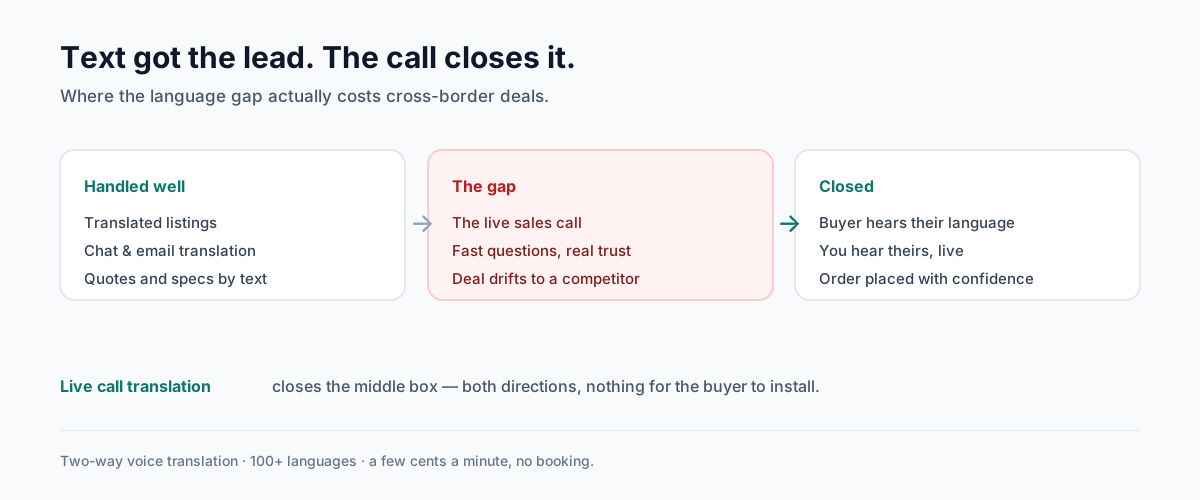
Text got you the lead. The call closes it.
Cross-border trade has become very good at the text layer. Translated listings, chat apps with built-in translation, email — a buyer on the other side of the world can find you and open a conversation without either of you thinking about language.
But real orders, especially large or custom ones, don't close over text alone. Buyers want a call. They want to hear you, ask fast follow-up questions, and get a read on whether you're a reliable partner before they wire money to another country. That live conversation is where trust is built — and it's the one layer where the language barrier hits hardest.
Typing every sentence into a translation app during the call doesn't cover it. It's slow, it's cold, and it signals exactly the uncertainty you're trying to overcome.
Why the obvious tools don't fit a sales call
- A hired interpreter works for a scheduled negotiation, but it's expensive, has to be booked, and adds a third person to a deal you'd rather keep direct.
- Typing into a translation site mid-call kills momentum and warmth.
- A meeting platform's built-in translation assumes your buyer is on that specific platform, on a paid plan, and covers only a handful of language pairs — most of Asia is missing. A buyer who just wants a quick call to check on an order isn't going to set that up first.
For a fast, trust-building sales call you need translation that's instant, two-way, and requires nothing from the buyer.
Translate the call, live, with nothing for the buyer to install
The approach that fits is to translate the live conversation in both directions in about a second. You speak your language; the buyer hears theirs; they respond and you hear it back — over a hundred languages. The buyer installs nothing: they click a link in any browser, or join the call as usual. No app, no account, no friction.
That's what TellAcross does, and for an exporter it unlocks a few things. You can sell into markets you don't speak — German, French, Spanish, Arabic and Japanese buyers handled with one tool instead of a hire for each language. The call stays fast and human, which is exactly what earns a cautious overseas buyer's trust. And the cost is a few cents a minute, in the range of fifteen to twenty-four cents, with no booking and no minimum — not an interpreter's meter running through every negotiation.
Trust is the real product in cross-border trade
When someone is sending money abroad for goods they haven't seen, from a supplier they've never met, they aren't only buying a product — they're deciding whether to trust you. Almost all of that decision happens in conversation. The supplier who can talk clearly and warmly in the buyer's own language doesn't just answer questions faster; they feel like the safer choice.
In a market where buyers have a dozen suppliers to pick from, being the one they can actually talk to is a real edge.