Can your bilingual staff interpret for patients? Almost certainly not
Qualified interpreter" is a defined regulatory term, and fluency alone doesn't meet it. What the standard actually requires, and why relying on bilingual staff is now a compliance exposure.
Prakash Vakhesa · August 11, 2026 · 3 min read
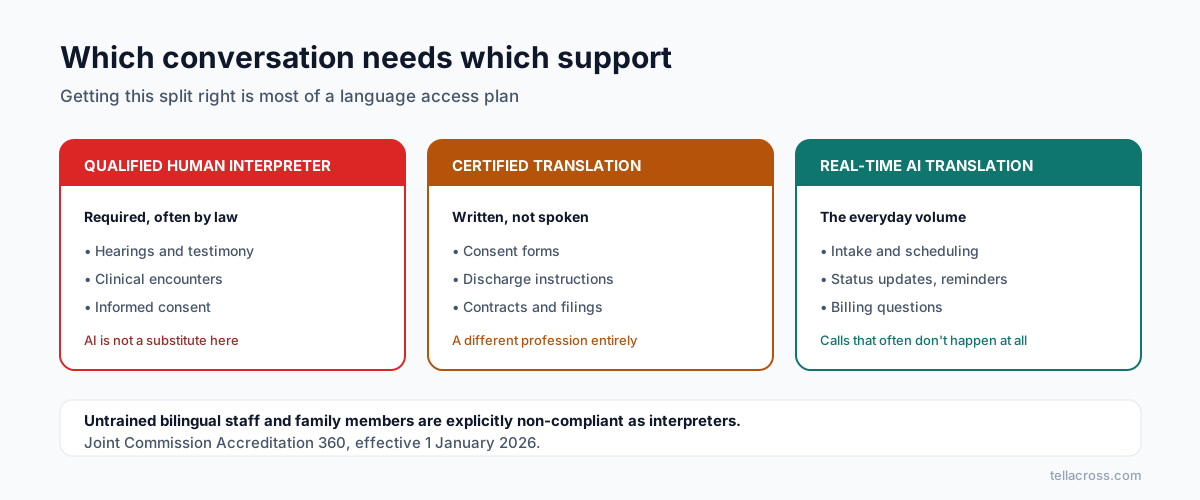
It's the most natural thing in the world. A patient arrives who speaks only Spanish, and someone says "get Maria from reception, she speaks Spanish." It solves the immediate problem, it's free, and it's been done that way for years.
Under the current rules it's also a compliance exposure, and the reasons are worth understanding properly rather than treating as bureaucracy.
What "qualified interpreter" actually means
The term is defined, not descriptive. A qualified interpreter must:
- be proficiently bilingual in both languages
- interpret effectively, accurately and impartially
- know the specialised vocabulary of the setting
- keep the message intact — including tone, sentiment and emotion
- adhere to interpreter ethical principles
The guidance states plainly that being bilingual alone does not make an employee qualified to interpret, and that interpreters must be familiar with the specialised terminology involved.
Maria may satisfy the first condition completely and none of the others.
The four requirements fluency doesn't cover
Specialised vocabulary. Everyday fluency doesn't include anticoagulant, contraindication, deductible or prior authorisation — in either language. A receptionist fluent in conversational Spanish may have no idea how to render a medication warning, and no way to signal that she's unsure.
Impartiality. A colleague has views. They know the doctor, they know how busy the clinic is, and they may unconsciously smooth over a patient's objection or hesitancy to keep things moving.
Keeping the message intact, including tone. Interpreting isn't paraphrase. If a patient is frightened, that fear is clinical information. Untrained interpreters routinely deliver the content and drop the affect — which is exactly the signal a clinician needed.
Interpreter ethics. Trained interpreters follow rules on completeness, first-person rendering, and flagging when they can't interpret something. That last one is critical: knowing to say "I don't have a word for this" is a learned professional behaviour, not an instinct.
Why this became urgent in 2026
Under the Joint Commission's Accreditation 360 framework, effective January 2026, language access is a formal patient safety requirement and the use of untrained bilingual staff or family members as interpreters is explicitly non-compliant.
Not discouraged. Named.
The cost nobody accounts for
There's a second problem that has nothing to do with regulation: you're taking someone away from their actual job.
Every time Maria interprets, reception isn't covered. She may be interpreting for forty minutes of a complex consultation. Nobody logs this, nobody budgets for it, and it's typically the busiest staff member because they're the one who's always there. It's an unmanaged cost that shows up as reception being short-staffed for reasons nobody can quite explain.
What to do instead
For clinical encounters: engage qualified interpreters — staff who have been trained and assessed, or a professional service. This is the requirement and there's no way around it.
If you have genuinely bilingual clinical staff: get them trained and assessed as interpreters. Several programmes exist for exactly this. Then they are qualified, and you have documentation proving it — which is what the evidence standard now asks for.
Write the policy down. Front-desk staff need to know they're expected to book an interpreter rather than improvise, and that declining to interpret is the correct action, not unhelpfulness. Without a written policy the informal practice always wins, because it's faster in the moment.
For non-clinical contact — appointment reminders, directions, billing questions, document chasing — real-time translation is a reasonable fit, and it takes that volume off your bilingual staff so they're free for their actual roles. That's where a tool like TellAcross belongs. It does not make you compliant for the clinical encounter, and nobody should tell you otherwise.
The uncomfortable summary
If your language access plan is "several of our staff speak Spanish", you don't have a language access plan — you have an informal arrangement that the 2026 framework specifically identifies as non-compliant, staffed by people whose actual jobs are being quietly interrupted.
The fix isn't expensive. But it does have to be deliberate.