Can a law firm just use Google Translate for client calls?
Google, Apple and Microsoft all have live translation now, so it's a fair question. The honest answer for a law firm comes down to one detail — what the person calling your office actually has on their end.
Prakash Vakhesa · August 21, 2026 · 3 min read
It's a reasonable question, and by 2026 more firms are asking it. Real-time translation stopped being science fiction — Google, Apple and Microsoft all ship it now. So before paying for anything purpose-built, it's worth asking plainly: can a firm just lean on the free and near-free tools everyone already has?
The answer isn't "no." It's "for some calls, yes — but not the one that matters most to you." And the reason comes down to a single detail most comparisons skip: what the person on the other end of the line actually has.
What the big platforms actually require
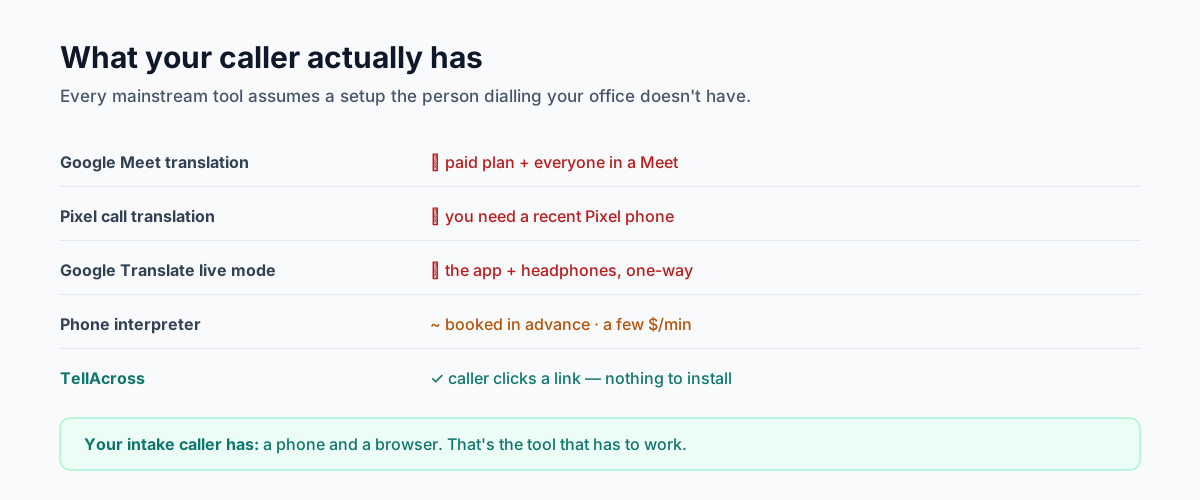
Each mainstream option quietly assumes a setup:
- Google Meet's speech translation works only when everyone is inside a Google Meet, and at least one side is on a paid Google AI or Workspace plan — roughly $14–$20 per user per month. It also covers only a handful of language pairs today. (We broke the platforms down in Google Meet, Zoom and Teams compared.)
- Pixel's on-device call translation translates phone calls, but only if you are holding a recent Pixel phone.
- Google Translate's live mode is a one-way consumer feature that needs the app and a pair of headphones.
Every one of these puts the burden on a device or account that someone controls in advance. That's fine when both parties are colleagues, friends or travellers who set things up. It falls apart for the call a law firm cares about.
Your intake caller has none of that
Picture the actual scenario. A prospective client who doesn't speak English found you on Google and dialled your number. They are a stranger, often stressed, sometimes unfamiliar with technology, calling from whatever phone they own. They are not in a Google Meet. They don't have a paid Workspace seat. They're not on a Pixel, and they're not wearing paired earbuds running a translation app.
The single moment you most need translation — the cold inbound intake call — is the exact moment the consumer tools were not built for. Asking a nervous first-time caller to install an app or join a meeting before you'll speak to them isn't a workflow. It's how you lose the call.
The cost math doesn't rescue the idea either
Suppose you standardised on Meet translation anyway. It's priced per seat, so a six-person office lands around $84–$120 a month — and you still have to get every non-English caller into a Google Meet before you can talk. For an inbound phone call, that's not realistic.
The other common fallback, a per-minute phone interpreter, works but runs a few dollars a minute, has to be booked, and drops a stranger into a privileged conversation. (We put real numbers on that in what a phone interpreter actually costs.)
What an intake call actually needs
Translating an intake call is a different job from translating a conference call. It needs three things the consumer features don't offer together: nothing for the caller to install, accuracy on legal terms that can't be garbled, and a company behind it when something breaks on a Friday afternoon.
That's the gap TellAcross fills. It translates the live call both directions in about a second — you speak English, the caller hears their own language, you hear them back in English. The caller installs nothing; they click a link in any browser. It runs at a few cents a minute, in the range of fifteen to twenty-four cents, with no booking and no minimum, and a mode tuned to keep legal terminology intact.
Where each tool honestly fits
To be fair — and you should distrust anyone who says a giant's product is useless — Google's tools are genuinely good for travel, personal calls and internal meetings where everyone is already on the same platform. TellAcross is built for the one case those skip: an inbound call from a client who has none of your technology and speaks none of your language.
Different jobs. The firms that keep confusing the two are the ones losing clients that a clearer first call would have signed.