Interpreter agency vs AI translation — which is cheaper at your call volume
The comparison isn't per-minute rate against per-minute rate. Minimums, scheduling overhead and unplanned calls decide it — and the answer flips depending on how your calls are shaped, not how many you have.
Prakash Vakhesa · October 6, 2026 · 4 min read
Disclosure: we make TellAcross, so treat the framing as interested. The model below is one you can run yourself with your own numbers, which is the point — I'd rather give you the method than a conclusion.
Most comparisons of interpreters and AI translation put two per-minute rates side by side and declare a winner. That's the wrong model, and it produces the wrong answer for most organisations.
The rate isn't what determines your cost. The shape of your calls is.
The three things that actually drive cost
Billing minimums. Phone interpreting is usually sold with a connection minimum. If your typical call is three minutes and your minimum is fifteen, you're paying five times the headline rate. This single factor swamps rate differences between vendors. Our breakdown of interpreter cost per minute covers the rate side; the minimum is what people forget to model.
Scheduling overhead. A booked interpreter costs staff time to arrange, and creates a delay between "we need this conversation" and "we can have it". That delay has a cost even when it isn't invoiced — a claim that waits three days, a patient who reschedules, a supplier issue that compounds.
The calls you don't make. The largest hidden cost, and it never appears on any invoice. When a conversation requires booking an interpreter, marginal conversations simply don't happen. The follow-up call, the "quick question", the check-in. You can't see this line item, which is exactly why it's usually the biggest one.
Sort your calls into four shapes
Before comparing prices, categorise your actual call volume. Most organisations have never done this and are surprised by the result.
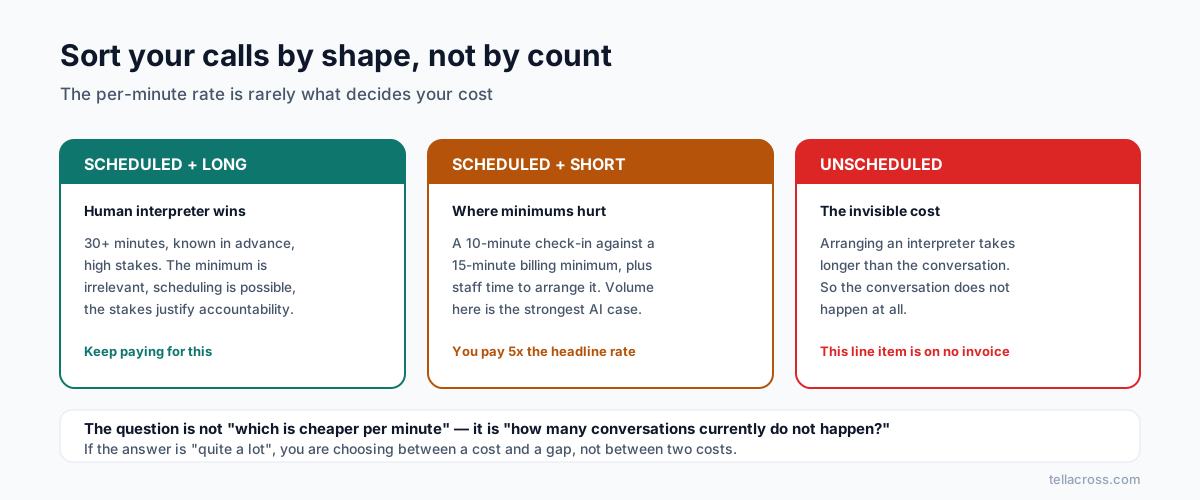
Scheduled and long. A consultation, a formal interview, a negotiation. Known in advance, 30+ minutes, high stakes. → A human interpreter is correct here, and usually cost-effective too. The minimum is irrelevant on a long call, scheduling is possible because it's planned, and the stakes justify the accountability.
Scheduled and short. A ten-minute check-in that has to happen at 2pm on Thursday. → This is where minimums hurt most. You pay a fifteen-minute minimum plus arrangement time for a ten-minute conversation. High volume of these is the strongest case for a per-minute AI tool.
Unscheduled and short. Someone at the desk, a call that just came in, a supplier ringing about a delay. → Interpreters are structurally poor here — not because they're worse, but because arranging one takes longer than the conversation. The honest comparison isn't interpreter versus AI, it's AI versus not having the conversation.
Unscheduled and high-stakes. An emergency, an incident, a dispute. → On-demand phone interpreting exists precisely for this, and it's what you should be paying for. Don't let a cheaper tool tempt you here.
The model
For each category, calculate annual cost as:
calls/year × max(actual minutes, billing minimum) × rate
+ (calls/year × staff minutes to arrange × loaded hourly cost)
Then, separately, estimate the fourth bucket: how many conversations aren't happening because arranging one is too much friction. Multiply by whatever a missed conversation costs you — a delayed claim, a lost enquiry, a supplier problem found late.
That last number is a guess. Make it anyway. A defensible guess beats leaving the largest term at zero, which is what a rate comparison implicitly does.
Where the crossover usually lands
Run this and a pattern emerges for most organisations:
- Low volume, mostly scheduled and long — stay with interpreters. A handful of consultations a month doesn't justify new tooling, and the quality difference is real.
- High volume of short calls, especially unscheduled — AI wins on cost by a wide margin, and the gap is mostly minimums and unmade calls rather than rate.
- Mixed, which is most people — a portfolio. On-demand interpreting for the high-stakes and emergency tier, AI for routine and unscheduled volume. Not either/or.
The mistake in both directions is uniformity. Organisations that put everything through interpreters pay heavily for three-minute conversations. Organisations that put everything through AI end up using it somewhere it doesn't belong, which costs more than the savings the first time it matters.
What AI genuinely doesn't replace
Worth stating plainly in a cost post, because cost is where this gets rationalised away.
Anything with legal or clinical consequence. Clinical encounters, recorded statements, court and immigration matters, consent conversations, regulated disclosures. The rules generally require a qualified human interpreter, and a saving here isn't a saving.
Anything needing an accountable party. If someone must be answerable for the accuracy of what was said, that's a person.
Sign language. Different requirement entirely.
The question that decides it
Not "which is cheaper per minute" — but:
How many of our cross-language conversations currently don't happen at all?
If the answer is "none, we book an interpreter every time", your costs are visible and an interpreter service may well be right for you.
If the answer is "quite a lot", then you're not choosing between two costs. You're choosing between a cost and a gap, and the gap is where the money actually is.
If you want to test the routine tier, TellAcross is per-minute with no call minimum and nothing for the other party to install — ten free minutes a month is enough to price a few real calls before deciding anything.