Working with clients whose language you don't speak — a developer's guide
Every freelancer competes for the same English-speaking clients. Japanese, German and Korean clients pay 30–50% more precisely because almost nobody calls them. What translation genuinely gets you, and what it doesn't.
Prakash Vakhesa · August 28, 2026 · 5 min read
Disclosure: we build TellAcross, a real-time call translation tool. I've tried to be precise below about what it does and doesn't solve, because the overclaimed version of this advice would waste your time.
If you're a developer or designer looking for international clients, your search is probably in English: Upwork, Fiverr, LinkedIn, US and UK companies. So is everyone else's — including thousands of people willing to charge less than you. That's the race you're in, and it's why rates feel like they only go down.
Meanwhile there's a set of clients with real budgets that almost nobody applies to, for one reason: the first call can't happen in English.
The premium is real, and it's large
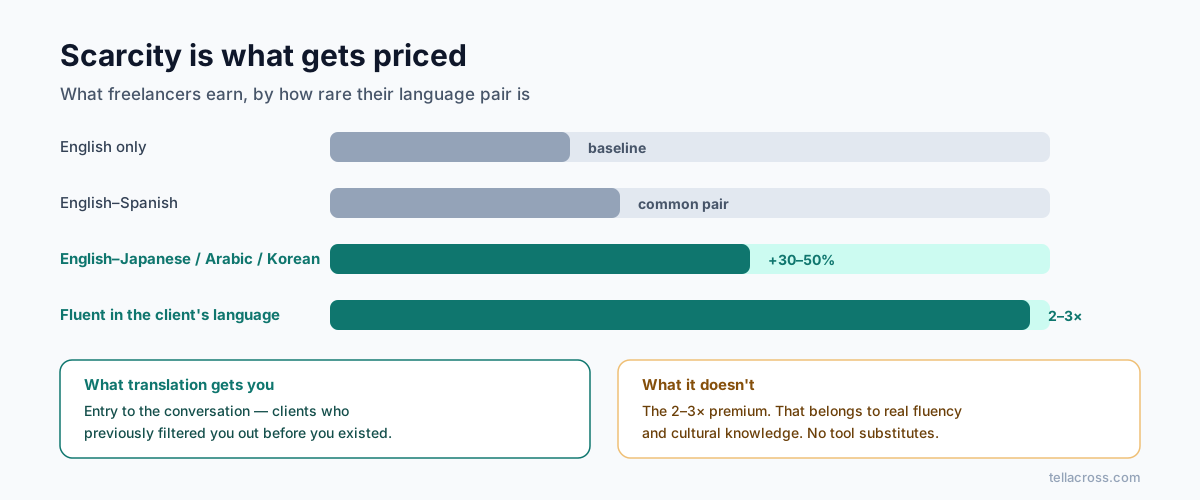
The data on this is unambiguous. Multilingual freelancers earn around 30% more, and those with rare pairs — English–Japanese, English–Arabic, English–Korean — earn 30–50% more than people working the common English–Spanish combination. The clearest example in that research: a Vietnamese developer fluent in Japanese can command 2–3× the rate of monolingual peers.
It's not that Japanese clients are generous. It's scarcity. A backend developer who can run a client meeting in Japanese is rare, and rare is what gets priced.
The market is there too: Germany leads Western Europe on technical rates at around €120/hour for senior React work, with the region spanning €50–175/hour. Japan's freelance market has record demand for full-stack, backend, DevOps and AI/ML specialists.
Now the honest part
Those numbers describe people who actually speak the language. A translation tool does not make you a Japanese speaker, and any post implying otherwise is selling you something.
So be clear-eyed about what translation actually buys:
It gets you into the conversation. Without it, a client who doesn't speak English filters you out before you exist. With it, you can take the call at all. That's the difference between zero and a chance — which is most of the value.
It doesn't get you the 2–3× premium. That belongs to genuine fluency and cultural knowledge you don't have yet. Expect to compete on your technical work, not on a language premium you haven't earned.
It doesn't survive deep ongoing collaboration alone. Daily standups, ambiguous requirements, disagreement about scope — these get harder in proportion to how much nuance is involved. For long engagements you'll eventually want real language investment, a bilingual project manager, or a client contact who does speak English.
The realistic promise isn't "3× your rate." It's "you can now bid on work that was previously invisible to you, with less competition than the English market."
The ladder that actually works
Step 1 — First contact and discovery. This is where translation is strongest and the stakes are lowest. You're establishing whether there's a fit. Both people speaking their own language means the client explains their real problem rather than the simplified version their English allows.
Step 2 — Proposal in their language. Write it in English, get it properly translated (a human, for anything you're being paid for). This signals seriousness and, crucially, it circulates internally to people who don't read English — often including whoever approves the budget.
Step 3 — Agree the working language explicitly. This is the step people skip and regret. Say plainly: "I'll deliver documentation and code comments in English; we can do calls with live translation; is there someone on your side comfortable in English for day-to-day?" Most clients find this reasonable. Discovering the mismatch in month two does not go as well.
Step 4 — Written follow-ups, always. After every call, send a short summary of what was agreed. This is good practice everywhere and essential across languages — it catches misunderstandings while they're still free to fix.
Where to actually find these clients
- Local job boards, not global ones. Japan has its own freelance platforms; Germany has Freelancermap and XING. Far less competition than Upwork, because the language filters most applicants out.
- Their language, in your search. Search for your specialisation in Japanese or German, not English. Different results, different competition.
- Agencies as intermediaries. Local agencies in those markets subcontract regularly and handle the client relationship. Lower rate than direct, much lower friction, and a good way to build references.
- Conferences and communities in that market. Remote participation is normal now, and being the one foreign developer who showed up is memorable.
Practical things that make the calls work
- Use a headset. Audio quality determines translation quality more than anything else.
- Short sentences, no idioms. "Let's circle back" doesn't survive; "let's discuss this next week" does.
- Learn twenty words anyway. Greeting, thank you, yes, no, "one moment please". It costs an evening and changes how the call feels.
- Send an agenda beforehand. Reading is easier than listening in a second language — they arrive prepared, and so do you.
- Keep the transcript. Cross-language requirements gathering is where scope disputes start. A transcript is the cheapest insurance you'll ever have.
For the calls themselves, TellAcross is browser-based with nothing for the client to install, covers 60+ languages both ways, and exports transcripts. Ten free minutes a month is enough for a first discovery call — which is the exact moment this matters most.
If you're in India, Vietnam or the Philippines
Your English is a genuine advantage in US and UK markets — and it's also the reason you're competing with everyone else from your region there, on price.
Japan, Germany, Korea and the Gulf have serious technical budgets and chronic developer shortages, and far fewer applicants precisely because those conversations can't happen in English. That's the opening. The Vietnamese-developer-who-speaks-Japanese example above is the ceiling of this strategy; being able to take the first call is the floor. The floor is worth having, and it's reachable this month.
The honest summary
Translation doesn't give you a language skill. It removes the reason you were never in the room.
If you're going to commit to a market seriously, learn the language — that's where the 2–3× lives, and no tool substitutes for it. But you can start now, with the clients you can already reach, and decide whether the market is worth that investment based on real conversations rather than guesses.
Start with one market, one language, and ten outreach messages. The response rate will tell you more than any amount of planning.