Where AI translation fails — and why knowing that makes it useful
Idioms, names, numbers, overlapping speech and silence-driven hallucination. The specific failure modes of live speech translation, and the habits that avoid most of them.
Prakash Vakhesa · August 12, 2026 · 4 min read
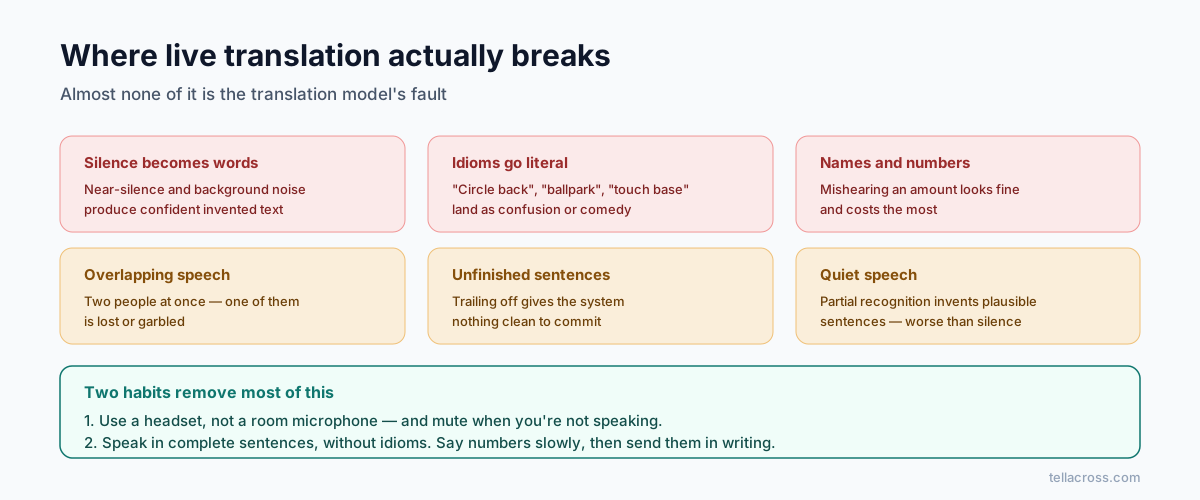
Every tool has a failure envelope. Knowing where live translation breaks makes it far more useful than pretending it doesn't — and most failures have a cheap workaround.
These are the ones we see most, from building the thing.
1. Silence and background noise become words
Speech recognition models are trained to find speech. Give one a stretch of near-silence, a television, or office chatter, and it will often produce confident, fluent text that nobody said. In the field this is called hallucination, and it's the single most common cause of "the translation said something bizarre".
What helps: mute when you're not speaking, and use a headset rather than a room microphone. A speakerphone in an open office is close to the worst case.
2. Idioms translate literally and land badly
"Let's circle back", "ballpark figure", "touch base", "let's take this offline" — these have no equivalent in most languages, and a literal rendering ranges from confusing to comic.
What helps: say the plain version. "Let's discuss this later" survives translation into any language on earth. This is the single highest-value habit, and it costs nothing.
3. Names and numbers are fragile
Proper nouns aren't in the model's expected vocabulary, and digits are easy to mishear. A wrong figure in a quote or a mangled surname on a legal file causes real damage, and neither looks like an error — the sentence around it reads perfectly.
What helps: say them slowly, and follow up in writing. Never let an amount, a date or a case number exist only in speech.
4. Overlapping speech loses a speaker
When two people talk at once, one of them is going to be lost or garbled. Humans handle this by tracking two voices; speech systems generally don't.
What helps: slightly more formal turn-taking than you'd use otherwise. A half-second pause between speakers fixes most of it.
5. Unfinished sentences produce nonsense
Live translation has to decide when a thought is complete before translating it — that decision is most of the perceived delay. Trailing off, restarting mid-sentence, or thinking out loud gives it nothing clean to commit.
What helps: finish your sentences, even if the thought is provisional. "I'm not sure yet" is a complete sentence and translates fine.
6. Code-switching confuses direction
Bilingual speakers naturally mix languages — a Hindi speaker dropping in English technical terms, for instance. This is normal human speech, and it genuinely complicates language detection: the system has to decide what language a sentence is before it can translate it.
What helps: setting your language explicitly rather than relying on auto-detect, if you code-switch often. We spent a lot of engineering effort on this specific case because it's the norm in Indian languages, not an edge case.
7. Accents and dialects vary in coverage
Coverage is uneven, and it isn't uniform within a language. A model may handle standard Spanish well and a regional variant poorly. This is a real limitation and one worth testing with your actual speakers rather than assuming.
What helps: test with the people who'll actually use it, in their normal speaking style, before committing.
8. Quiet speech fails silently
Someone softly spoken, sitting far from the mic, gets partial recognition — and partial recognition produces plausible, wrong sentences rather than obvious gaps. It's harder to catch than total failure.
What helps: check input levels once at the start. Ask the quietest person to speak and confirm they're being picked up.
The pattern
Almost everything above is an audio problem or a speaking-style problem, not a translation problem. Which is good news: those are the cheap things to fix.
If you did only two things: use a headset, and speak in complete sentences without idioms. That eliminates most of the failure modes on this list, for any tool you choose.
What this means for choosing where to use it
These failure modes are exactly why we're consistent that live translation belongs in intake calls, scheduling, status updates and team meetings — and not in hearings, sworn testimony or clinical encounters, where a confidently wrong sentence with no signal that anything went wrong is precisely the dangerous case.
Knowing where a tool breaks is what lets you use it aggressively where it doesn't.