Interviewing candidates across a language barrier — a hiring manager's guide
You're assessing the job, not the English. How to separate language fluency from actual capability, when to bring in translation, and the interview design changes that make the difference.
Prakash Vakhesa · August 25, 2026 · 4 min read
Disclosure: we make a real-time translation tool, mentioned in context below. Most of this guide is about interview design, which matters more than any tool.
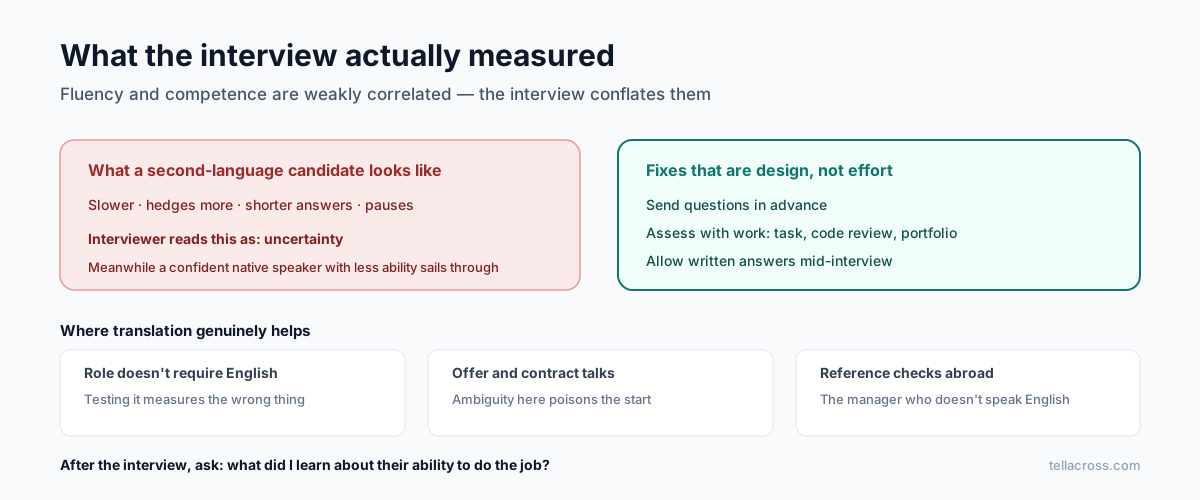
Hiring across borders means interviewing people whose English is their second, third or fourth language. The failure mode is well documented and expensive: you assess English fluency and believe you assessed competence. They're weakly correlated, and the strongest candidates are frequently the ones who interview worst.
The bias, stated plainly
A candidate speaking their second language under time pressure sounds slower, hedges more, and gives shorter answers. All three read as uncertainty to an interviewer. Meanwhile a native speaker with a confident manner and less ability sails through.
You cannot debias this by trying harder to be fair in the moment. You change it by changing the interview.
Interview design changes that work
Send questions in advance. For technical and behavioural rounds both. Some interviewers resist — "we want to see them think on their feet". Ask honestly whether the job requires thinking on your feet in a second language under observation. For most roles it doesn't, and preparation time removes a variable that has nothing to do with performance.
Assess with work, not talk. A take-home task, a code review, a portfolio walkthrough, a written case response — these measure capability directly and are largely language-neutral. Weight them heavily. Conversation-only assessment is where the bias concentrates.
Allow written answers mid-interview. Letting someone type a technical explanation while you read it removes accent and speaking-pace from a judgement that should be about the content.
Slow down and stop using idioms. "Walk me through", "deep dive", "circle back", "run with it" — all opaque to a non-native speaker, all replaceable. And pace matters more than vocabulary: they're translating in their head as you speak.
Let silence be. A pause usually means composing a sentence in a second language. Interviewers routinely fill it, and read the interruption as the candidate not knowing.
Ask one thing at a time. Multi-part questions lose a part. Always.
Where translation tools fit
For most international hiring, English is the shared working language and the above is sufficient — the candidate will work in English, so interviewing in English is legitimate.
Translation genuinely helps in three cases:
The role doesn't require English. A developer on a team that communicates in writing, a factory supervisor, a local market hire. If English isn't a job requirement, testing it in the interview is measuring the wrong thing entirely.
Final-stage conversations that must be precise. Compensation, contract terms, notice periods, relocation. Misunderstandings here poison the start of an employment relationship. A conversation where both people speak their own language removes the ambiguity — that's where a tool like TellAcross fits: browser link, nothing for the candidate to install, transcript you can attach to the offer file.
Reference checks abroad. A previous manager in another country who doesn't speak English is often the most useful reference you'll never get. Translation makes that call possible.
What to look for in a tool
Short list, since the requirements here are narrow:
- The candidate installs nothing. Asking a candidate to create an account is a bad first impression and a drop-off point. Browser link only.
- Your actual language pairs, in both directions — not a headline count. Coverage is narrower than marketing implies, especially outside Europe.
- A transcript, for the record and for colleagues who weren't on the call.
- Per-use pricing. Hiring is bursty; per-seat licensing for an occasional need is waste.
Two things not to do
Don't use a bilingual colleague as an interpreter. Same problems as everywhere else: they're not trained, they'll paraphrase, and you've pulled them off their job. Worse in interviews — they form an opinion of the candidate and it leaks into the rendering.
Don't decide language ability from the interview alone. If the job genuinely needs strong English, assess it deliberately — a written sample, a task-focused call — rather than inferring it from interview nerves. The two are not the same signal.
The check that matters
After a cross-language interview, ask yourself: what did I learn about their ability to do the job? If the honest answer is mostly about how they speak English, the interview measured the wrong thing — and that's a design problem you can fix before the next one.