How to handle a phone call when you don't share a language
Practical tactics for getting through a call where the other person's English — or yours — isn't strong. What to do before, during and after, and when to stop improvising.
Prakash Vakhesa · August 10, 2026 · 3 min read
Phone calls are the hardest cross-language format there is. You lose facial expression, gesture, and the ability to point at things — everything people normally lean on when words run out. Video is easier. In-person is easier still.
Here's what actually helps when the call has to happen anyway.
Before the call
Send the purpose in writing first. A short message confirming what the call is about, roughly how long it'll take, and what you need from them. Reading is easier than listening in a second language — they get time to look up unfamiliar words, and they arrive knowing what to expect.
Write down your numbers, dates and names in advance. These are what get mangled, and having them ready means you can spell or send rather than repeat.
Learn the greeting. Not fluency — a greeting. It sets a tone that says you're aware of the effort they're making, and it costs five minutes to learn once.
During the call
Slow down before you simplify. Most people jump straight to simpler words while keeping the same pace. Pace matters more. The other person is often translating in their head as you speak, and needs the processing time.
Short sentences, one idea each. Three linked thoughts in one breath will lose at least one.
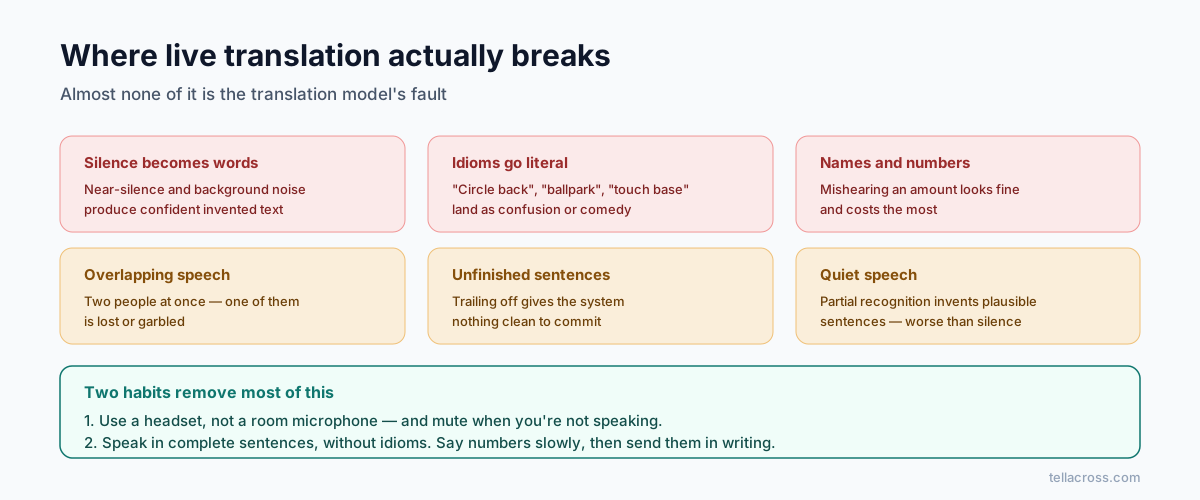
Drop idioms entirely. "Touch base", "ballpark", "circle back", "let's park that" — none of these survive. Say the literal thing.
Kill background noise. On a call where comprehension is already stretched, ambient noise consumes the attention needed for the language. Take it somewhere quiet, use a headset.
Never ask "do you understand?" You will get "yes" every time, in every culture. Ask them to tell you what they'll do next, in their own words. That's the only reliable check, and it takes fifteen seconds.
Don't raise your voice. Universal instinct, never helps. They can hear you.
Let silence sit. A pause usually means someone is composing a sentence in a second language. Filling it interrupts them, and they lose the thread.
After the call
Always follow up in writing. Summarise what was agreed, what happens next, and who does what. This is the single highest-value habit on this page: it catches misunderstandings while they're still cheap, and gives them something to translate at their own pace.
Keep it short and plainly worded — a wall of text defeats the purpose.
When improvising isn't good enough
Everything above helps at the margins. It does not make you understood when there's no shared language at all, and it is not sufficient when the content actually matters.
Be honest about which situation you're in:
- Casual, low-stakes, some shared language → the tactics above are usually enough.
- The content matters — money, deadlines, obligations, health → get proper language support. Misunderstandings here cost more than the call.
- Legal or medical consequences → a qualified interpreter, and in many settings that's a legal requirement, not a preference.
The failure mode isn't a call that goes badly. It's a call where both people believe it went fine and later discover they agreed to different things.
The other option
For the middle case — content that matters but doesn't need a certified interpreter — real-time translation removes the problem rather than managing it. Each person speaks their own language and hears the other's, so nobody is operating at a disadvantage and nobody's guessing.
That's what TellAcross does: browser-based, 60+ languages, both directions, with a transcript you can send as the written follow-up. Ten free minutes a month is enough to try it on a real call.
Whatever you use, the habits above still apply. Clear audio and complete sentences make every tool better — and are what most translation failures come down to.