What to look for when buying call translation software
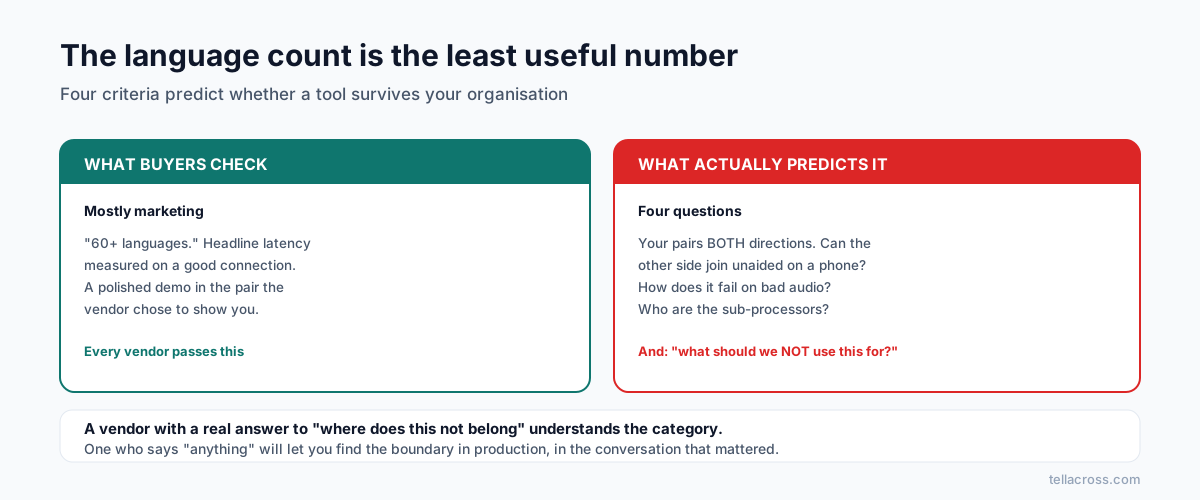
Language count is the least useful number on any vendor's page. Here are the criteria that actually predict whether a tool works in your organisation — and the questions that get straight answers.
Prakash Vakhesa · October 8, 2026 · 5 min read
Disclosure: we make TellAcross. Some criteria below favour us and some don't — I've flagged where we're a poor fit, because a checklist that every vendor passes is useless to you.
Call translation is an unusually hard category to evaluate, because the demos are uniformly impressive and the failures only show up in production. These are the criteria that predict the difference.
1. Your specific pairs, in both directions
The headline language count is marketing. What matters is your two or three actual pairs, tested both ways.
Direction asymmetry is common and rarely disclosed: many tools are noticeably better translating into English than out of it, because that's where the training data is. If your customers hear the outbound direction, that's the one to judge.
Ask: "Which pairs are weakest, and how do you know?" A vendor with real quality data can answer. One who says everything is equally good hasn't measured.
2. What the other person has to do
This is the criterion most under-weighted by buyers and most decisive in practice.
If the other party must install an app, create an account, or grant a non-obvious permission, a meaningful fraction simply won't. For a sales call that's a lost prospect. For a patient or a supplier it's a failed conversation.
The bar: a link that opens in a mobile browser and works. Test it yourself with someone outside your organisation and don't help them.
3. Latency, measured on a real network
Latency figures in marketing are measured on good connections. Ask what happens on mobile data, and whether latency is constant or accumulates over a long call.
Accumulating lag is a different and worse problem: a call that's fine for five minutes and unusable at twenty.
4. How it fails
More predictive of your experience than peak quality.
Does it produce a confident wrong sentence when audio is poor, or does it signal uncertainty? Does a failure stop the call or degrade it? Confident errors are the dangerous ones — nobody catches them, and they end up in decisions.
Ask: "Show me what a bad-audio call looks like." Vendors who've thought about this have an answer.
5. The data position, in specifics
A translated call generates more records than people assume: original audio, a transcript in the source language, translated text, and often synthesised speech. Each is separate and each may be retained.
Ask, and expect immediate answers:
- Is audio stored? For how long? Can we turn it off?
- Are transcripts stored, and can we delete a call and everything derived from it?
- Which sub-processors handle the audio? (Speech recognition, translation and voice synthesis are usually three different companies.)
- Where is it processed geographically?
- Is a DPA available, and does it name the sub-processors?
Vagueness here is disqualifying. It means either they haven't thought about it or they'd rather you didn't.
6. Pricing that matches your usage shape
Per-seat pricing on bursty usage is how translation budgets get wasted — twelve licences serving four calls a week.
Ask: Is a minute connected time or speech time? Is there a per-call minimum? What happens at the plan limit — does it stop, or does it bill? Can we see per-user usage before the invoice?
7. Transcripts you can export
Underrated until the first dispute. Cross-language conversations are exactly where "they told me X" arguments arise, and an exportable record is cheap insurance. Check the format, whether it includes both languages, and whether you can get it out without asking support.
8. Domain vocabulary
General models mishandle industry terms, drug names, part numbers and proper nouns. Ask whether there's any mechanism to bias toward your vocabulary — and if there isn't, test whether your twenty most common terms survive.
9. Where the vendor says not to use it
This is the question I'd weight most heavily, and it's not on most buyers' lists.
Ask directly: "What should we not use this for?"
A vendor with a real answer — clinical encounters, legal proceedings, recorded statements, anything requiring an accountable interpreter — understands the category and is telling you the truth about a boundary that exists whether or not they mention it. A vendor who says "anything" is either inexperienced or willing to let you find the boundary yourself, in production, in the conversation that mattered.
10. Whether it fits the tier you actually need
Sort your cross-language conversations into scheduled/unscheduled and high/low stakes. Most organisations need more than one solution — on-demand human interpreting for the high-stakes tier, software for routine volume. A vendor pushing you to consolidate everything onto them is optimising for their revenue, not your risk.
Where we're a poor fit
To make this checklist worth something:
TellAcross is built for routine and unscheduled conversations — browser-based with nothing for the other side to install, per-minute with no call minimum, exportable transcripts. It's a bad choice for scheduled high-stakes interpretation, anything with a regulatory record, and anywhere a person needs to be accountable for the words. We're also not a sign language solution, which is a different requirement entirely.
If your volume is mostly long, scheduled, consequential calls, an interpreter service is the better purchase and you should make it.
The shortest version
Test your own pairs both ways, on a bad network, with someone outside your organisation who gets no help joining. Ask what the vendor stores and who else sees it. Ask what they'd tell you not to use it for.
Those four things separate the tools that survive contact with your organisation from the ones that demo well.