Gemini 3.5 Live Translate — what Google actually shipped, and what's still preview
70+ languages, 2,000 direct pairs, your own voice preserved. The searches are spiking, but what's available today is narrower than the headlines. A sober breakdown.
Prakash Vakhesa · August 23, 2026 · 3 min read
Google's Gemini 3.5 Live Translate is the most significant thing to happen to speech translation this year, and the search interest shows people know it. It's also generating the usual gap between announcement and availability. Here's what's real, what's preview, and what it changes.
What the model does
Four things stand out technically:
70+ languages, 2,000+ direct combinations. The important word is direct — previous systems routed everything through English, so a Hindi→Japanese call was really Hindi→English→Japanese, compounding errors at each hop. Direct pairs remove a whole class of mistranslation.
Your voice survives translation. The output preserves intonation, pacing and pitch — the listener hears something like you speaking their language, not a generic synthetic voice. T-Mobile's network feature makes the same bet; voice preservation is clearly becoming the standard.
Automatic language detection. No pre-selecting source and target — the model works out what's being spoken. Genuinely useful, with one caveat from our own experience building this: auto-detection is exactly where code-switched speech — Hinglish, Spanglish — gets misjudged. Worth testing with real mixed speech before trusting it.
Noise robustness. Designed to work in loud environments rather than assuming clean studio audio. If it holds up in practice, that addresses one of the biggest real-world failure modes.
What you can actually use today
This is where the headlines and reality diverge:
- Google Translate app (Android/iOS): rolling out to consumers — the most accessible way to try the model now.
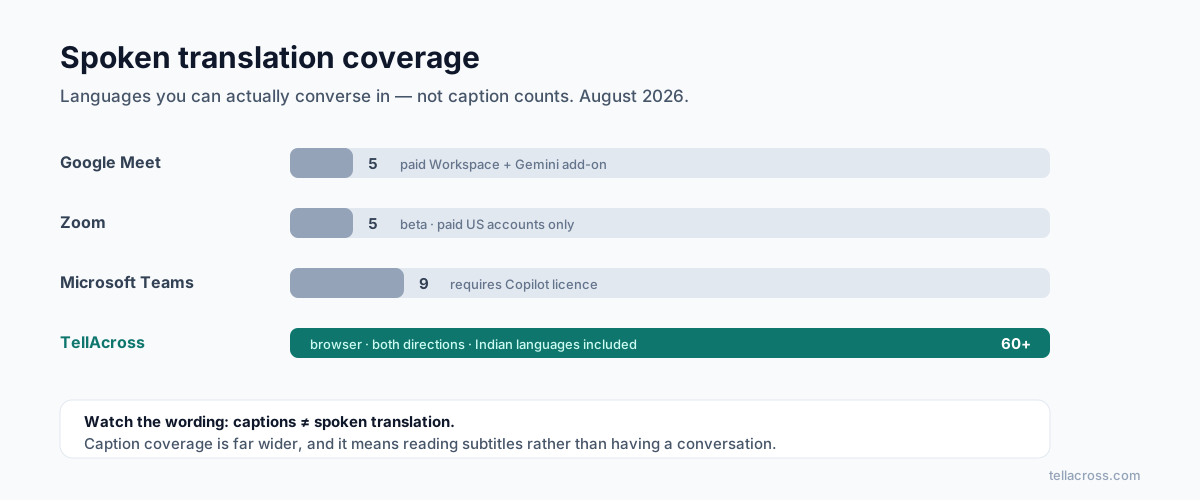
- Google Meet: the 70+ language expansion is in private preview for enterprise customers as of June. General availability, pricing and which Workspace tiers get it are unannounced. Regular Meet users still have the five-language version.
- Gemini Live API: available to developers building their own products.
So if your takeaway from the coverage was "Meet translates 70 languages now" — not yet, unless you're in the enterprise preview. For everyone else it's the Translate app (person-to-person, one phone) or waiting.
Honest implications, including for us
A frontier lab shipping 70-language direct-pair speech translation raises the bar for everyone in this space, us included. Pretending otherwise would insult your intelligence. Three things are still true:
Availability beats capability. A model in private preview doesn't translate your Thursday client call. What you can use today, on your plan, for your call type is the only comparison that matters, and it keeps being the gap between announcements and practice — for Google's five-language Meet feature all year, and now again.
The call type matters. Gemini in Meet covers Meet meetings, on qualifying Workspace plans, when it ships. A browser link that either party opens with no account, no Workspace tier and no matching platform — that's a different product shape, and it's the shape a lawyer calling a client or a founder calling a supplier actually needs.
Depth in specific languages still differentiates. Broad coverage and good coverage aren't the same. Our bet stays what it was: Indian languages done properly — code-switching, romanised input, accents — plus exportable transcripts and per-minute pricing rather than per-seat licensing.
What to do with this
If you have Google Workspace enterprise, ask your admin about the preview — it's worth evaluating. If you're a consumer, try the Translate app rollout; it's free and impressive. And whichever tool you evaluate, test it the same way: your real language pair, real mixed speech, real background noise, both directions. The model generation matters less than whether your conversation survives the trip.