Recruiting nurses and care workers from overseas — the language problem nobody budgets for
International healthcare recruitment runs on dozens of calls per placement, most with candidates whose English is being assessed while they use it. Where language actually costs you placements, and what to do at each stage.
Prakash Vakhesa · September 2, 2026 · 4 min read
Disclosure: we build TellAcross, a real-time call translation tool, and it appears in one section below. Most of this post is about how international healthcare recruitment actually breaks down, which matters more than any tool.
International healthcare recruitment has an odd shape. The candidate must eventually work in English — that's not negotiable, it's a patient safety requirement. But almost everything before that point is a conversation where language is getting in the way of the thing you're actually trying to assess.
Agencies plan for the visa, the credential verification, the English exam. Very few plan for the twenty-odd calls in between.
Where the calls actually happen
A single overseas placement typically involves: an initial screening call, a documents call, an employer interview, at least one "here's what's actually happening with your application" call, a pre-departure briefing, and a handful of anxious calls in between that nobody scheduled.
Most of those aren't assessments. They're logistics, reassurance and paperwork. And that's the distinction the whole problem turns on.
The mistake: testing English when you meant to gather information
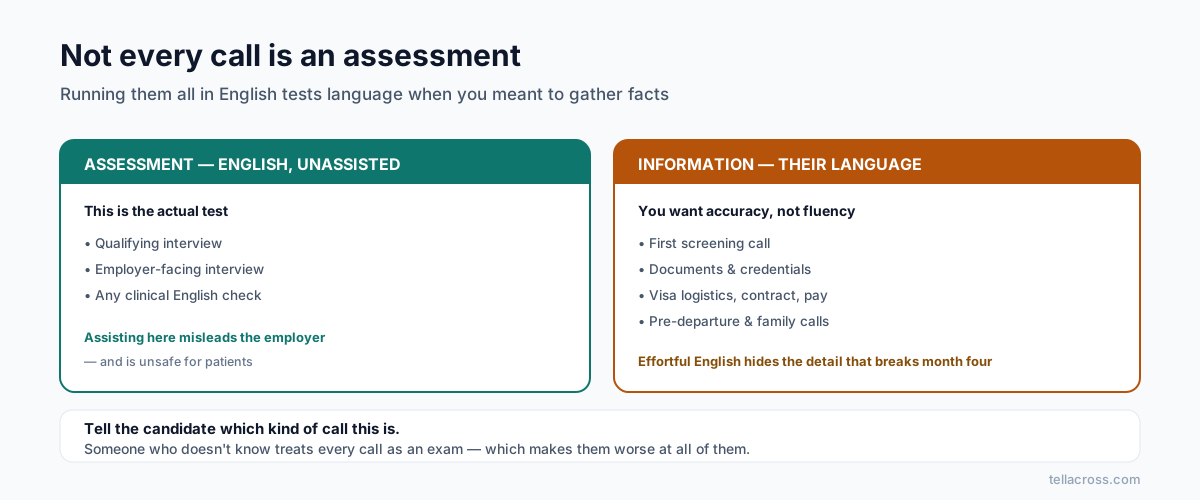
If a candidate's English is being evaluated in the qualifying interview — fine, that's the point, and it should be in English with no assistance.
But when you run the documents call in effortful English, you don't get a language assessment. You get a worse documents call. The candidate is spending half their attention on the language and half on your question, so you get shorter answers, fewer volunteered details, and a much higher chance that something important — a gap in employment, a dependent they hadn't mentioned, a credential that's under a different name — doesn't surface until it's expensive.
Two things are being conflated: can this person work in English? and do I have accurate information about this person? You need both. Running every call in English only reliably gets you the first.
What that costs
The failure mode is rarely dramatic. It's a placement that falls over in month four because a detail was missed in month one, and the detail was missed because nobody could explain it comfortably.
For an agency, a placement that collapses late is roughly the worst possible outcome: the recruitment cost is spent, the employer relationship takes the damage, and the candidate — who often borrowed money to get there — takes the worst of it. Anything that reduces the rate of late-stage surprises is worth more than it looks on a spreadsheet.
A practical split
In English, unassisted: the qualifying interview and any employer-facing assessment. This is the actual test. Assisting here would be dishonest to the employer and unsafe for patients.
In their language, deliberately: the first screening call, documents and credential gathering, visa logistics, contract and pay explanations, pre-departure briefing, and the family conversation — because in most of these placements the decision is genuinely a family one, and the spouse or parent asking the hard questions may speak no English at all.
Their choice, either way: the pastoral calls. Someone who is anxious about moving countries will express what's actually worrying them far more precisely in their own language.
Being explicit about which call is which also removes a real fairness problem. A candidate who doesn't know whether they're being assessed will treat every call as an exam, which makes them worse at all of them.
What to look for in tooling
- The candidate installs nothing. They're on a phone, often on mobile data, frequently in a different timezone. A browser link is the only thing that reliably works.
- The languages you actually recruit in. For healthcare that usually means Tagalog, Hindi, Malayalam, Tamil, Nepali, Arabic, Spanish and Portuguese — check your specific pairs rather than a headline count.
- Transcripts you can keep. Cross-language documents calls are exactly where "they told me X" disputes come from later.
- Per-minute pricing. Recruitment call volume is spiky. Per-seat licensing for something used in bursts is waste.
TellAcross does these — browser-based, 60+ languages, exportable transcripts, per-minute, with ten free minutes a month, which is enough to run one real screening call before deciding anything.
Where it does not belong
Not in the English assessment, for the reasons above. Not in anything clinical — that requires a qualified human interpreter, and a recruitment agency shouldn't be anywhere near that decision. And not as a substitute for the English exam the visa requires.
It also doesn't fix a bad process. If your documents call is disorganised in English, it will be disorganised in Tagalog.
The honest summary
Language isn't the hard part of international healthcare recruitment — immigration is, and credentialing is. But language is the part that's silently degrading the quality of information you're collecting on every non-assessment call, and it's the cheapest of the three to fix.
Start by writing down which of your calls are assessments and which aren't. Most agencies have never made that list, and making it usually changes how three or four of the calls get run.