Buying language services for a clinic — what you actually need, tier by tier
Interpreter agency, video remote interpreting, bilingual staff certification, AI for non-clinical contact. What each costs, what each is for, and which combination a small practice actually needs.
Prakash Vakhesa · August 26, 2026 · 4 min read
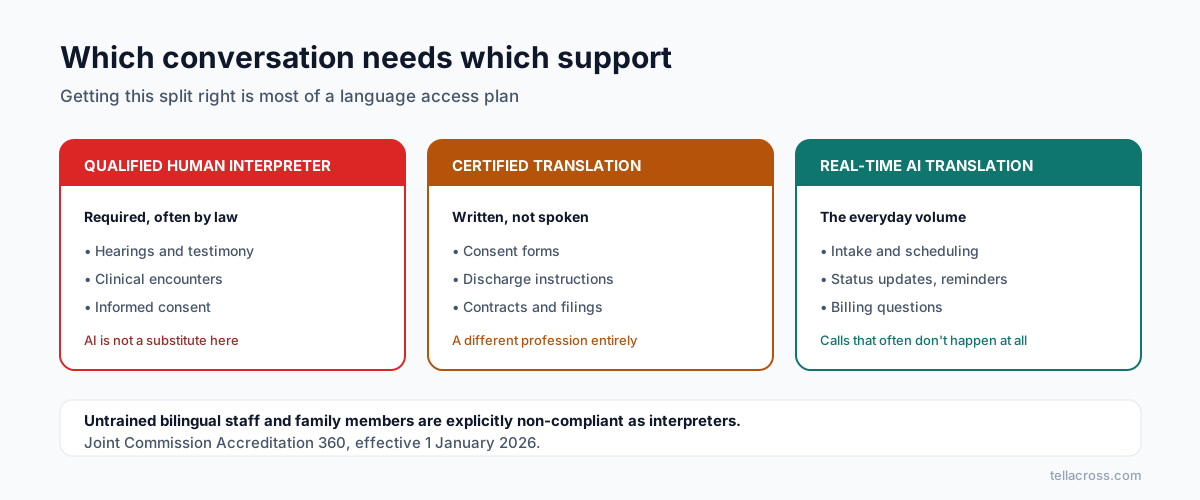
Disclosure: we make TellAcross, which sits in the last tier below and explicitly does not satisfy your interpreter obligations for clinical encounters. We'd rather say that clearly than sell you a compliance problem.
Most practices buy language services reactively — a patient arrives, someone panics, a phone interpreter line gets used, and that becomes the system. Here's the deliberate version, given that language access is now an audited patient safety requirement.
The four things you can buy
1. On-demand phone interpreting (OPI). Call a number, get an interpreter in minutes. Roughly $1.25–$4.00 per minute, usually with a connection minimum. Best for: unscheduled encounters, rare languages, anything you can't plan for. Nearly every practice needs this as a baseline, even with other tiers in place.
2. Video remote interpreting (VRI). Same idea, with video — necessary for sign language and valuable when visual context matters (demonstrating an inhaler, examining a wound). Priced higher than OPI. Needed if you serve Deaf patients; otherwise optional.
3. Scheduled in-person interpreters. Booked ahead, usually hourly with a minimum. Best for: long consultations, difficult diagnoses, anything where rapport matters. Most expensive per encounter, and unbeatable for the encounters that warrant it.
4. Certifying your own bilingual staff. If you already employ genuinely bilingual clinical staff, training and assessing them as qualified interpreters converts an existing informal practice into a compliant one — which it currently is not. One-time cost, ongoing benefit, and it's the highest-return move available to practices with the right staff.
Where AI fits, precisely
Not in the exam room. Qualified human interpreters are what the rules require for clinical encounters, and there's legislative movement toward restricting AI translation in federal settings, not away from it.
Where it does fit is the non-clinical volume that surrounds care and currently gets handled by whoever happens to be free: appointment scheduling and reminders, confirming which documents to bring, billing and insurance questions, checking whether a prescription was collected, first enquiries from people who aren't patients yet.
That work is real, frequent, not covered by the interpreter mandate in the same way, and today most practices either skip it or quietly hand it to a bilingual receptionist who has another job. Moving it to a tool frees your bilingual staff for the encounters where they're actually needed.
Choosing a vendor: seven questions
- Which languages, and how fast is connection time for the rare ones? The average is meaningless; ask about your specific tail languages.
- What's the billing minimum? A 15-minute minimum on a 2-minute call is where budgets quietly disappear.
- Are interpreters certified for healthcare specifically? General interpreting is not medical interpreting.
- Can they provide usage reporting per encounter? The 2026 standard is evidence that services were delivered — not that a contract exists. Reporting is how you produce it.
- What's the after-hours coverage? Emergencies don't respect business hours.
- BAA and HIPAA posture? Any vendor hearing patient information needs the paperwork.
- What happens when they can't connect anyone? Every service fails sometimes. Ask what the documented fallback is.
What a small practice actually needs
For a 1–5 clinician practice serving a mixed-language population, a workable stack:
- OPI contract as the baseline for everything clinical. Non-negotiable.
- Certify one or two bilingual staff if you have them — the biggest single improvement to both compliance and patient experience.
- VRI only if you serve Deaf patients or regularly need visual context.
- AI translation for front-desk and non-clinical calls, so those conversations happen at all instead of being deferred or improvised.
- A written policy stating that family members do not interpret, and that front-desk staff book an interpreter rather than improvising. Without this the informal practice always wins, because it's faster in the moment.
Most practices have the first item and none of the rest. The written policy costs nothing and closes the gap the 2026 framework names specifically.
The mistake to avoid
Buying one thing and treating it as the whole answer. An OPI contract doesn't serve scheduled complex consultations well; certified staff don't cover the language they don't speak; AI doesn't touch clinical encounters. It's a portfolio, and the point is matching the tier to the encounter — deliberately, in a written policy, before the patient is standing at your desk.